
The Fed lent $23.15 billion on the Friday after Thanksgiving. The collateral, the timing and the next round of Treasury settlements tell us what to watch after month-end.
At 8:30 a.m. New York time on Friday, November 27, eligible counterparties took $23.15 billion from the Federal Reserve’s standing repo operation, including $22.75 billion against Treasuries. Take-up was zero on Wednesday and just $2 million on Tuesday. Friday’s afternoon operation also drew zero. Combined daily use was the second highest in 2026 through Friday, behind $30.50 billion on February 17. It was also the first day above $2 billion since April 15. Ethos Repo Market Monitor · Ethos repo data feed · New York Fed operation results
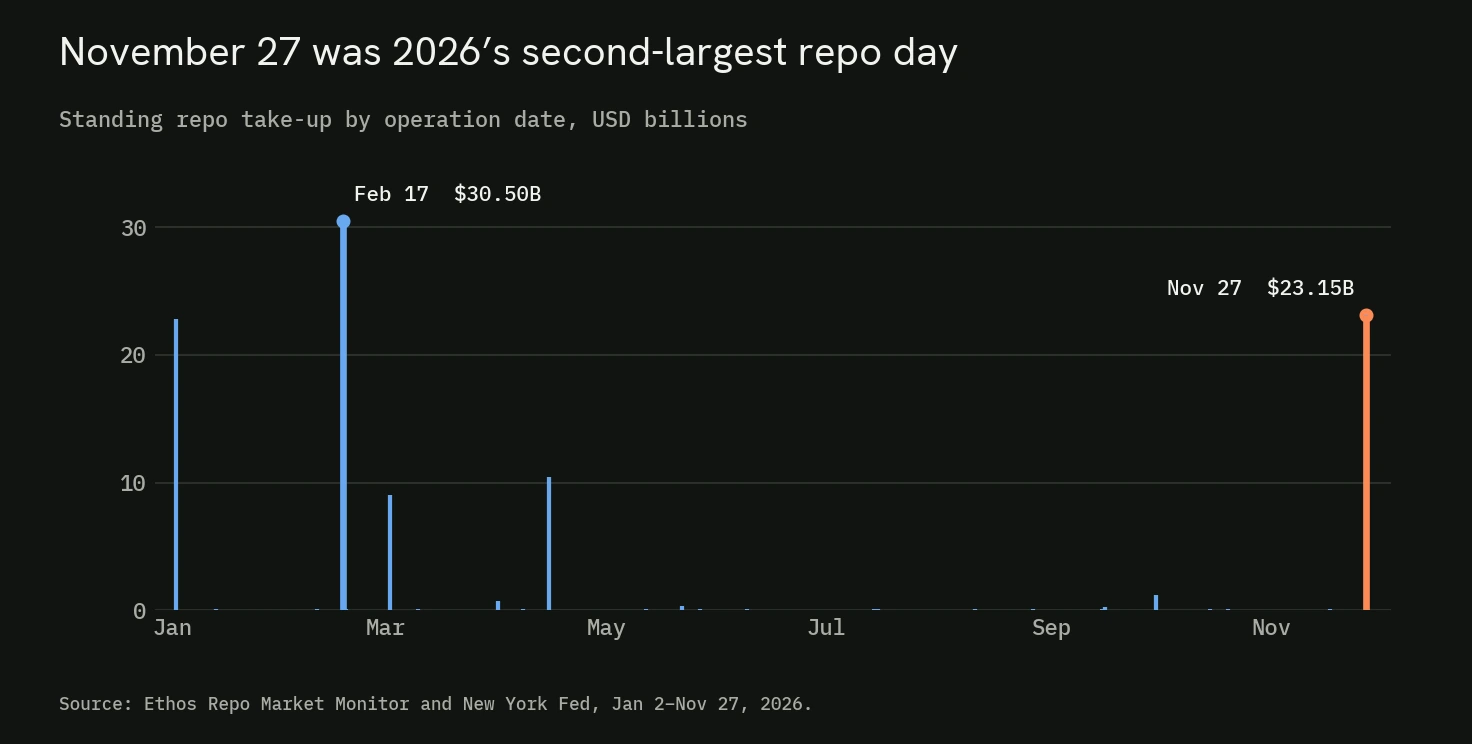
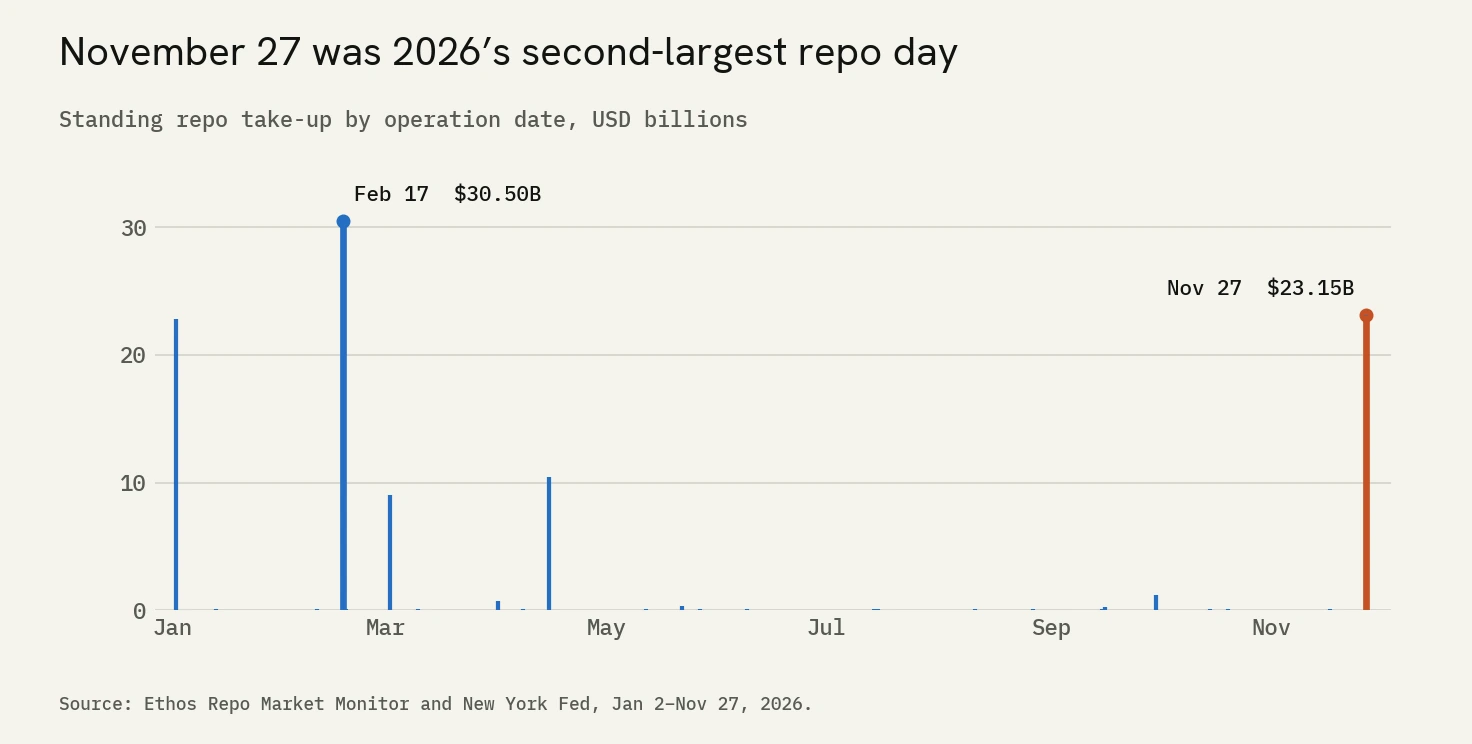
The total tells us that the Fed was an attractive source of cash for eligible borrowers that morning. The timing and collateral tell us more about where the pressure was. I would put the most weight on what happens after Friday’s financing comes due, because the Thanksgiving calendar also produced a comparable number a year ago.
The collateral points to Treasury financing
The Desk accepted $22.75 billion against U.S. Treasuries, $400 million against agency mortgage-backed securities and zero against agency debt. Treasuries accounted for 98.3% of take-up. The Treasury category must be settled with Treasury collateral under the Desk’s rules. That makes Friday’s operation a direct window into the financing of government securities. Borrower identities appear in the Fed’s transaction disclosures with a two-year lag. Ethos repo data and operations · New York Fed results · Standing repo rules
Treasury’s schedule put four bill auctions and a reopened two-year floating-rate note on Friday’s settlement calendar. More securities were due to settle Monday, including the two-, five- and seven-year notes. Friday’s overnight repo also matures Monday. Dealers taking delivery of new securities need cash at settlement, and holiday and month-end reporting can make balance sheet capacity harder to find. That clustering makes early funding a plausible explanation for the draw. The totals do not show how much cash was raised against newly settled issues. Ethos repo settlement calendar · Treasury auction schedule
Less cash at the Fed, more pressure at the top of the market
Bank reserves fell $73.13 billion to $2.929 trillion between November 18 and November 25. The Treasury General Account rose $31.25 billion to $923.56 billion over the same two Wednesdays. The weekly average TGA moved in the opposite direction, so the distinction matters. These are Wednesday balances. The TGA increase was one of several changes in Fed liabilities over the week. Ethos repo and bank reserves · Ethos Fed Net Liquidity · November 19 H.4.1 · November 27 H.4.1
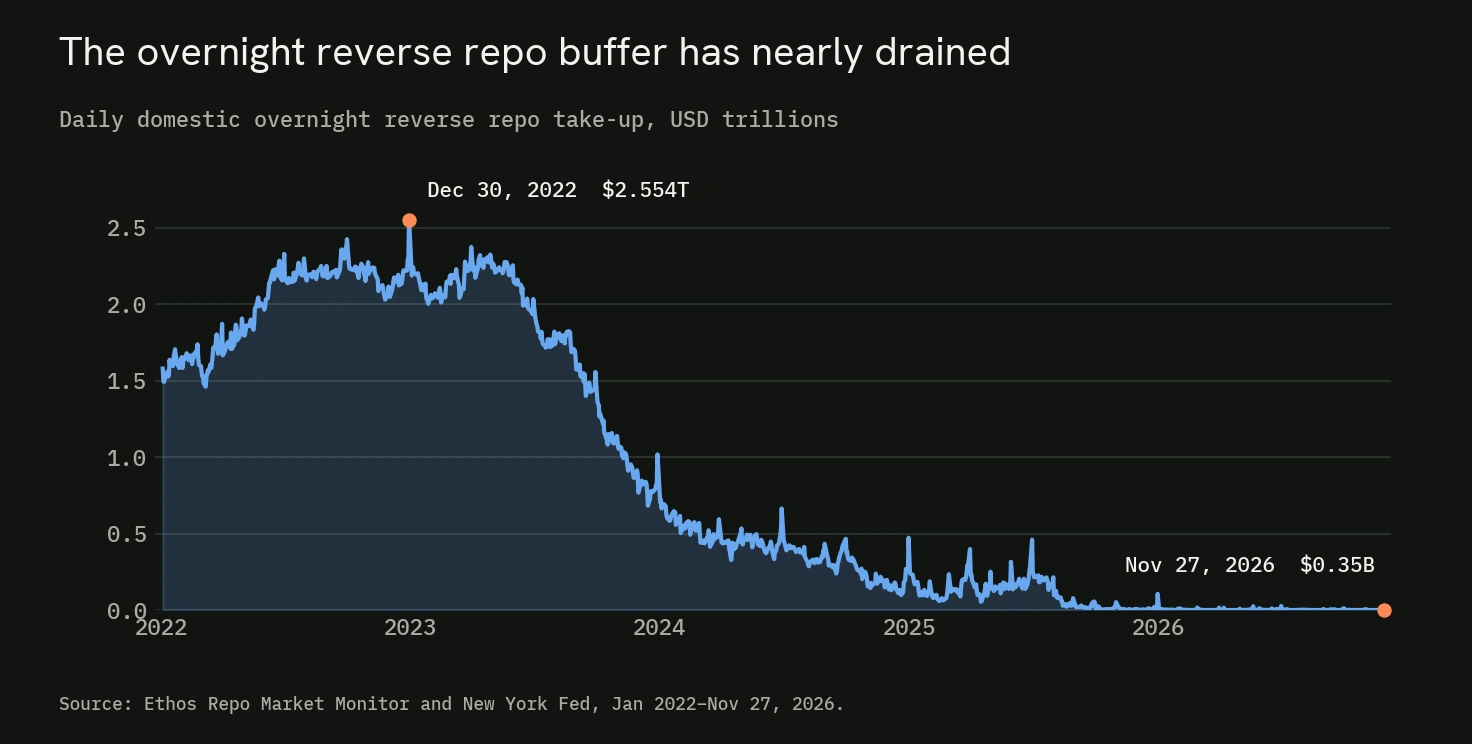
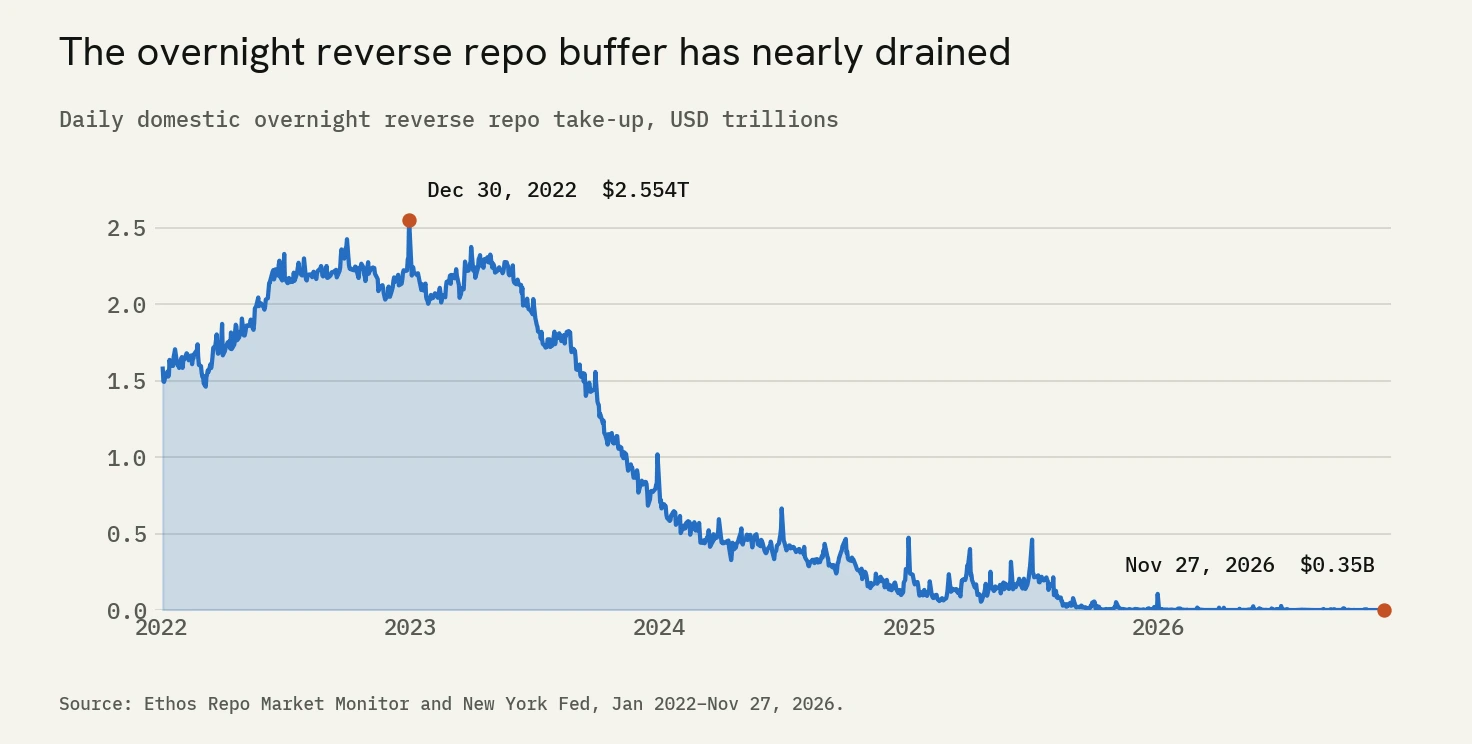
The Fed took in just $350 million through its overnight reverse repo operation on Friday. At the end of 2022 that facility held $2.554 trillion. Money funds used to be able to shift cash parked at the Fed into bills, cushioning part of the reserve drain when Treasury rebuilt its cash balance. With very little cash left in the facility, Treasury cash accumulation is more likely to draw on reserves, all else equal. The path still depends on who funds the purchases and when Treasury spends the proceeds. Track both facilities in Ethos · Ethos repo data feed · New York Fed reverse repo operations
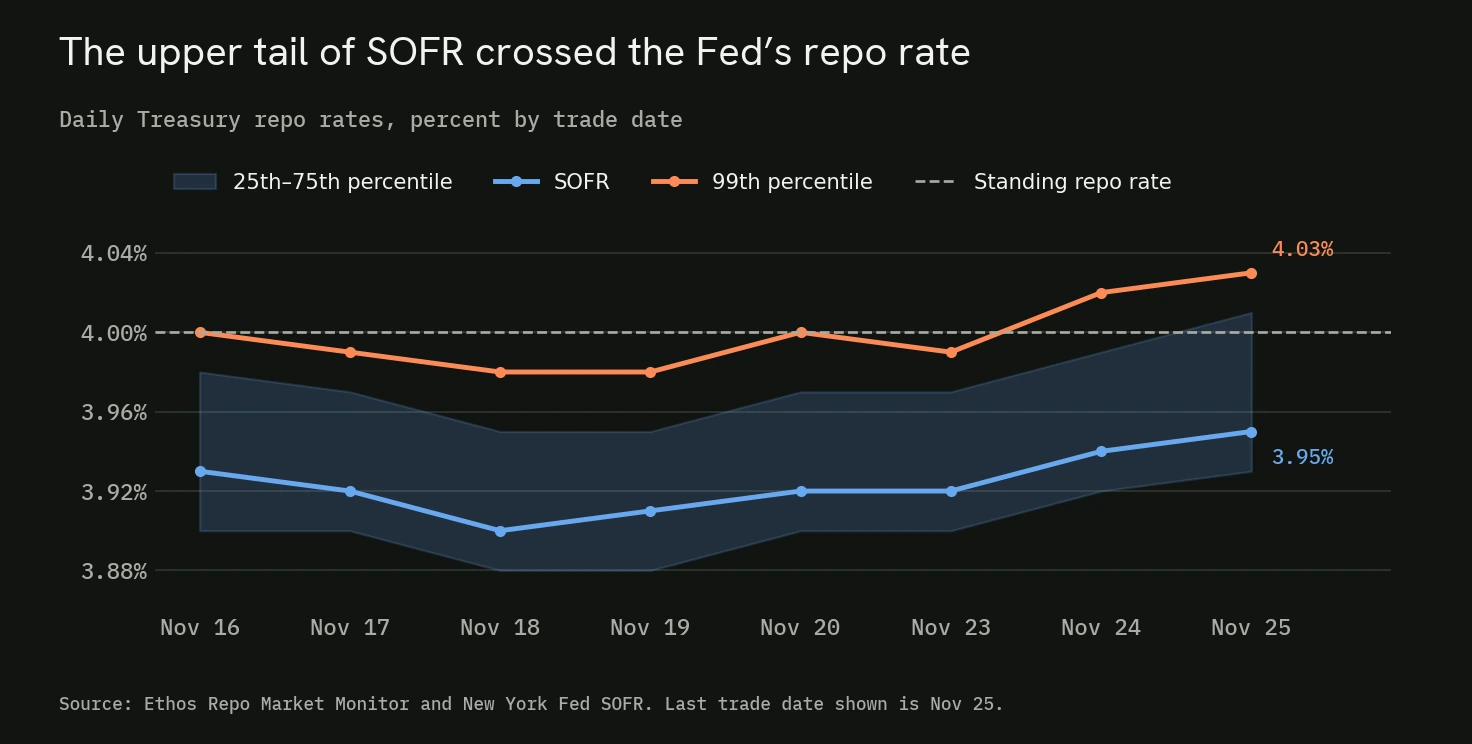
The price of funding had already started to move. SOFR, the volume-weighted median rate on overnight Treasury repo, rose from 3.91% on November 19 to 3.95% on November 25. The 99th percentile hit 4.03%, three basis points above the Fed’s 4.00% standing rate. The median was still five basis points below that rate and effective fed funds held at 3.88%. Friday’s borrowing is consistent with eligible firms securing cash early when some private trades had already become more expensive. November 25 observations describe trades before the holiday. Ethos repo rates and stress days · New York Fed SOFR observations · New York Fed federal funds data

Last Thanksgiving was comparable. The collateral was different.
On November 28, 2025, the equivalent Friday after Thanksgiving, daily standing repo use reached $24.40 billion. Agency MBS accounted for $13.15 billion that day and Treasuries for $11.25 billion. On December 31, 2025, the standing facility reached a record $74.60 billion, including $31.50 billion in Treasuries and $43.10 billion in agency MBS. This year’s holiday draw was similar in size to last year’s and much more concentrated in Treasuries. Ethos standing repo history · New York Fed 2025 operations · New York Fed 2025 open market operations report
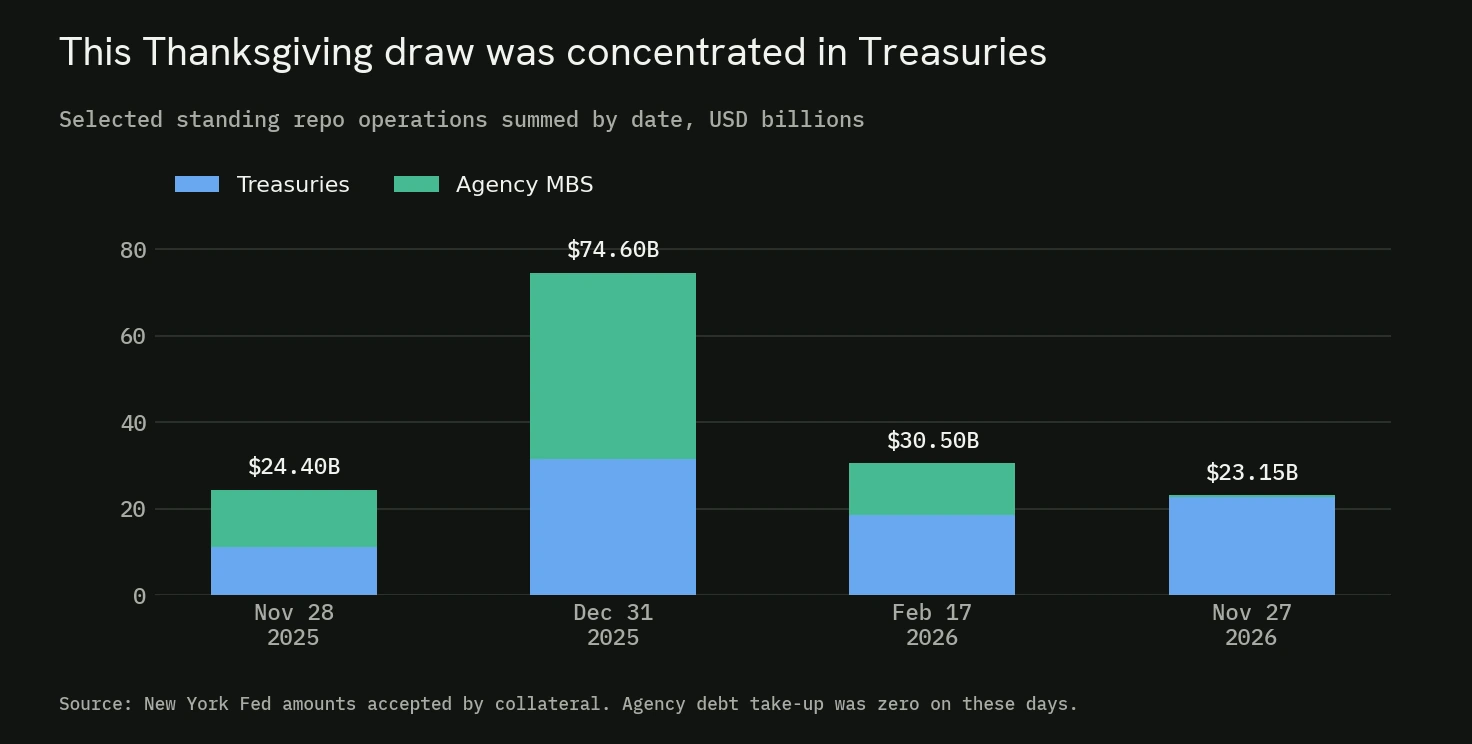
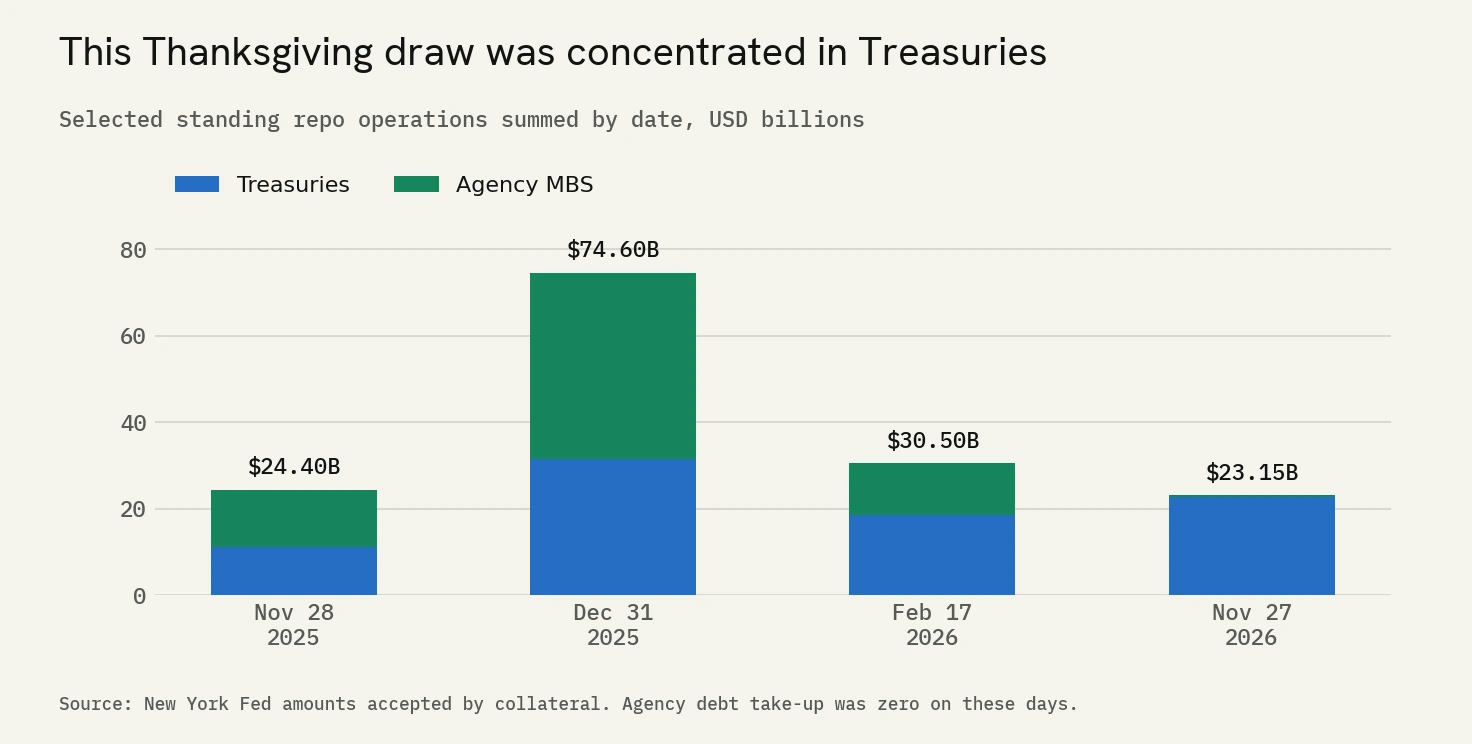
The December 2025 spike came after the Fed ended quantitative tightening on December 1, then started reserve management purchases and removed the aggregate limit on standing repo in December. That December the Fed was cutting its policy rate. In 2026 it raised the target range in September and held it at 3.75%–4.00% in October. The standing facility can supply short-term cash at a policy-consistent price even while the Fed keeps borrowing costs high elsewhere. The two actions can coexist, which makes day-to-day funding conditions especially worth watching. Ethos repo operations · Fed December 2025 decision · Fed September 2026 hike · New York Fed operations report · Ethos on the December rate decision
September 2019 shows what a broader funding shock looks like
In September 2019, corporate tax payments and a large Treasury settlement drained roughly $120 billion from bank reserves over two business days. On September 17, SOFR hit 5.25% and the effective federal funds rate broke above the Fed’s target range. The New York Fed supplied about $53 billion in its first overnight operation. Rates eased as the Desk continued its operations that week. The Fed expanded its market support again in March 2020 when the pandemic triggered a separate rush for cash. Explore 2019 SOFR and federal funds rates in Ethos · Ethos repo data feed · Federal Reserve account of September 2019 · September 17 SOFR observation · The Fed’s March 2020 response
What matters about 2019 is the spillover from Treasury financing into the federal funds market. Going into this Thanksgiving, the expensive end of repo had moved above the standing rate while the median and effective fed funds stayed below it. The next few readings will tell us whether this month’s pressure reaches more borrowers. Track repo and federal funds rates in Ethos
Funding pressure and loan losses can arrive together
Regulators also closed United Fidelity Bank on November 27. The Indiana lender had about $5.9 billion in assets, the largest U.S. bank failure since Republic First Bank in April 2024. Its reported noncurrent loans rose from 0.49% of total loans at June 30 to 70.63% at September 30, according to the FDIC’s financial data. The morning repo operation preceded the public closure announcement. The published results give collateral and volumes, with counterparty identities disclosed later. A dealer can raise cash overnight against eligible securities. Recovering value on a noncurrent loan depends on the borrower and the underlying collateral. FDIC BankFind financial data for United Fidelity · OCC receivership announcement · Ethos on the bank’s failure
United Fidelity was the seventh FDIC-insured bank failure of 2026 through November 27, compared with two in all of 2025. California closed Nano Banc on September 25. Sunwest Bank assumed substantially all its deposits, and the FDIC initially estimated a $114 million cost to the Deposit Insurance Fund. FDIC failed bank list · FDIC resolution of Nano Banc
Higher funding costs and weaker commercial property cash flows can make refinancing harder. Banks reported weaker demand and tighter standards across the three commercial real estate loan categories in the October national survey. Eighth District lenders also reported a 41-point swing in overall loan demand between August and November and rising delinquencies. Those surveys describe pressures on borrowers and lenders. The two receivership announcements establish the closures and how regulators resolved them. October loan officer survey · Ethos on the St. Louis Fed survey · Ethos credit conditions
Japan’s yen defense uses a separate funding channel
Japan’s Ministry of Finance confirmed a coordinated yen purchase with the U.S. Treasury on July 31, U.S. time, and said it planned to use the Fed’s Foreign and International Monetary Authorities (FIMA) repo facility. Japan reported ¥15.4 trillion of yen purchases across three intervention dates in the July–September quarter. On August 4, Treasury Secretary Scott Bessent publicly urged the Fed to consider increasing the facility’s size. The facility lets approved foreign monetary authorities raise dollars temporarily against Treasuries. That gives them a way to obtain dollars for intervention without an outright Treasury sale. The Fed’s November 25 balance sheet showed $1 million in foreign official repo outstanding, two days before the domestic draw. Ethos Repo Market Monitor · Japan’s confirmation of joint action · Japan’s intervention totals · Bessent’s CNBC interview · Fed FIMA rules · Fed balance sheet
The Bank of Japan held its overnight policy rate near 1.25% in October. By mid-November the yen was back near 160 to the dollar, and Finance Minister Satsuki Katayama reiterated that Japan was coordinating with the U.S. on sharp, one-sided moves. Japan’s exposure to imported fuel adds another channel when the dollar cost of energy rises. A rapid rise in the yen or in the cost of borrowing it can also force investors to unwind positions in foreign assets. I would look for that pressure in exchange rates, dealer financing and the Fed’s separate foreign-official repo disclosures. Friday’s domestic awards are reported by collateral category. Bank of Japan Governor Ueda’s November testimony · IMF market monitor, November 13 · Ethos dollar and FX monitor · Ethos repo data feed
Bessent has also pointed to stablecoins as a potential source of demand for Treasury bills and to AI as a potential source of productivity growth. Both matter on a longer horizon: federal debt subject to the limit surpassed $40 trillion on October 1. Stablecoin reserves can change who buys short-dated government debt, and AI productivity gains could affect the economy’s capacity to carry debt. Friday’s operation was about who could supply cash against securities on a particular morning. Bessent’s Treasury Market Conference remarks · GAO federal debt audit · Ethos on AI debt issuance
What I would watch after November 30
Funding markets can show strain before it appears in bank lending or earnings. Watch how much of Friday’s take-up is replaced once it matures, whether the upper tail of SOFR stays above the standing rate and whether the median follows. A quick drop in usage after month-end would fit the calendar explanation. Repeated use on ordinary days, especially alongside broader rate pressure, would give the Fed more reason to ask how readily cash is reaching the institutions that need it. Follow operations, rates and reserves in the Ethos Repo Market Monitor · Download the Ethos repo data feed
Data and methods
- Operations. Daily use sums the amount accepted across completed New York Fed standing overnight repo operations. The 2026 rank runs through November 27. Selected-day collateral amounts are matched to the Desk’s detailed results. Ethos repo operations and CSV downloads · Machine-readable Ethos feed · New York Fed operations
- Rates and balances. SOFR is grouped by trade date. H.4.1 levels are Wednesday observations. The reverse repo series is domestic overnight take-up from the Desk’s operations. Ethos market monitor · SOFR methodology · H.4.1 release
- Settlements and loan quality. Treasury’s auction calendar lists settlement dates. The bank ratios are the FDIC’s reported noncurrent-loans-to-total-loans measure, rounded to two decimals. Treasury calendar · FDIC BankFind API