Introduction
The repurchase agreement market, often called the repo market, is a core component of global financial infrastructure. It enables short-term, collateralized lending between institutions holding securities and those with available cash balances.
Although this market routinely processes transactions measured in trillions of dollars each business day, its mechanics receive limited mainstream attention compared with equity or currency markets.
Data published by the Federal Reserve indicates that U.S. repo activity can reach several trillion dollars daily, illustrating the significance of this funding channel within money markets and the government securities market.
This article provides a structured explanation of the repo market, including transaction mechanics, common market participants, and operational structures.
Key risks and policy considerations are addressed, with emphasis on the role of central bank liquidity facilities and regulatory developments.
The objective is to offer a neutral, reference grade overview suitable for readers seeking clarity on market plumbing and short-term funding practices in modern financial systems.
What Is the Repo Market?
The repo market refers to the infrastructure that facilitates repurchase agreements (repos), which are short-term financing contracts.
In a repo, one party sells securities and agrees to repurchase them at a specified future time and price.
The difference between the sale and repurchase price reflects the repo rate the implicit interest rate paid for access to cash. This structure represents a form of secured borrowing, with securities serving as collateral.
In practice, institutions that need temporary cash provide securities, while institutions with excess cash provide funding.
U.S. Treasury collateral is typically used due to its high liquidity and credit quality, although other assets such as agency securities or high-grade corporate bonds may also serve as collateral depending on market convention and risk appetite.
Repos support liquidity across bank funding markets, enabling institutions to meet settlement needs, finance securities inventories, and manage short-term balance sheet requirements. The repo market forms a cornerstone of securities financing activity globally.
How the Repo Market Works
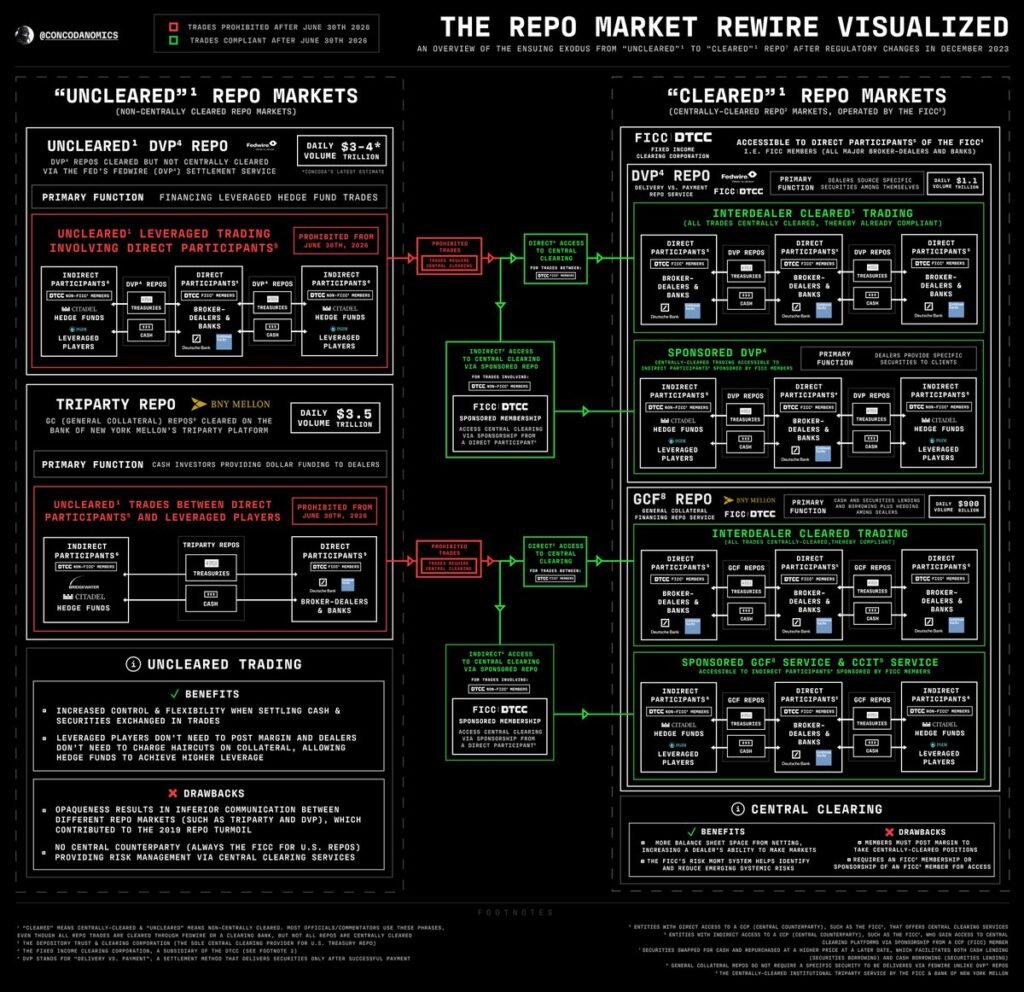
Infographic: The Repo Market Visualized
The secured cash loan market: the most systemically important money market globally

Basic Transaction Mechanics
A repo involves two linked transactions:
- An initial exchange in which securities are transferred to a cash provider in return for funds.
- A repurchase transaction at an agreed-upon future date, when the securities are returned and the borrower pays back the cash plus interest.
These exchanges ensure that the funds provider holds collateral, reducing counterparty risk. In the event of default by the borrower, the lender retains the securities and may liquidate them to recover funds.
The collateral haircut—a risk-management deduction from collateral value—protects the lender against price volatility. For example, a 2% haircut on $100 million in Treasury securities would allow borrowing of $98 million.
Step by Step Repo Transaction Example
A representative repo transaction may occur as follows:
- A dealer holds Treasury securities but requires short-term cash to meet settlement obligations.
- The dealer enters a repo, selling $100 million in Treasury notes to a money market fund at a slight discount, receiving $99.8 million after haircut.
- The repo agreement specifies that the dealer will repurchase the securities the next day for $99.802 million.
- The $2,000 difference represents interest paid on the overnight borrowing, defining the effective overnight repo rate.
This sequence illustrates secured, short-term funding commonly used by dealer banks and other institutions.

Time Horizons: Overnight vs. Term Repos
Repos are categorized by maturity:
| Overnight repo | One-day maturity, automatically unwinds the next business day |
| Term repo | Fixed maturity longer than one day (days to months) |
| Open repo | Indefinite maturity, terminable by either party with notice |
Short maturities allow frequent adjustment to market conditions and collateral valuations. Longer terms appear during periods of predictable cash flows, funding needs, or policy provision of central bank liquidity.
Key Participants in the Repo Market
The repo market supports a broad range of institutions, each with different funding motives and liquidity objectives.
Banks and Broker-Dealers
Banks and broker-dealers rely on repos to:
- Finance securities inventories
- Manage daily cash obligations
- Facilitate open market operations and Treasury repo activity
- Meet regulatory liquidity metrics such as the liquidity coverage ratio
Dealer firms, which intermediate securities markets, represent a central node in repo activity.
The list of current primary dealers of the Federal Reserve Bank of New York, effective January 31, 2025:
Wells Fargo Securities, LLC
ASL Capital Markets Inc.
Bank of Montreal, Chicago Branch
Bank of Nova Scotia, New York Agency
BNP Paribas Securities Corp.
Barclays Capital Inc.
BofA Securities, Inc.
Cantor Fitzgerald & Co.
Citigroup Global Markets Inc.
Daiwa Capital Markets America Inc.
Deutsche Bank Securities Inc.
Goldman Sachs & Co. LLC
HSBC Securities (USA) Inc.
Jefferies LLC
J.P. Morgan Securities LLC
Mizuho Securities USA LLC
Morgan Stanley & Co. LLC
NatWest Markets Securities Inc.
Nomura Securities International, Inc.
RBC Capital Markets, LLC
Santander US Capital Markets LLC
SMBC Nikko Securities America, Inc.
Société Générale, New York Branch
TD Securities (USA) LLC
UBS Securities LLC
Institutional Cash Providers
Institutions with surplus cash include:
- Money market funds
- Pension funds
- Insurance companies
- Corporate treasury departments
These participants seek low-risk, short-term investment options, making repos attractive given their secured nature.
Leveraged Financial Strategies
Certain hedge funds employ repos to increase exposure to bond markets, a process known as repo leverage. This practice allows leveraged positions while maintaining collateralized funding; however, it introduces sensitivity to funding costs and market volatility.
Central Banks
Central banks conduct Federal Reserve repo operations and operate reverse repo facilities to:
- Support financial system liquidity
- Stabilize short-term interest rates
- Provide central bank liquidity during funding stresses
The Federal Reserve’s Fed reverse repo facility enables eligible institutions to invest excess cash securely, helping maintain control over short-term interest rates.
Types of Repo Agreements
Classic Repos vs. Sell-Buybacks
- Classic repos involve legal sale-and-repurchase contracts with margining and collateral management.
- Sell-buyback arrangements follow similar economics but are structured as outright sales combined with forward contracts rather than repo agreements.
Classic repo structures are more robust, especially regarding collateral margining and default procedures.
Tri-Party Repos vs. Bilateral Repos
| Structure | Description | Collateral Management |
|---|---|---|
| Tri-party repo | A custodian manages settlement | Automated by custodial banks |
| Bilateral repo | Direct settlement between counterparties | Managed between trading parties |
Tri-party systems enhance operational efficiency and reduce settlement frictions. Bilateral markets allow customized terms and flexibility in collateral and margining.

Reverse Repos Explained
A reverse repurchase agreement represents the cash provider’s perspective. In a reverse repo, the investor lends cash and receives securities as collateral. This structure is widely used by central banks to drain excess liquidity and manage money-market rates.

Open-Ended Repos
Open repos continue until one counterparty terminates the trade. Payments occur daily, and collateral may be re-valued regularly. These contracts offer flexibility but require operational discipline.
Why the Repo Market Matters
Liquidity Provision
Repos provide liquidity financing to financial institutions holding securities positions. Efficient access to cash supports smooth settlement, trading, and balance-sheet management.
Support for Government Securities Markets
Repos underpin the Treasury repo and sovereign bond markets, enabling efficient trading and price discovery. High-quality government securities serve as widely accepted collateral, reinforcing confidence in the funding system.
Monetary Policy Transmission
Central banks use repo instruments as monetary policy tools, influencing interest rate policy and controlling liquidity. Adjustments in repo facilities or rates can influence short-term borrowing costs and broader financial conditions.
Financial Stability Considerations
Well-functioning repo markets help reduce systemic risk by supplying secure funding mechanisms. Disruptions can cause liquidity stresses, with broader implications for financial stability.
Risks in the Repo Market
Although repos are secured transactions, they involve identifiable risks.
Counterparty Risk
Borrower defaults could result in collateral liquidation challenges. While Treasury securities are highly liquid, other collateral types may pose valuation or execution risks.
Collateral Valuation Risk
Price fluctuations in collateral require active monitoring and margin calls. In periods of market stress, collateral volatility may increase, affecting repo terms and pricing.
Liquidity Risk
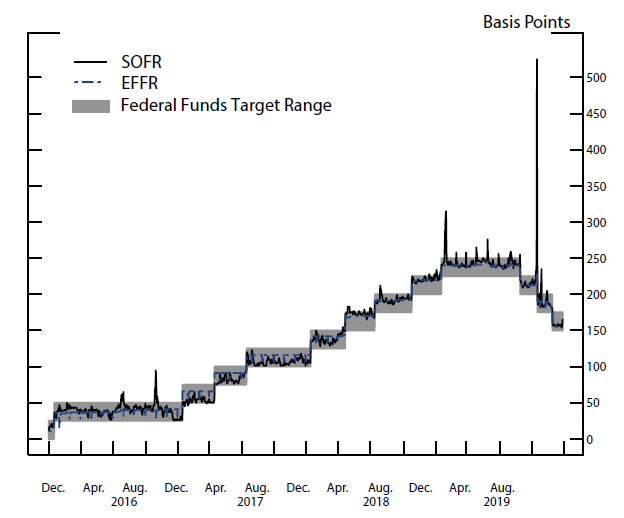
If cash supply tightens or demand increases suddenly, repo rates may rise sharply.
A notable episode occurred during the repo market 2019 spike, when short-term funding rates increased due to imbalances in liquidity supply and demand across bank funding markets.
Operational and Settlement Risk
Operational complexities in repo clearing, settlement timing, and collateral movement may pose risks if systems or counterparties face disruptions. Robust processes for repo settlement and collateral management reduce these exposures.