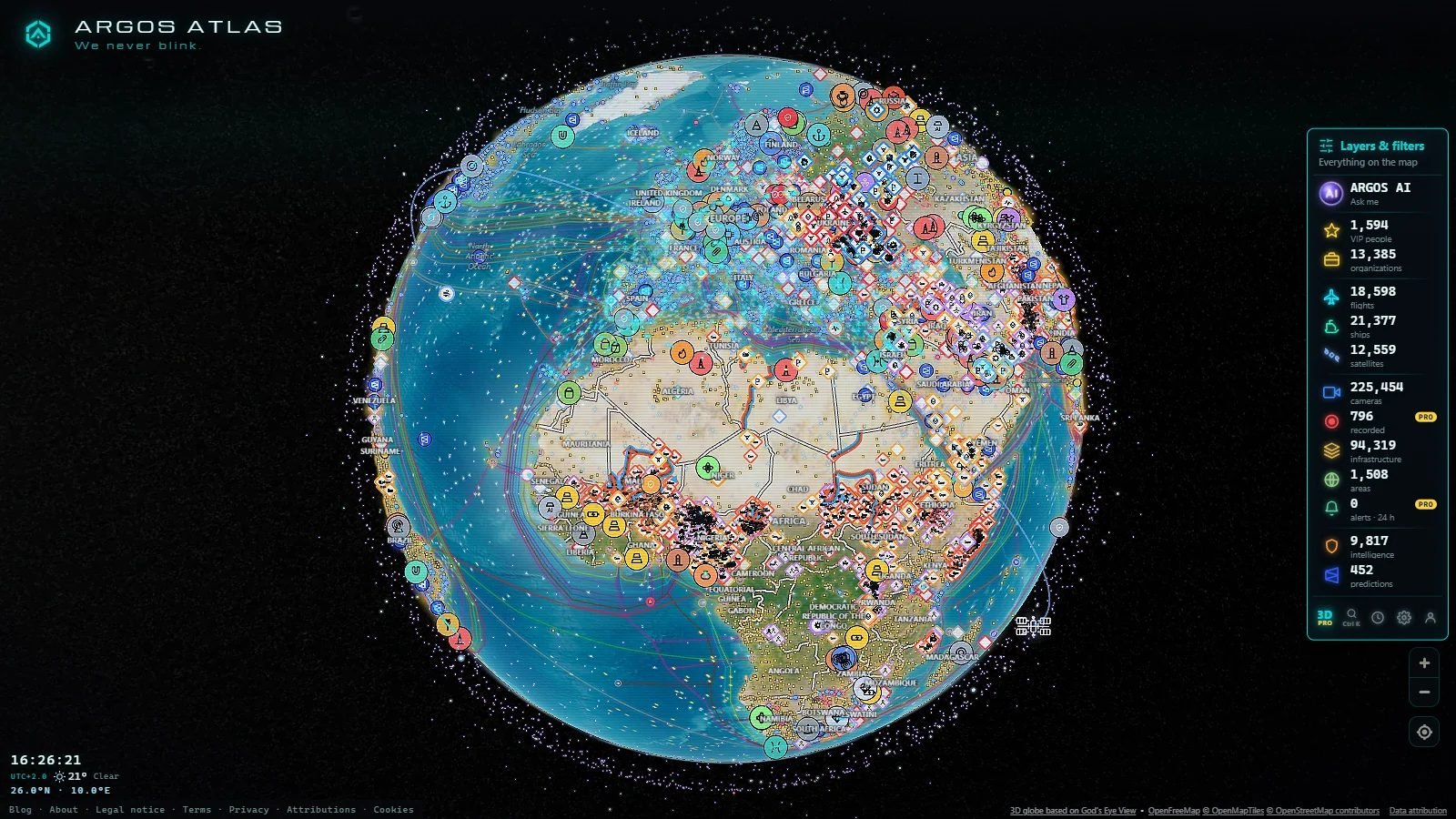
Look at a place directly: more than 200,000 public cameras, with flights, ships and conflict events, on one globe. Built by Argos Atlas, an independent service we link to and credit.
 Open Argos Atlas ↗
What it is
Argos Atlas gathers the public traffic cameras and webcams that cities, road authorities and ports already publish, scattered across hundreds of official portals, and places each one where it belongs on a single map. Around them it draws everything that moves: aircraft, ships, satellites, verified events on war frontlines, infrastructure, companies and markets. It is free to use; a free account is all it takes to get in.
Why it sits under Research
World Monitor gives the news and risk layer. Eagle’s Eye is the other half: when a headline names a port, a crossing or a city, you can look at it yourself through its public cameras and see what is moving around it. For the Gulf, that means checking a strait or a terminal while reading the Iran Intel briefs; for energy, it means watching tanker traffic rather than reading about it.
What you can see
- More than 200,000 public traffic cameras and webcams from official portals around the world, geolocated and kept alive
- Flights, ships and satellites moving in real time
- War frontlines with photo- and video-verified events, and an instability index for each country
- Infrastructure, companies and markets on the same canvas, in a 2D map or a 3D globe
- Argos AI, which answers questions using the map’s own data
Argos Atlas does not allow its map to be shown inside other websites, and its terms keep the service to its own users, so it opens in a new tab.
Argos Atlas is an independent service with no connection to Ethos Research. The preview is the image Argos Atlas publishes for links to its site, © Argos Atlas. The map re-publishes open official camera feeds and credits every source; see its Sources and method and Attributions pages.