The Allegory of the Cave
Imagine people who have spent their entire lives chained inside a cave, facing a wall. Behind them burns a fire. Between the fire and the prisoners, others carry objects whose shadows move across the wall. Unable to turn around, the prisoners know only those shadows. To them, the shadows are reality.
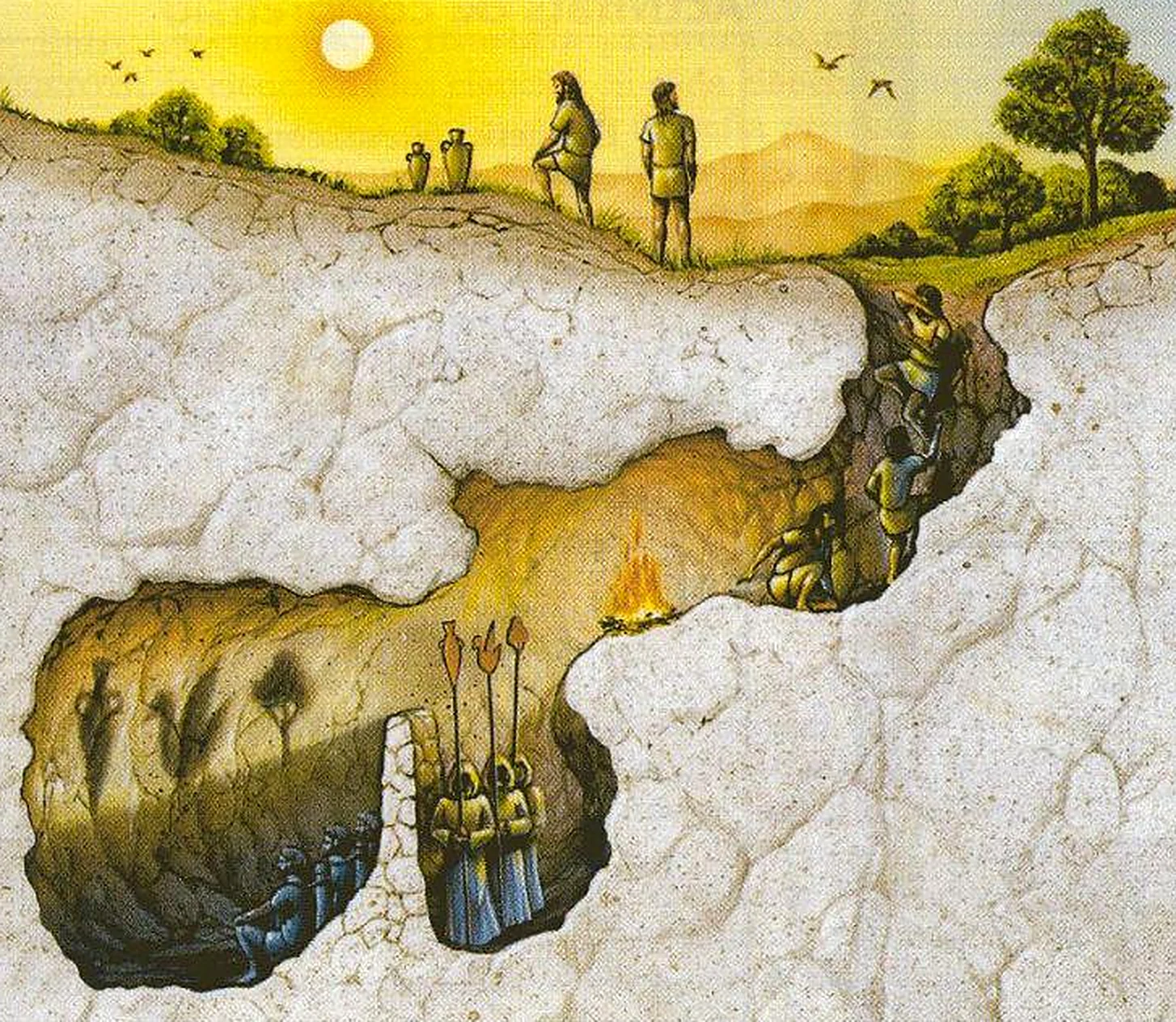
Then one prisoner is freed. Turning toward the fire is painful; the familiar world suddenly makes less sense. When he is led outside, the sunlight is almost unbearable. But gradually, his eyes adjust. He begins to see the things themselves rather than their shadows, and eventually the sun that makes sight possible. If he returns to the cave, the others find his account difficult to believe. What he has discovered challenges everything they have always taken for granted.
This is Plato’s Allegory of the Cave, from Book VII of The Republic. It is a story about the limits of perception, the discomfort of questioning what we think we know, and the difficult journey toward understanding.
What It Changed for Me
Plato’s allegory changed the way I see the world.
I first encountered it in high school through Mr. Kontogiannis, my Ancient Greek and Latin teacher. I will always credit him for introducing me to an idea that has stayed with me ever since, and for helping spark a way of thinking that continues to shape how I understand the world.
It made me realize how easily we can mistake what is familiar for what is true, or confuse a compelling explanation with a complete one. I began to look beyond what is immediately visible and ask different questions: What am I actually seeing? What created it? Which assumptions am I accepting without noticing? And what evidence would make me change my mind?
That shift reaches beyond financial markets. It shapes how I approach information, accepted beliefs, institutions, and my own judgments. To question an idea is not necessarily to reject it. It is to understand it well enough to know why it should, or should not, be believed.
And the lesson is not that I have escaped the cave once and for all. It is that I must remain willing to discover where my own understanding is still limited.
Why Ethos Research Exists
Financial markets have their own shadows: prices, charts, headlines, forecasts, and confident narratives. These signals matter, but none tells the whole story on its own. Beneath them lie forces that are less immediately visible: liquidity, monetary policy, incentives, market structure, economic conditions, positioning, and human behavior.
Ethos Research exists to look beyond the shadows.
Our mission is to connect what we see to the mechanisms behind it. Through independent, evidence-led research, we examine underlying drivers, test assumptions, challenge consensus without rejecting it reflexively, and distinguish what we know from what we merely believe.
We do not promise a final truth or perfect foresight. We commit to a way of thinking: curious enough to ask better questions, disciplined enough to follow the evidence, and humble enough to change our minds.
The goal is not to claim certainty. It is to pursue clarity that is earned, not assumed.
Philosophical reference: Plato, Republic, Book VII, 514a to 517a (Allegory of the Cave). This is a contemporary summary and interpretation, not a direct translation.