
Investment-grade bonds supplied most of the money. The terms on riskier borrowers are starting to show which parts of the AI build-out depend on lenders staying willing to fund them.
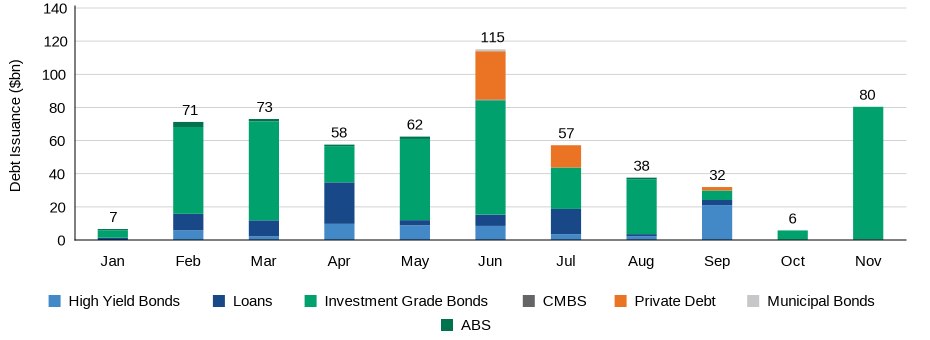
Global AI-related debt issuance reached about $599 billion through November 12, according to the monthly figures in J.P. Morgan Asset Management’s November report. That is 2.65 times the $226 billion issued in all of 2025. November had already reached $80 billion by the cutoff. Only June, at $115 billion, was larger in the series. J.P. Morgan Asset Management research, exhibit 1
What I want to know is how much of the next round can be paid for from cash the borrowers generate themselves. A company that can fund a project from its other businesses has room to wait if bond buyers ask for more. A company that needs new financing to get a data center earning revenue has a much narrower choice. That difference is showing up in credit prices while the issuance totals are still setting records.
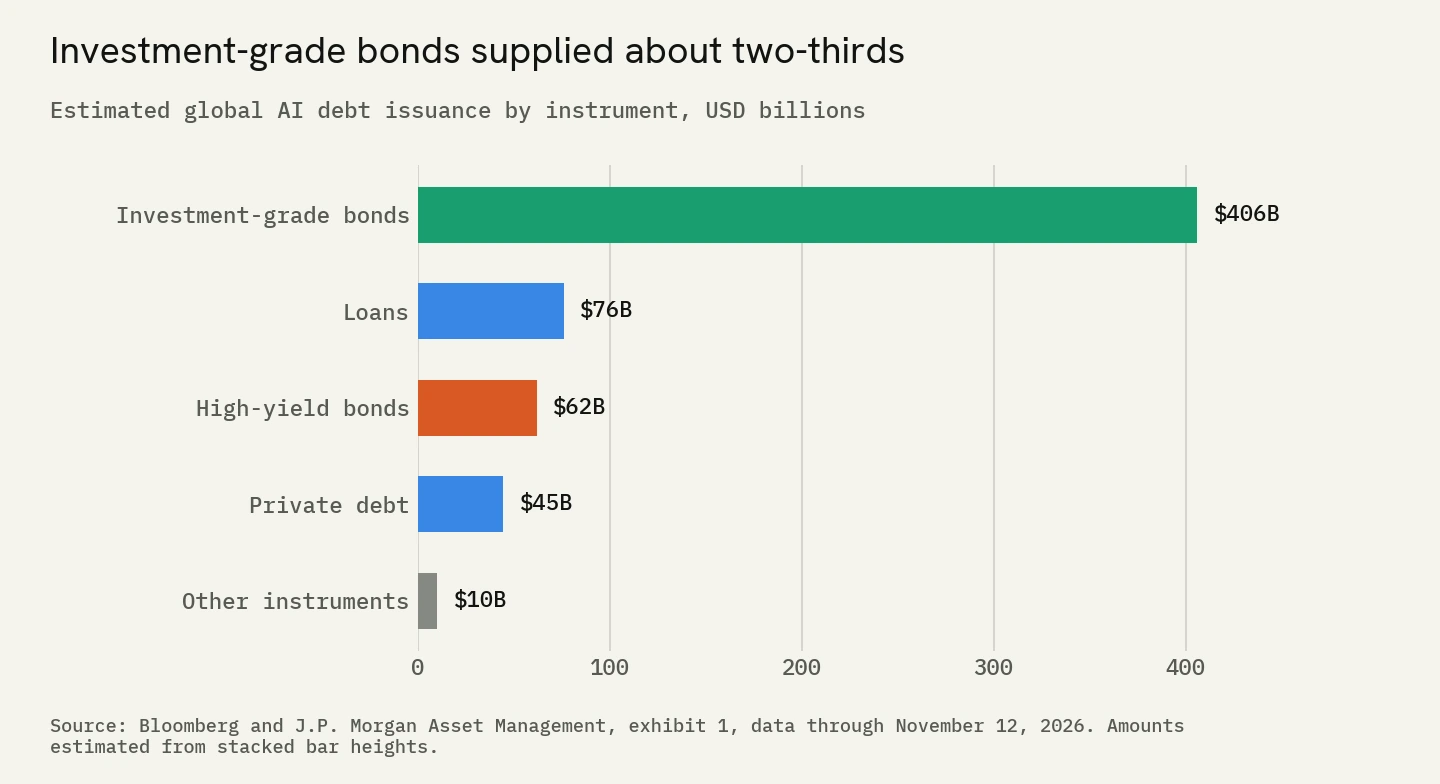
Investment-grade bonds supplied about two-thirds of the financing
Adding the printed monthly labels gives $599 billion. The original exhibit shows how that financing was raised. Investment-grade bonds contributed roughly $406 billion, or 68%. Loans followed at $76 billion, then high-yield bonds at $62 billion and private debt at $45 billion. Asset-backed securities, commercial mortgage-backed securities and municipal bonds together contributed about $10 billion. Nearly all of the November issuance through the cutoff came from investment-grade bonds. The instrument estimates come from the original bar heights and are rounded to the nearest billion. J.P. Morgan Asset Management, exhibit 1


Explore AI debt issuance
Global issuance through November 12, 2026. Instrument amounts are approximate. Bloomberg and J.P. Morgan Asset Management
Gross issuance includes new borrowing that refinances existing debt. Some offerings also support general corporate needs alongside AI spending. In my piece on AI bonds and Treasury yields, I looked at how these bonds reach investors through dealers, swaps and repo. The ECB’s November review puts the cross-border effect in numbers. U.S. hyperscalers accounted for close to 8% of the euro investment-grade corporate benchmark’s bonds with more than ten years left to maturity by market value at the end of June. Long-dated credit portfolios are taking on exposure to a small group of U.S. tech borrowers. ECB November Financial Stability Review · AI Bonds Reach Treasury Yields Through Three Channels
The cash accounts show who needs outside capital
Through September, Alphabet spent $132.0 billion in cash on property and equipment against $127.1 billion in operating cash flow. Meta generated $96.9 billion against $83.1 billion in those purchases. CoreWeave brought in $5.6 billion and spent $23.6 billion. CoreWeave’s cash capex exceeded operating cash flow by $17.9 billion in nine months. These are company-wide cash figures. CoreWeave’s purchases include capitalized internal-use software. Alphabet 10-Q · Meta 10-Q · CoreWeave 10-Q

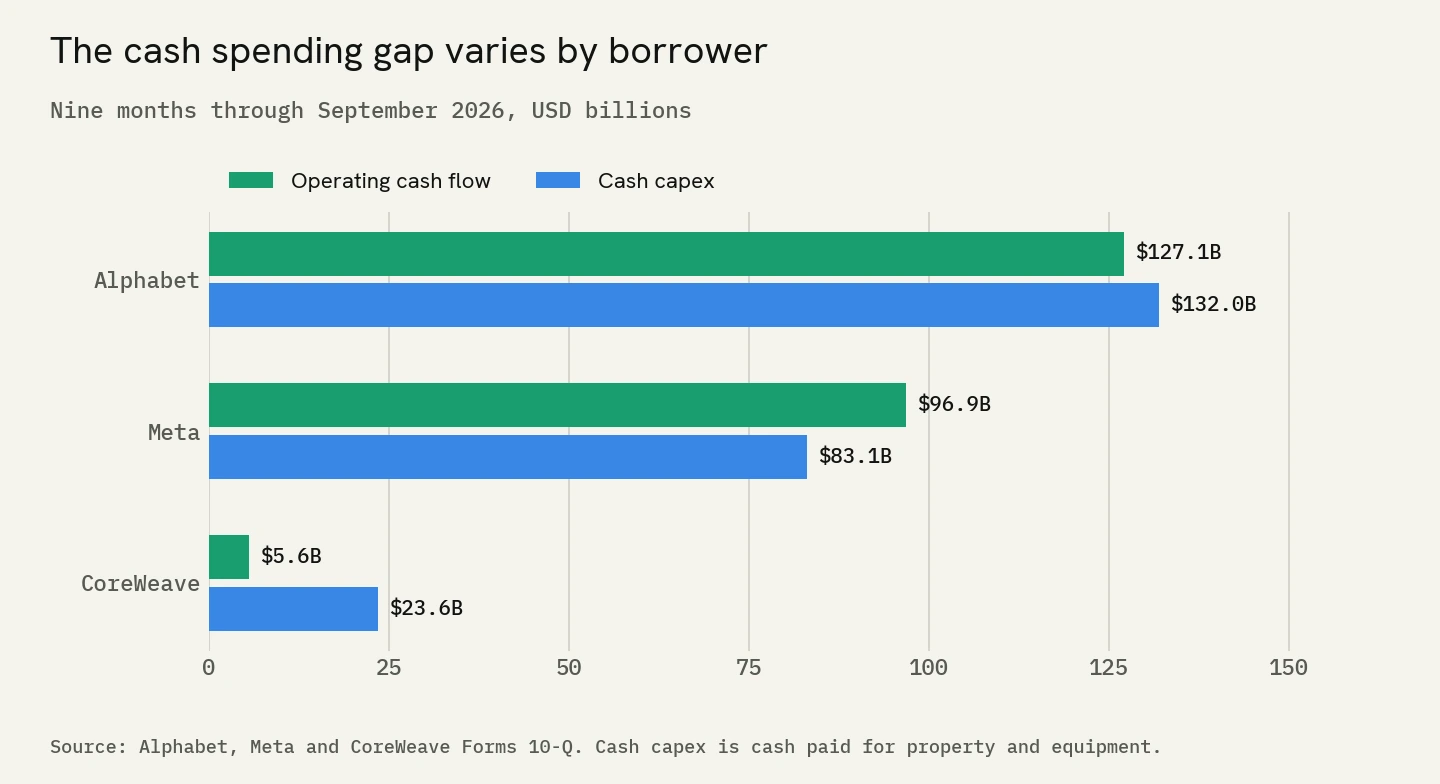
CoreWeave’s November update showed why lenders are still interested. Third-quarter revenue rose from $1.37 billion to $3.66 billion year over year. Management also raised the low end of its full-year capex guidance, to $37–39 billion. The company can keep growing fast and still need outside capital if it pays for equipment and construction ahead of customer receipts. The cash gap shows how much timing matters. CoreWeave third-quarter results · CoreWeave 10-Q
Oracle borrowed for 20 years and a data center got 364 days
Oracle closed $10 billion in new senior notes on November 4, alongside a $10 billion common-stock offering at the priced base size. The bonds paid coupons from 7.00% in 2029 to 8.65% in 2046. The 2031 tranche paid 7.45%. Its pricing document listed expected ratings of Baa2, BBB− and BBB from Moody’s, S&P and Fitch respectively, all investment grade. The bond and equity combination gives Oracle two sources of funding, and the notes lock in a dollar coupon well past the first generation of equipment the build-out is buying. Oracle pricing term sheet · Oracle closing 8-K
| Borrower and date | Financing | Terms |
|---|---|---|
| Oracle, November 4 | $10 billion of senior notes across five maturities | Fixed coupons of 7.00% to 8.65%. Maturities from 2029 to 2046. |
| CoreWeave, April and June | About $2.75 billion of 2031 unsecured notes and $1.3 billion of dollar 2032 unsecured notes | Fixed coupons of 9.75% and 9.625%. |
| CoreWeave, September | $4.2 billion of convertible senior notes due 2033 | 2.875% coupon with a conversion feature. |
| Applied Digital, November 23 | $300 million senior secured bridge facility for Delta Forge 1 | 364 days at SOFR plus 300 basis points. Draws depend on conditions. |
Selected transactions with different pricing dates, security and maturity. Facility size is the commitment. Fixed coupons, floating-rate margins and market yields measure different things. Oracle 8-K · CoreWeave 10-Q · Applied Digital 8-K
Applied Digital’s Louisiana campus shows what the next check looks like. The company says an investment-grade hyperscaler has signed a long-term lease. Yet the new loan matures in 364 days, and draws depend on construction milestones, regulatory approvals and other conditions. Applied expects to seek more financing to finish the project. A strong tenant can make a project easier to finance. The lender still needs the project to reach the stage where the construction loan can be refinanced. Applied Digital 8-K
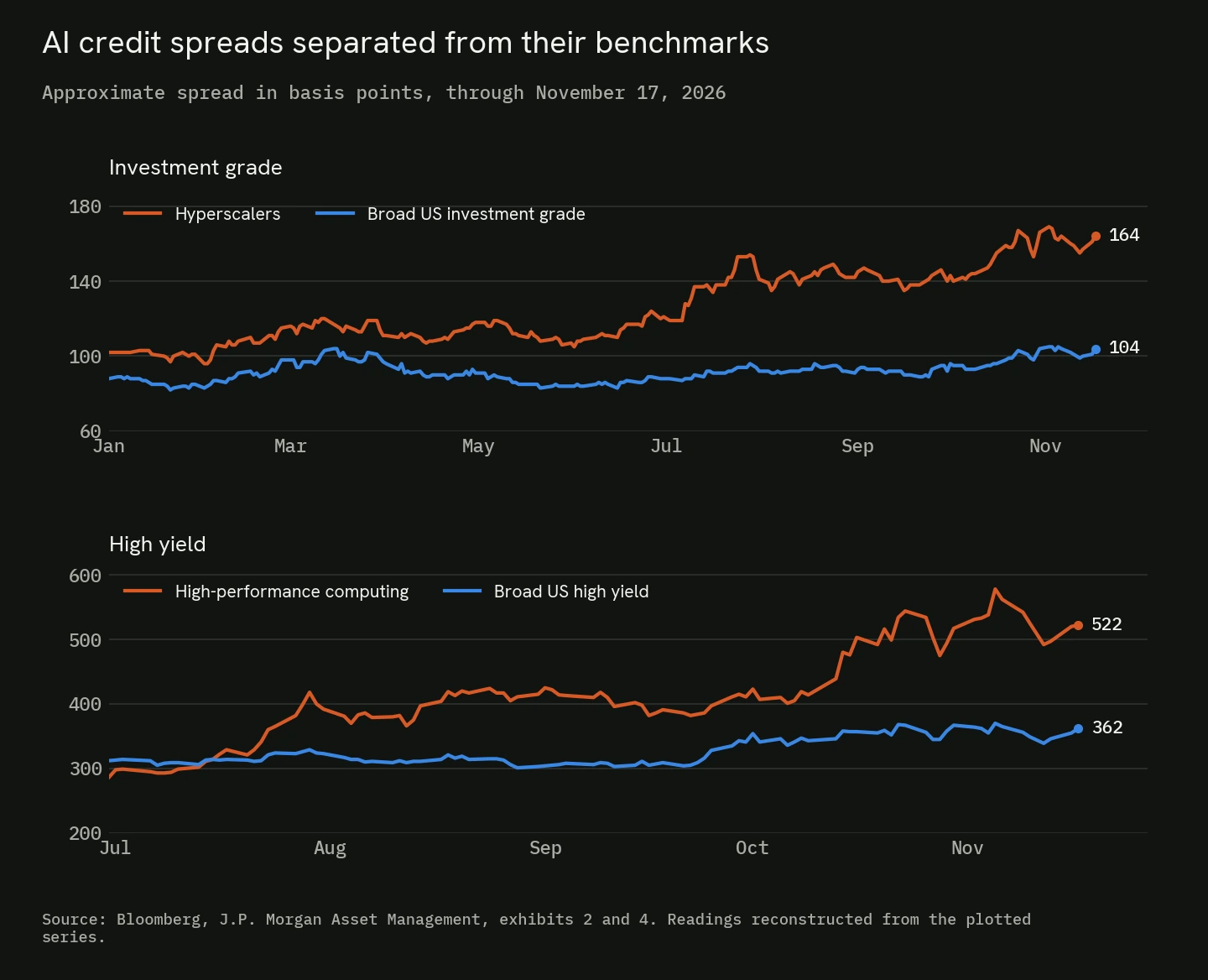
AI junk bonds have seen the larger spread move
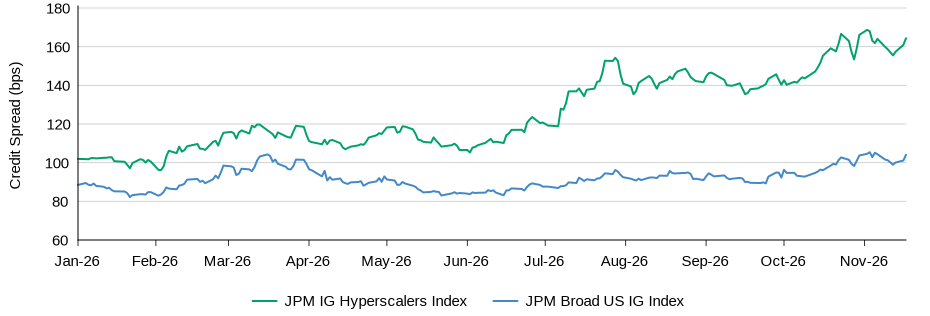
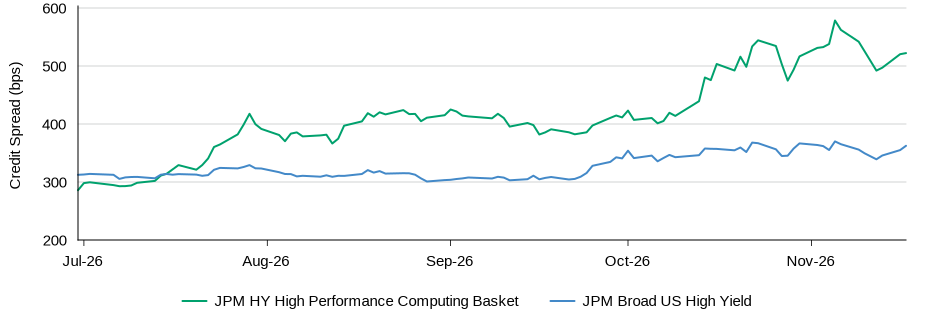
The J.P. Morgan high-yield computing basket ended November 17 near 522 basis points, compared with 362 for its broad U.S. high-yield index. At the end of June, the same series were near 286 and 312. That puts the basket’s November premium at about 160 basis points, a swing of roughly 186 basis points relative to the broader index. Over the same period, the investment-grade hyperscaler basket’s premium rose about 27 basis points, from 33 to 60. These are estimates from the source plots. J.P. Morgan Asset Management, exhibits 2 and 4
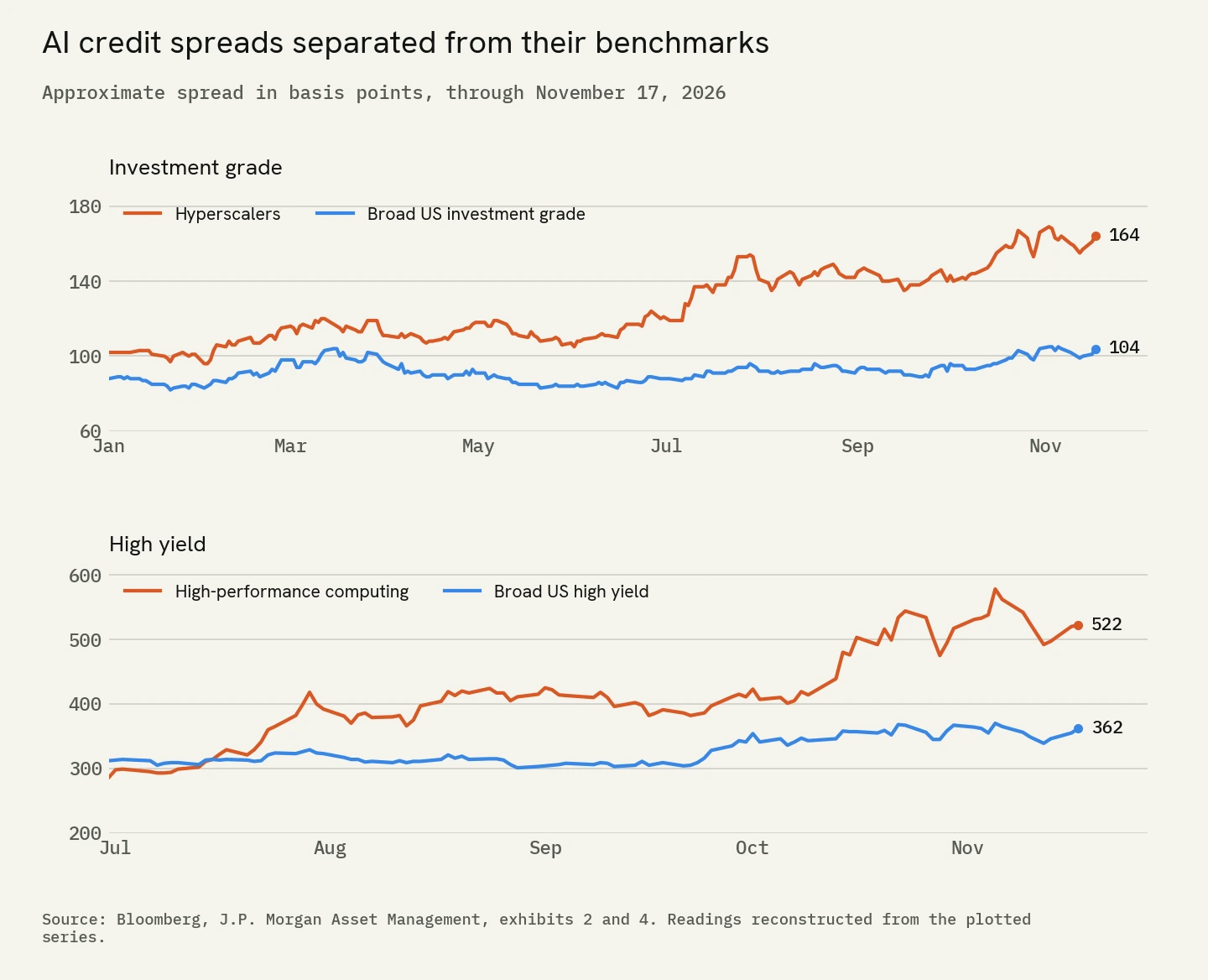
On November 23, CoreWeave shares rose 22.3% while a bond due in 2031 traded at a 16.57% yield, up 20 basis points on the day, according to Axios citing Tradeweb. That existing bond’s market price is a clue to what investors might ask for on the next deal. It adds a cash-market example to what I saw in the hyperscaler credit-default swap data earlier this week. Axios on the Tradeweb data · Ethos on hyperscaler CDS and the dotcom build-out
The spread charts also leave room for a less alarming explanation. Heavy issuance can weigh on a bond price when buyers need a concession to take on more duration, even if the company’s ability to pay has changed little. I put more weight on widening spreads when they start to change the financing terms companies can get or the projects they can start. That matters beyond tech if banks are also asking more of businesses and nonbank lenders, as the Fed’s recent lending surveys showed. J.P. Morgan Asset Management on issuance pressure · Ethos on bank credit standards · Ethos on the St. Louis Fed survey
The Fed Risks Tightening Into a Slowdown compares the financing cycle with telecom and explains how the Fed’s advanced-computing tally differs from the one used here.
The next test is which projects still get financed
Bloomberg reported on November 25 that JPMorgan’s strategists expect $450 billion of global investment-grade AI-focused bond issuance and $1.4 trillion of AI capital spending in 2027. Fed Governor Michael Barr has separately highlighted how long leases and residual-value guarantees spread exposure beyond the debt visible on company balance sheets. The more of the build-out that depends on a future refinancing, the more the terms on the next few deals matter. Bloomberg on JPMorgan’s forecast · Fed Governor Michael Barr on AI financing
I’m watching whether shorter bridge loans fund into long-term debt on workable terms, how much cash the cloud providers collect as they bring capacity online, and whether the cost of refinancing changes what companies build. A heavy calendar can keep producing record numbers even as some projects become harder to finance. The number I’d watch next is the price borrowers have to pay to keep those projects moving.
Frequently asked questions
How much AI-related debt had been issued in 2026?
The monthly totals in J.P. Morgan Asset Management’s chart add up to $599 billion through November 12, 2026. That compares with $226 billion for all of 2025. J.P. Morgan Asset Management, exhibit 1
How much was in junk bonds?
High-yield bonds account for roughly $62 billion in the original exhibit’s stacked bars. Loans and private debt have their own categories and can have different ratings and protections. Original exhibit 1
What is a credit spread?
It is the extra yield investors demand on a bond relative to a benchmark, commonly a government bond of similar maturity. A wider spread can reflect higher perceived credit risk, less market liquidity or a bigger concession to absorb new supply. J.P. Morgan Asset Management on AI credit repricing
How we checked the numbers
The monthly chart uses the printed totals in J.P. Morgan Asset Management’s November 24 report, based on Bloomberg and its own data through November 12. The instrument estimates use the height of the original stacked bars. Spread readings use the original line coordinates and are rounded to the nearest basis point. The underlying index membership and transaction-level dataset were unavailable in the exhibits. Issuer cash capex uses the consolidated cash purchases of property and equipment disclosed in each September filing. Verified marks primary-source figures, Reported marks news and market reporting, and Analysis marks calculations or interpretation. Information available November 28, 2026.
Sources
- J.P. Morgan Asset Management: The AI build-out is repricing credit, November 24, 2026.
- SEC: Alphabet 10-Q, Meta 10-Q and CoreWeave 10-Q, third quarter 2026.
- SEC: Oracle offerings and closing 8-K, November 4, 2026.
- Applied Digital: Delta Forge 1 bridge financing, November 23, 2026.
- Federal Reserve: Michael Barr on AI financing and financial stability, November 16, 2026.
- Axios: What bonds are telling us about the AI trade and Bloomberg: JPMorgan’s 2027 AI debt outlook, November 25, 2026.
Related on Ethos Research
- From the Dotcom Bust to the AI Boom, History Warns of a Growing Credit Risk
- AI Bonds Reach Treasury Yields Through Three Channels That Crowding Out Does Not Explain
- The Credit Market Is Sending a Warning Beneath the Economic Headlines
- Premarket Turmoil Suggests the AI Selloff Is Becoming a Macro Problem
Commentary, not investment advice.