


The FAA had just finished rolling out SMART, its $875 million artificial intelligence tool for air traffic, across the airspace of all 22 regional control centers when the nationwide ground stop hit.
Surely the National Air Traffic Controllers Association (NATCA) would never use a conveniently timed nationwide shutdown, days after an AI rollout it was shut out of testing, to push back against automation that could threaten its members’ jobs… right?
And surely the $30.1 billion aviation modernization request that the White House and the Transportation Department sent to Congress just hours before the shutdown will not now hand officials, contractors and the union considerably more leverage over funding, staffing protections and how the money is spent… right?
What if the most important part of the nationwide FAA shutdown is not the communications failure itself, but who stands to gain from it, financially and politically?
What happened before the FAA ground stop?
Consider the sequence of events.
On 21 September the FAA began deploying SMART (Strategic Management of Airspace, Routes and Trajectories), an AI-powered system that pulls together about 200 data streams and suggests reroutes to traffic managers. It was developed under an $875 million, 12-year contract awarded to Air Space Intelligence in June. The National Air Traffic Controllers Association later said it had taken no part in designing, testing or implementing the technology.
On 9 October, 25 lawmakers wrote to the FAA and the Transportation Department asking them to pause the system until questions about safety evaluation, training and oversight were answered.
Despite those concerns, on 10 November the FAA said SMART was active at all 22 regional air traffic control centers.
Then things became particularly interesting.


What is in the $30.1 billion aviation request?
Follow the money. On the morning of 13 November, Transportation Secretary Sean Duffy and White House budget director Russell Vought asked Congress for another $30.1 billion for aviation modernization. The proposal included:
- $10.1 billion for air traffic control modernization, of which $7.2 billion is for a common automation platform and controller workstations and $2 billion is for cloud computing
- $2 billion to replace and improve control towers
- $18 billion for airport projects, including $10 billion to modernize or replace aging terminals

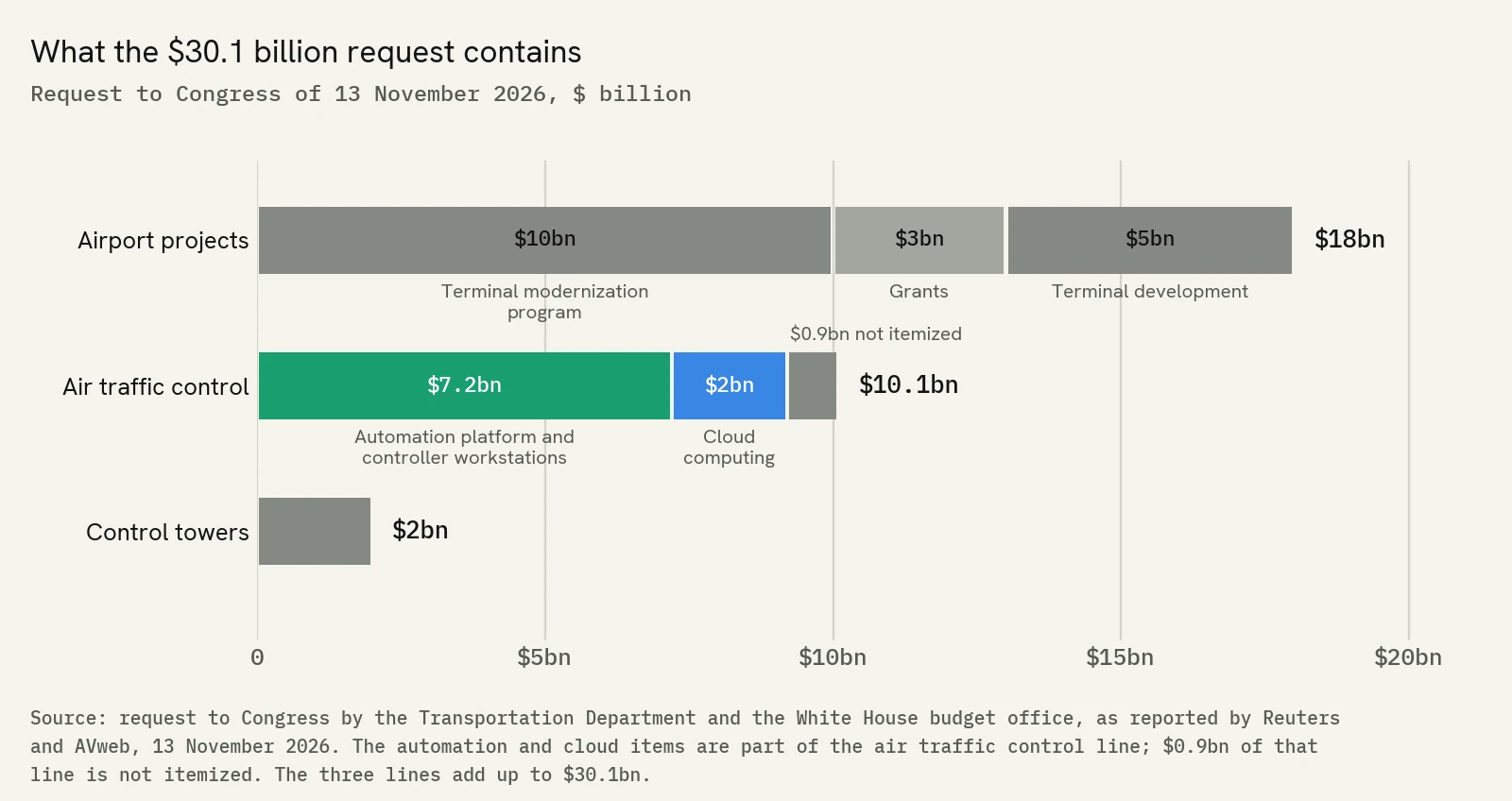
The money would come on top of the $12.5 billion that Congress approved in July 2025, and the request renews a proposal the administration first made in September.
Just hours later, communications problems at the nation’s 22 regional air traffic control centers triggered an extraordinary nationwide ground stop. It lasted more than four hours and disrupted more than 10,000 flights. It was the first nationwide ground stop since January 2023.
By that evening the number had grown. Duffy told reporters the agency needs $50 billion to overhaul the system. “Give us the resources to build a state-of-the-art air traffic control system,” he said.
The timing raises a question worth investigating. What are the odds that an infrastructure crisis on this scale unfolds hours after the administration asks for tens of billions of dollars to modernize that very infrastructure?
Coincidence is entirely possible. But the financial and political incentives deserve scrutiny.
What do officials say caused the outage?
Duffy blamed aging routers on the FAA’s communications network that were “overloaded with data”. CBS News, citing several sources, reported that an update triggered a reboot and a crash on the private network that links the control centers. Homeland Security Secretary Markwayne Mullin said investigators had found no evidence of a cyberattack, and the investigation continues.
Asked about the AI system, Duffy said: “There’s no possible way SMART would have impacted what happened.” It gives recommendations to traffic managers and is not connected to the systems controllers use to separate aircraft.
SMART is a planning tool, not a communications system, and no link to the outage has been established. That still warrants an investigation of its rollout, its procurement and the vulnerabilities of the infrastructure around it.
Who benefits from the crisis?
Consider a hypothetical scenario.
The government wants to speed up aviation modernization, expand automation and secure very large new appropriations. Contractors stand to win substantial business. Airlines favor technology that promises greater efficiency.
Meanwhile, the union representing the people who direct aircraft says it was left out of developing and testing the new AI system.
Then an extraordinary nationwide failure shows exactly how vulnerable the existing infrastructure has become.
Suddenly an enormous spending request is much easier to justify.
The crisis also creates negotiating leverage. Officials and technology contractors can argue that more automation and investment are essential, while controllers and their union can demand a bigger role, more staff and stronger safety protections.
These interests are not necessarily aligned, and there is no evidence that the union or the government deliberately engineered the disruption.
But an important distinction remains.
An institution does not have to manufacture a crisis to exploit the political and financial opportunities it creates.
And the darker possibility of deliberate manipulation, although unsupported by current evidence, is precisely why an independent examination of the timeline matters.
Which questions should investigators answer?
- Who approved SMART’s nationwide expansion despite objections from Congress?
- What safety testing took place, and why were controllers excluded?
- Did modernization work affect the communications infrastructure?
- Who stands to receive contracts from the $30.1 billion request?
- Will investigators scrutinize funding incentives and decisions rather than simply accept officials’ explanations?
The question may not be whether the government caused this crisis, but whether it will use the disruption to accelerate an aviation overhaul that controllers were already questioning.
Frequently asked questions
What is the FAA’s SMART system?
SMART stands for Strategic Management of Airspace, Routes and Trajectories. It is an AI-based planning tool that combines about 200 data streams, including weather, flight paths, traffic volumes and controller staffing, and recommends reroutes. Controllers remain responsible for separating aircraft. The FAA says that since 21 September it has helped reroute 180 flights, saving an average of 10 minutes and nearly 80 gallons of fuel per flight.
What caused the FAA ground stop on 13 November 2026?
Officials attribute it to overloaded routers and switches on the FAA’s aging telecommunications network, which disrupted communications at the 22 regional control centers. Investigators say they have found no sign of a cyberattack, and the investigation continues.
Did the AI system cause the outage?
No link has been established. The Transportation Secretary says SMART is not connected to the systems that failed.
How much money is the administration asking Congress for?
The request of 13 November is for $30.1 billion, on top of the $12.5 billion approved in July 2025. After the outage the Transportation Secretary put the need at $50 billion.
How we checked the numbers
Orange marks facts reported by the named outlets listed below. Blue marks commentary: the scenario and the questions are the author’s, and nothing in the reporting shows that the outage was deliberate. Reports differ on when the ground stop began, between about 3 p.m. and 4 p.m. Eastern time; they agree it was lifted at 8:15 p.m. The $875 million is the value of the wider contract under which SMART was developed.
Sources
- Reuters via Investing.com: White House urges Congress to provide $30.1 billion for aviation reform, 13 November 2026
- AVweb: White House Renews Push for $30 Billion ATC Plan, 13 November 2026
- AVweb: FAA Rules Out SMART AI System as Cause of Nationwide Ground Stop, 13 November 2026
- AVweb: FAA Expands AI-Assisted Traffic Management Nationwide, 12 November 2026
- FLYING: FAA’s SMART AI System Now Active at All 22 ARTCCs, 10 November 2026
- FLYING: FAA Must Pause Use of AI-Based SMART ATC System, Lawmakers Say, 14 October 2026
- CNBC: FAA lifts ground stop after more than four hours, but flight cancellations will stretch into the weekend, 13 November 2026
- PBS NewsHour (Associated Press): FAA grounds all flights at U.S. airports due to air traffic control communications problems, 13 November 2026
- AeroTime: Duffy presses Republican Congress to fund ATC overhaul after nationwide outage, 14 November 2026
- Federal Aviation Administration: Statement on Nationwide Ground Stop
Related on Ethos Research
- Is the AI threat becoming the next climate change in government spending politics?
- The Economy Is Barely Breathing, But Wall Street Keeps Buying The AI Story
- Nvidia’s Intelligence Crisis: What Huang’s Resignation Doesn’t Resolve
Commentary, not investment advice.