
Match Group reported $891.232 million in revenue for the quarter ending 30 September 2026, while its investor disclosures described improvements in conversations, retention and user activity across its dating businesses. The company also reported approximately 13.8 million monthly payers, demonstrating the commercial scale of a market built around helping strangers encounter one another. The more I examine these dating app statistics, the more concerned I become about the distance between what digital platforms measure as successful interaction and what people actually hope to experience when they seek a relationship.
The Attachment Project’s research offers an interesting comparison, with 80.6% of 31,431 respondents selecting love or a serious relationship as a motivation for dating-app use. Yet 45.4% also selected passing time, while 36.4% selected validation and 35.8% selected excitement or novelty, with participants permitted to choose multiple motivations. I find this overlap important because people can enter a platform with sincere romantic intentions while gradually incorporating it into habits that have little to do with meeting somebody. A search for intimacy can become a recurring source of anticipation, particularly when the possibility of another match is always available.
This matters because digital platforms increasingly influence how people encounter potential partners, evaluate physical appearance and interpret the attention they receive from others. A relationship usually develops through experiences that reveal qualities no short profile can fully describe, including reliability, emotional judgement and the ability to understand another person’s needs over time. When an interface encourages rapid evaluation and makes alternatives continuously visible, I worry that the habits developed during the search can begin to influence expectations about relationships themselves.
I co-founded Bonded Studio with Steve Zafeiriou, which gives me a direct interest in the design of technology for human connection. My argument here concerns the wider dating industry and the research available to evaluate it, independently of the approach we are developing through Bonded Studio. I believe the central question is whether commercial platforms can demonstrate that the behaviour they optimise leads to better relationships, rather than assuming that increased participation establishes the value of the experience.
Dating app statistics establish reach without proving long-term compatibility
The growth of online dating is well documented, although the statistics often cited to demonstrate its success measure participation rather than the durability or quality of the relationships people form. In a nationally weighted survey conducted in July 2022, Pew Research Center found that 30% of American adults had used a dating website or application, rising to 53% among those aged 18–29. Among adults already married, cohabiting or in a committed relationship, 10% reported meeting their current partner through online dating, increasing to 20% among partnered adults under 30. These findings establish that online dating provides a genuine way for people to meet partners, although they cannot demonstrate that a particular recommendation algorithm produces better compatibility than an alternative method.


View chart data and sample bases
| Measure | Reported value | Population or base |
|---|---|---|
| Ages 18–29 | 53% | US adults aged 18–29 |
| Ages 30–49 | 37% | US adults aged 30–49 |
| Ages 50–64 | 20% | US adults aged 50–64 |
| Ages 65+ | 13% | US adults aged 65 and older |
| All US adults · aggregate | 30% | All US adults, including the age groups shown |
The distinction becomes important when companies describe their ability to match individuals according to preferences, interests and patterns of behaviour. In April 2024, Laura Spinney reported in The Guardian that University of Michigan sociologist Elizabeth Bruch regarded the scientific evidence for the long-term effectiveness of proprietary matching systems as insufficient. The article explained that commercial platforms rarely provide independent researchers with the data necessary to follow couples through time or evaluate the relationships generated by their recommendation systems. I think the absence of that evidence should concern anyone interested in understanding whether algorithmic matching has delivered the improvements in human compatibility that its technological sophistication might suggest.
There is also reason to consider how the process of selecting partners changes when a person is repeatedly presented with additional choices. A 2020 study by Elisabeth Timmermans and Cassandra Alexopoulos examined 395 current dating-app users and found associations between attachment anxiety, motivations for use and a lower likelihood of meeting other users offline. The researchers also found associations between attachment orientations and the reported number of relationships and friendships originating through dating applications. These observations do not establish that applications create anxious attachment, but they indicate that the experience of using them interacts with psychological characteristics people bring to the platform.
The Attachment Project’s much larger survey adds evidence about the different reasons users return, although its recruitment method does not establish that its participants represent the general dating population. Among the 31,431 people answering its motivations question, 80.6% selected finding love, 45.4% selected relieving boredom, 36.4% selected validation and 35.8% selected novelty. I see a potential conflict between the immediate satisfaction offered by an entertaining search and the slower process of discovering whether another person is compatible through sustained interaction. Both activities can occur on the same platform, but they demand different kinds of attention and reward different forms of behaviour.


View chart data and sample bases
| Measure | Reported value | Population or base |
|---|---|---|
| Love / serious relationship | 80.6% | 31,431 respondents to the multi-select motive item |
| Boredom / passing time | 45.4% | 31,431 respondents to the multi-select motive item |
| Validation / confidence | 36.4% | 31,431 respondents to the multi-select motive item |
| Excitement / novelty | 35.8% | 31,431 respondents to the multi-select motive item |
The existence of these competing motivations does not mean that people are insincere about wanting relationships, because individual motives are often complicated and can change according to circumstances. It suggests, however, that the frequency with which somebody opens a dating application cannot reliably tell us why they returned or whether the experience is making them more satisfied with their romantic life. That limitation becomes more consequential when activity is incorporated into the measurements used to develop and evaluate a commercial product.
The commercial system measures engagement more precisely than relationship quality
I tend to approach digital businesses through the same questions I ask when examining other markets, beginning with how revenue is generated and which measures management considers evidence that the business is improving. For dating applications, these questions matter because the product can create value by introducing potential partners while also earning recurring revenue from continued participation. Those objectives can support one another when users are satisfied with the service, but they can also create tension when the outcome somebody wants would reduce their reason to keep using it.
Match Group’s financial disclosures make the economic structure particularly visible, since the company reports paying users, revenue per payer, retention and activity measures across its portfolio. Its Q3 2026 financial results showed average monthly payers declining from 14.5 million a year earlier to 13.8 million, while average monthly revenue per payer increased from $20.58 to $21.19. Quarterly total revenue declined from $914.275 million in Q3 2025 to $891.232 million in Q3 2026, illustrating how user numbers, pricing and business performance can change independently. These figures are appropriate indicators of a company’s financial condition, but they cannot establish how many satisfying relationships were formed during the same period.


The company has also developed measures intended to reflect the quality of interaction rather than merely the volume of activity. Match Group defines Sparks as the number of users engaging in six-way conversations at a brand level during a week, and its Q3 2026 materials describe this measure as a proxy for meaningful connection. Tinder’s Sparks increased 1% year on year during the quarter, while Sparks Coverage, the proportion of active users experiencing a Spark, increased 5% year on year. I regard these as more informative than counting impressions alone, although a conversation of that length still tells us little about whether two people subsequently meet, understand one another or establish a stable relationship.
The ability to collect behavioural information is another important part of modern platform design, because recommendations can be adjusted according to how users respond to profiles and interactions. Match Group’s prepared remarks describe the development of recommendation systems designed to optimise Sparks, retention and what management calls ecosystem health, together with plans for recommendations that respond to user actions within seconds. This demonstrates how directly behavioural signals can be incorporated into product development, although it does not establish that management deliberately seeks to prevent users from leaving through successful relationships.
A successful introduction can strengthen a platform’s reputation, attract new customers and encourage recommendations, while an existing user who remains active can continue generating subscription revenue and useful behavioural signals. The commercial incentives are therefore more complicated than the claim that dating companies simply want everybody to remain single, and their effects should be investigated rather than presumed. What concerns me is that the business can repeatedly measure the behaviours most closely connected to its operations while having much less public evidence about the ultimate relationship outcomes those behaviours are intended to support.
This creates a wider question about the standards people develop when romantic attention is organised through systems of rapid comparison. A person’s profile offers a small and carefully selected representation of their life, while the qualities that sustain a relationship generally become visible through experiences that require time and mutual responsibility. When another option is continuously accessible, it becomes easier to imagine that an ideal partner is waiting somewhere beyond the next interaction, even though that expectation is difficult to test against real relationships. I worry that this combination of endless choice and the curated images people encounter across social media encourages increasingly unrealistic expectations, particularly when the search itself becomes more familiar than the work of getting to know somebody.
The psychological mechanism deserves careful treatment because repeated anticipation, variable rewards and social comparison are plausible influences on behaviour, but the evidence considered here does not demonstrate a particular dopamine response to every swipe. Nor does it establish that dating applications have caused widespread cognitive decline or a general collapse in people’s capacity to form meaningful relationships. I regard these as questions requiring longitudinal research, especially studies that distinguish the effects of platform design from pre-existing patterns of loneliness, rejection sensitivity and dissatisfaction.
Research on wellbeing, safety and older daters exposes the limits of access
A growing body of scientific literature raises concerns about the relationship between dating-app use, appearance-based judgement and psychological wellbeing. In a 2025 systematic review published in Computers in Human Behavior, Zac Bowman and colleagues examined 45 studies published between 2016 and 2023. Among the 22 studies examining body image, 19 reported adverse findings, while 14 of the 29 studies examining mental health and wellbeing reported adverse findings. The review included predominantly cross-sectional research, which limits the ability to determine whether the applications themselves caused those outcomes.


Other studies help explain why these concerns are relevant without establishing a single direction of causality. In a 2022 study involving 690 participants, Khandis Blake and colleagues found a small positive association between lifetime dating-app use and disordered eating symptoms, while also identifying relationships involving appearance-based rejection sensitivity and emotional regulation. A 2026 meta-analysis covering 27 studies and 21,263 participants found associations between swiping-based dating-app use and behavioural dysregulation, with Hedges’ g of 0.44, and body-related outcomes, with g of 0.32. The pooled result for general wellbeing was statistically non-significant, demonstrating why the findings should be considered by outcome rather than reduced to the assertion that dating apps universally damage mental health.
The repeated emphasis on physical appearance is important because people may begin to understand their desirability through the attention they receive from others. In a system where the first judgement is frequently based on a photograph and a brief profile, the experience of rejection can be difficult to separate from somebody’s perception of their physical worth. I suspect that repeated comparison can reinforce unrealistic expectations about both ourselves and potential partners, although the available evidence does not establish how persistent these effects are after a person stops using the applications.
Personal safety introduces another limitation that engagement statistics cannot adequately describe. In September 2026, the Behavioural Insights Team reported findings from 1,008 heterosexual women in Australia who had recently used dating platforms, finding that 99% had experienced at least one behaviour included in its assessment of technology-based abuse during the preceding three months. The prototype assessment covered 39 behaviours of different kinds and seriousness, including potential indicators of emotional manipulation, which means the headline percentage cannot be interpreted as the prevalence of severe abuse among all female dating-app users. The researchers also reported psychological or emotional behaviours among 95% of respondents and identified design features that could expose women to unwanted contact or surveillance.
Global Dating Insights reported the findings on 22 September 2026 and noted that 19% of women who had reported harmful behaviour felt their complaint had been taken barely seriously or not seriously at all. Its article describes the same underlying Behavioural Insights Team research, so the two publications should be understood as separate accounts of one study rather than independent confirmation. I believe the broader implication concerns the additional emotional effort required when a person must repeatedly assess whether the attention they receive is genuine, respectful and safe.
Older adults face barriers before online connection even begins
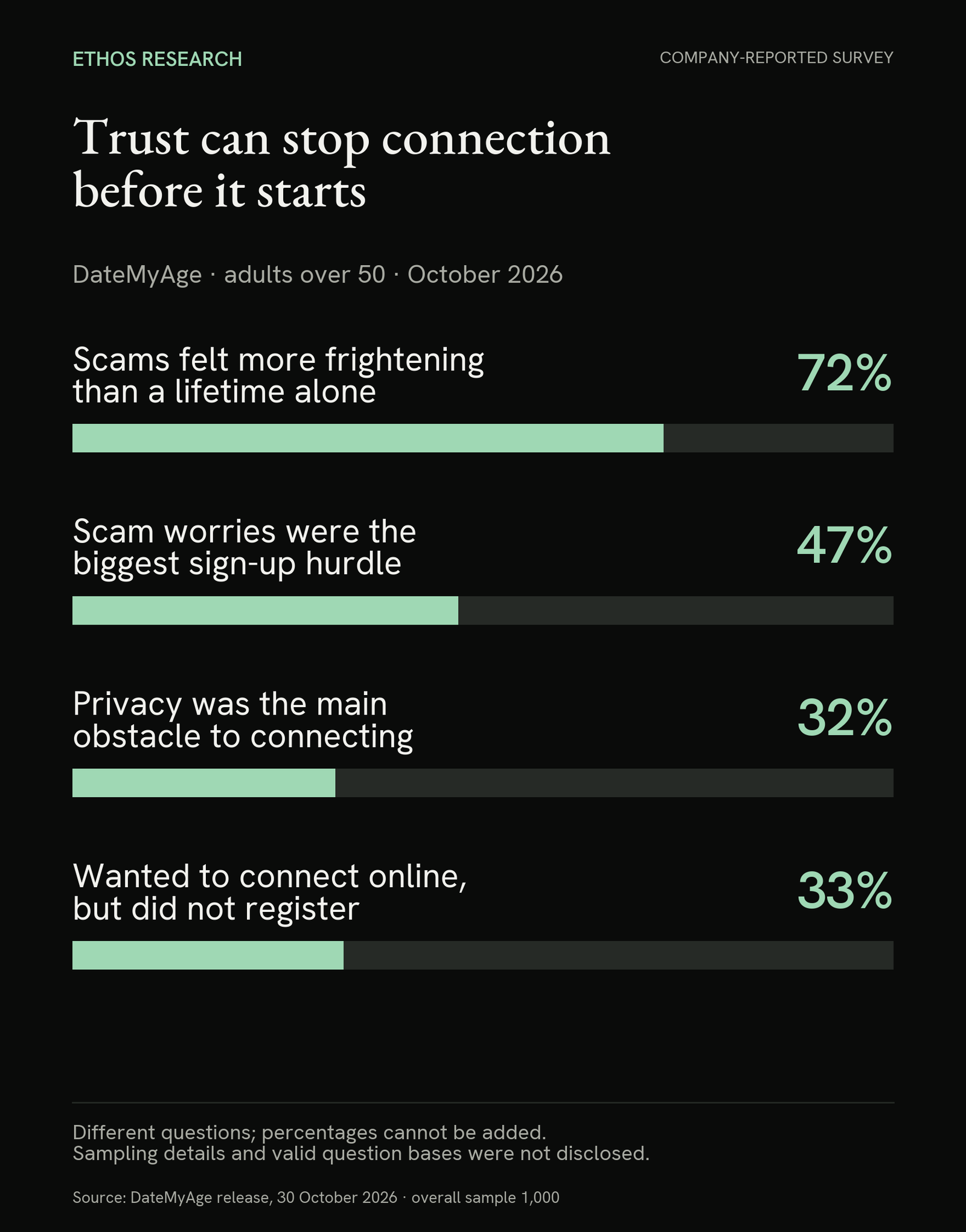
The experience of adults over 50 adds a different perspective, because some people remain outside the online dating market despite wanting to form new relationships. In a survey published by DateMyAge on 30 October 2026, the company reported questioning 1,000 adults over 50 about their attitudes towards online relationships, privacy and personal safety. The company reported that 72% of respondents feared being scammed online more than spending the remainder of their lives alone, while 47% identified fear of scams as their greatest barrier to signing up. A further 32% identified privacy concerns as their biggest obstacle to building online connections, and 33% said they had wanted to connect online but stopped before registering. The press release does not provide enough information about sampling, country coverage or individual question denominators to establish how representative these percentages are. Nevertheless, I think the findings raise a useful question about whether digital connection products are being evaluated according to the confidence and security people need before they are willing to participate.

The same survey also reported that 57% could not say they had met somebody new in whom they were genuinely interested during the preceding decade, although the underlying release distinguishes people who recalled a period longer than ten years from those who could not remember their last such meeting. Another 52% were uncertain whether their children would approve of them forming connections online, while 11% said they would welcome assistance from a younger person in setting up a profile. These findings suggest that social expectations and practical confidence can influence participation alongside the more widely discussed problems of swiping and matching.


An independent comparison is available from Pew Research Center’s study of online dating after 50, which found that 17% of US adults aged 50 and older had ever used dating services, while only 3% had done so within the preceding year or were current users. Among older Americans who had tried online dating, 47% said they had encountered somebody they believed was attempting to scam them, and 45% reported at least one of four forms of unwanted behaviour. These findings were collected using a nationally weighted US survey and provide stronger population-level evidence for the importance of trust and safety, although the survey populations and question wording differ from DateMyAge’s research.
I find this particularly revealing because access to a digital platform represents only the first step in the process of building a relationship, while confidence, willingness to participate and trust in another person determine what can happen afterwards. An interface may provide a large number of available contacts without reducing the uncertainty that makes someone reluctant to begin a conversation. In that sense, expanding the market for online interaction does not necessarily address the obstacles that prevent people from experiencing meaningful connection.
What I take from it
There is an important counter-case to the concerns raised here, because online dating has enabled real relationships and can provide access to social communities that would otherwise be difficult to reach. In a 2018 review, Shangwei Wu and Janelle Ward described how gay dating applications support activities extending beyond romantic matching, including social networking and participation in communities. Dating companies have also begun introducing features intended to reduce low-quality interactions, with Hinge reporting in September 2024 that its Your Turn Limits feature increased messaging responsiveness by 20% during testing.
I welcome those developments because the problem I see concerns the standards by which connection technology is assessed, and those standards can change as companies develop better ways to evaluate outcomes. I would reconsider my concern if independently replicated research demonstrated that engagement-oriented matching systems consistently produce more satisfying long-term relationships than lower-engagement alternatives, without corresponding increases in psychological or safety-related harms. Until then, the more I examine the evidence, the more convinced I become that the ability to generate another interaction remains an incomplete measure of a technology designed to bring people closer.
I have examined one alternative approach through Bonded Studio’s work on meaningful connection, which I discuss in a separate article alongside the research that informs it and the questions that remain unresolved.
Frequently asked questions
What percentage of people use dating apps?
Pew Research Center found that 30% of American adults had ever used an online dating service as of July 2022, although the figure measures lifetime experience rather than the proportion actively using dating apps at that time.
Do dating apps actually create serious relationships?
Yes, Pew found that 10% of partnered American adults in 2022 had met their current partner through online dating, although that figure does not measure how satisfying or durable those relationships were compared with alternatives.
Are dating-app matching algorithms scientifically proven to work?
The independent evidence discussed here does not establish that proprietary matching algorithms consistently identify partners who will have better long-term relationships. Limited access to commercial and longitudinal data makes that question difficult to evaluate.
Why do people continue swiping when they want relationships?
The Attachment Project’s respondents reported overlapping motivations involving love, boredom and validation, suggesting that the same activity can serve both relationship goals and immediate emotional needs.
Can dating apps cause depression or low self-esteem?
Systematic reviews have identified associations between dating-app use and some adverse psychological outcomes, but most available studies cannot determine whether the apps caused those difficulties or whether people with existing vulnerabilities were more likely to use them.
Why are adults over 50 reluctant to date online?
DateMyAge’s company-reported survey identifies concerns about scams, privacy and family approval, while Pew’s independent US research confirms that perceived scams and unwanted behaviour are common among older people who have used online dating.
What would make dating apps better for relationships?
I would favour independently evaluated measures of consensual meetings, mutual satisfaction, safety and sustained relationship quality, with attention to whether people benefit from the service after their use of it has ended.
How we checked the numbers
I checked the cited primary research, company financial disclosures, the Behavioural Insights Team report and Pew Research Center material against the figures used here as available on 17 November 2026.
Verified identifies information checked against a primary study, filing or official dataset; Reported identifies claims published by a named company or organisation that have not been independently reproduced; Secondary identifies information taken from another author’s account or synthesis; and Analysis identifies my interpretation.
The Attachment Project’s recruitment and weighting are not sufficiently disclosed to establish representativeness. DateMyAge reports 1,000 respondents but does not disclose enough sampling or item-level denominator information to support population estimates. Its percentages describe different questions, not mutually exclusive answers. The 57% figure combines people reporting more than ten years with those unable to remember the last such meeting.
Match Group’s payer figure is a reported average monthly measure, not a deduplicated count of people across all its brands. The charts round 14.527 million and 13.789 million to 14.5 million and 13.8 million; their two panels use separate scales.
The Behavioural Insights Team assessment concerns 1,008 recently active heterosexual women in Australia, one selected platform per respondent and 39 behaviours of differing seriousness, including possible precursors or warning signs. Its 19% complaint-response figure applies to women who made reports to a platform.
The Bowman review’s results section counts 19 of 22 body-image studies and 14 of 29 mental-health and wellbeing studies as reporting adverse findings. These categories overlap and include qualitative work; the counts are not population prevalence or uniformly tests of statistical significance. The results section gives 48.3% for 14 of 29, while the abstract prints 48.6%; the calculated 48.3% is used here.
The four charts use the cited values, separate labels and source notes. Their dark and light versions follow the article’s reading theme. Observational associations, engagement measures and company surveys do not by themselves establish causation or long-term relationship quality.
Sources
- Match Group: Q3 2026 Form 10-Q, quarter ended 30 September 2026; Q3 2026 Prepared Remarks, 2 November 2026.
- Pew Research Center: The Who, Where and Why of Online Dating in the U.S., 2 February 2023.
- Pew Research Center: How Americans 50 and Older Use Online Dating Sites and Apps, 17 July 2023.
- Attachment Project: The Psychology of Dating Apps, undated, accessed 17 November 2026.
- The Guardian: The Science Isn’t There, Do Dating Apps Really Help Us Find Our Soulmate?, 28 April 2024.
- Cyberpsychology, Behavior, and Social Networking: Anxiously Searching for Love (Among Other Things), published online 27 April 2020.
- Computers in Human Behavior: Dating Apps and Their Relationship with Body Image, Mental Health and Wellbeing, April 2025; publisher-version PDF via Flinders University.
- Journal of Eating Disorders: Dating App Usage and Motivations for Dating App Usage Are Associated with Increased Disordered Eating, 28 November 2022.
- Communications Psychology: A Systematic Review and Meta-Analysis of the Mental Health Correlates of Swiping-Based Dating App Use, 2 July 2026.
- Behavioural Insights Team: Understanding Tech-Based Abuse of Women on Dating Platforms, September 2026.
- Global Dating Insights: 99% of Women Report Abuse on Dating Platforms, Australian Study Finds, 22 September 2026.
- DateMyAge: Why Singles Over 50 Fear Connecting Online More Than Being Alone, 30 October 2026.
- Sociology Compass: The Mediation of Gay Men’s Lives, A Review on Gay Dating App Studies, 2018.
- Hinge: Hinge Launches Your Turn Limits Globally, 18 September 2024.
- Bonded Studio: Technology Should Bring Us Closer, undated, accessed 17 November 2026.
Related on Ethos Research
- Loneliness Was Never a Glitch. It Was the Matrix.
- The Science of Human Connection: Why Bonded Is Built Differently
- What Is Bonded Studio? The Conversation Game Built to Bring People Closer
Commentary, not investment advice.