
The 10-year Treasury yield surged toward 5% today, rising roughly 14 basis points by late morning after a hotter-than-expected CPI report and warnings of more aggressive Federal Reserve tightening.
But the important development is where yields are rising fastest.
The bond market’s warning
| Maturity | Late morning, 10 Nov (market quotes) | Official close, 10 Nov | Change on the day (close) |
|---|---|---|---|
| 2-year | about 4.76%, up 21 bp | 4.73% | +17 bp |
| 5-year | 4.83%, up 17 bp | 4.81% | +14 bp |
| 10-year | about 5.00%, up 14 bp | 4.98% | +10 bp |
| 30-year | 5.36%, up 10 bp | 5.35% | +9 bp |
Sources: late-morning market quotes as observed by Ethos Research; official closing par yields from the US Treasury.
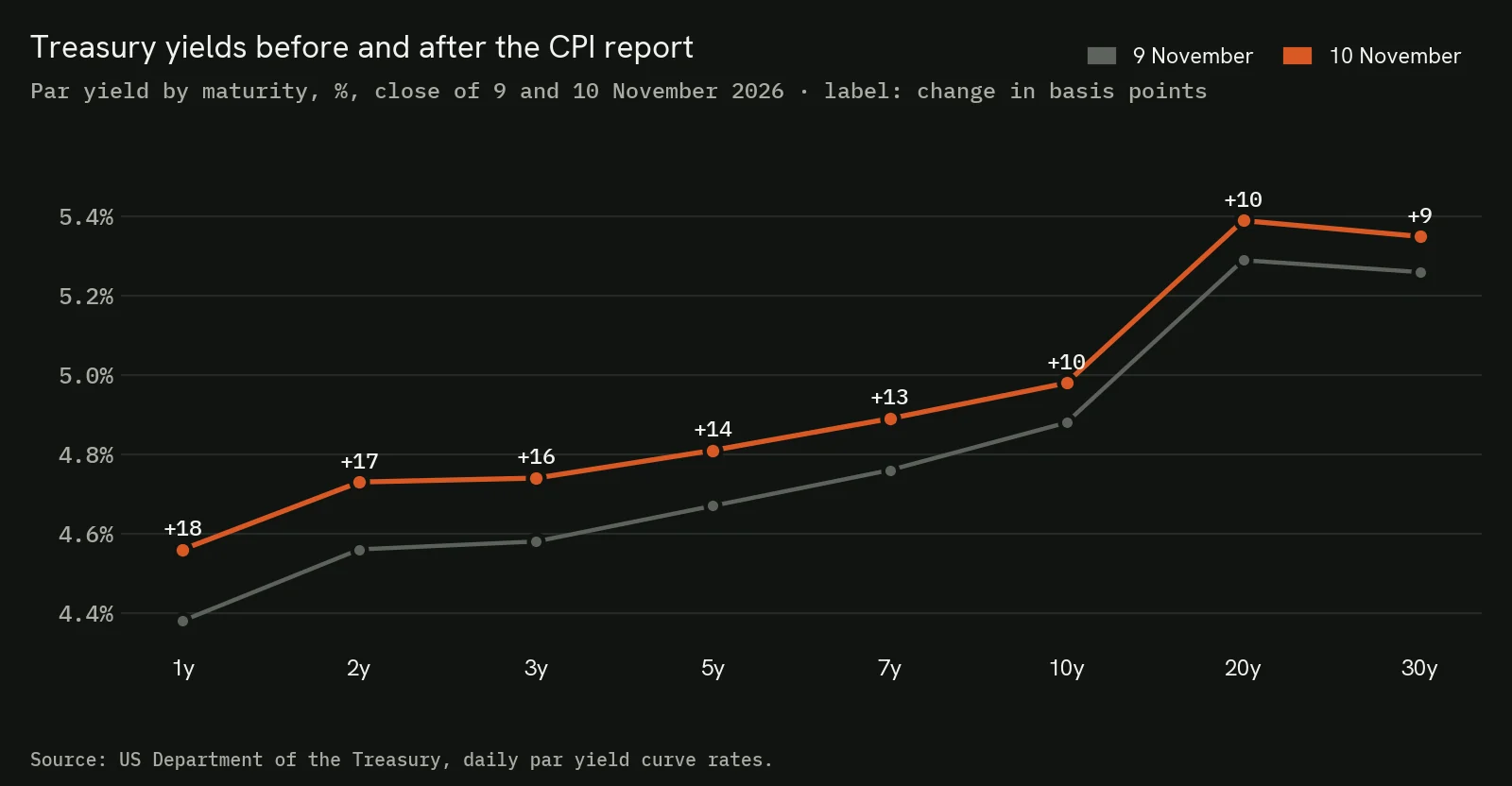
The 2-year yield rose much faster than the 10-year, narrowing their spread from about 32 to 25 basis points at the close.
This is bear flattening. Investors are selling bonds and repricing Federal Reserve policy, with the greatest pressure concentrated in shorter maturities.
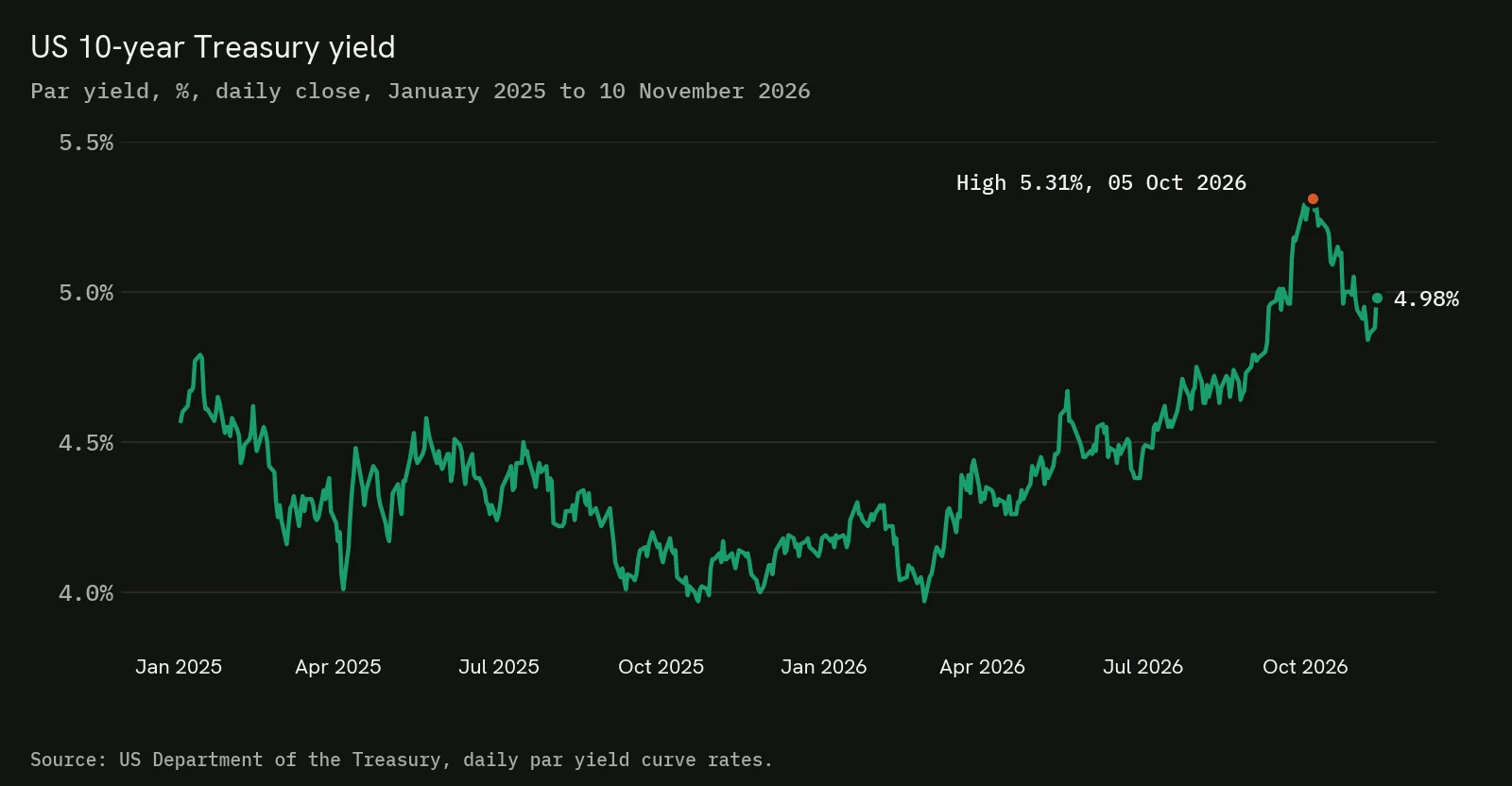
The 10-year peaked at 5.31% on 5 October 2026, then eased through October before turning higher again this week.
Why yields are rising
Fed Governor Christopher Waller signalled before the CPI release that December could warrant a rate increase. In a speech in London he said he was “leaning toward supporting an increase in our policy rate of 25 basis points at the FOMC’s December meeting”, and that if the October data came in hotter than expected, “a 50-basis point hike in the policy rate should be considered”.
Hours later, October headline CPI rose 0.4% against 0.3% expected, while core increased 0.3% against 0.2% expected. The full report is in October CPI Reveals Persistent Inflation.
Markets are pricing more restrictive policy for longer, not necessarily stronger economic growth.
Long-term yields are influenced by expected nominal growth, combining real economic growth and inflation. But the composition matters. Third-quarter nominal GDP rose at a 5.6% annual rate, with real growth of 3.4%. Roughly 2.1 percentage points reflected rising prices.
Higher yields driven by productive growth are fundamentally different from higher yields driven by inflation and the monetary response needed to contain it. Longer yields also reflect expected policy rates and term premiums, so nominal GDP is a useful indicator, not a precise pricing formula.
The energy shock complicates everything
Refining and shipping disruptions keep diesel, heating oil and other finished fuels expensive even as crude fluctuates. Higher fuel costs squeeze households and business margins, while restrictive interest rates increase refinancing costs and discourage investment.
The Fed cannot repair refineries or restore shipping routes by raising rates. It can suppress demand enough to contain inflation, but at the risk of worsening the economic slowdown.
The CPI report confirms the dilemma. Energy’s direct contribution to monthly inflation fell sharply, while the contribution from everything excluding energy increased.
What happens next
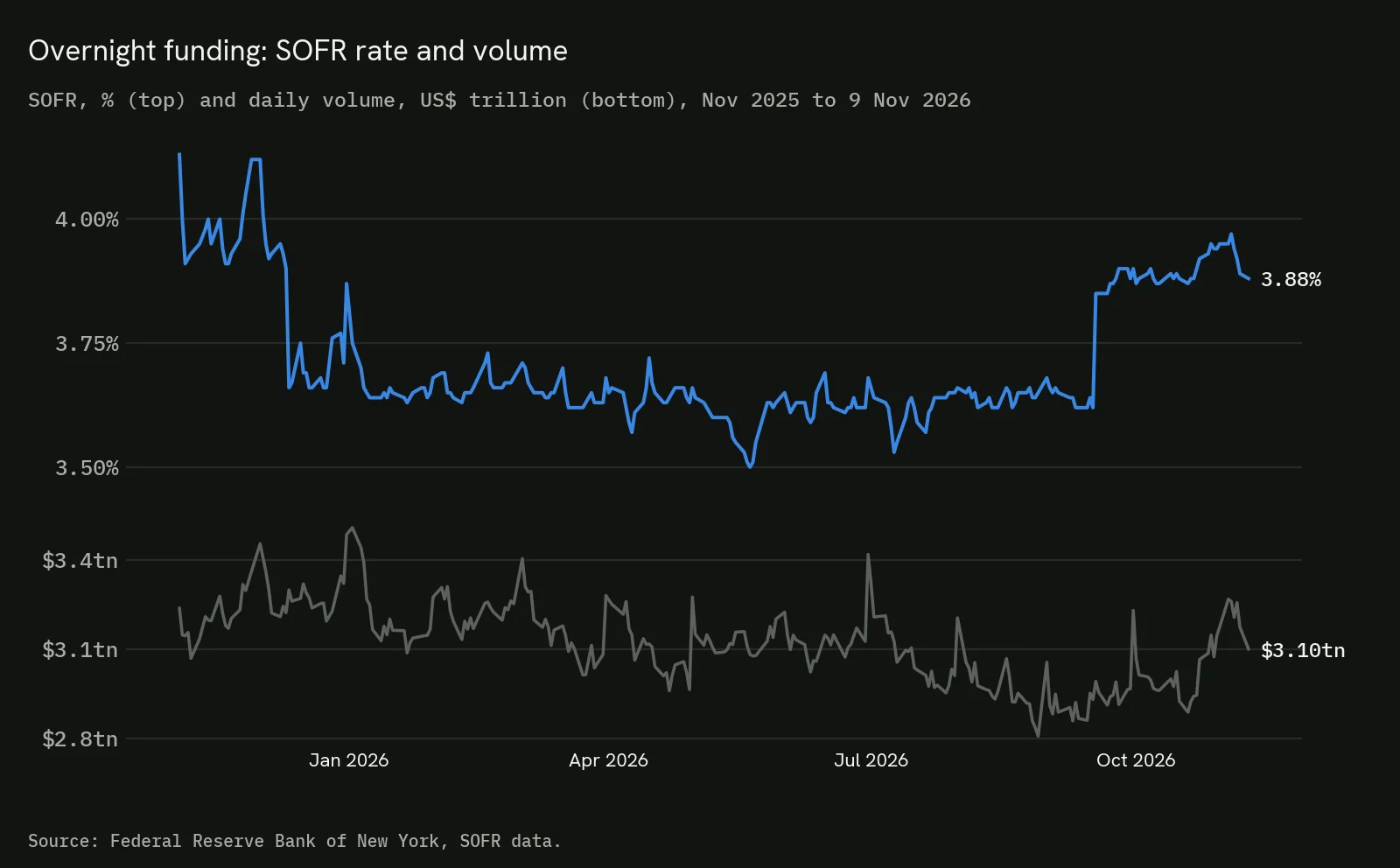
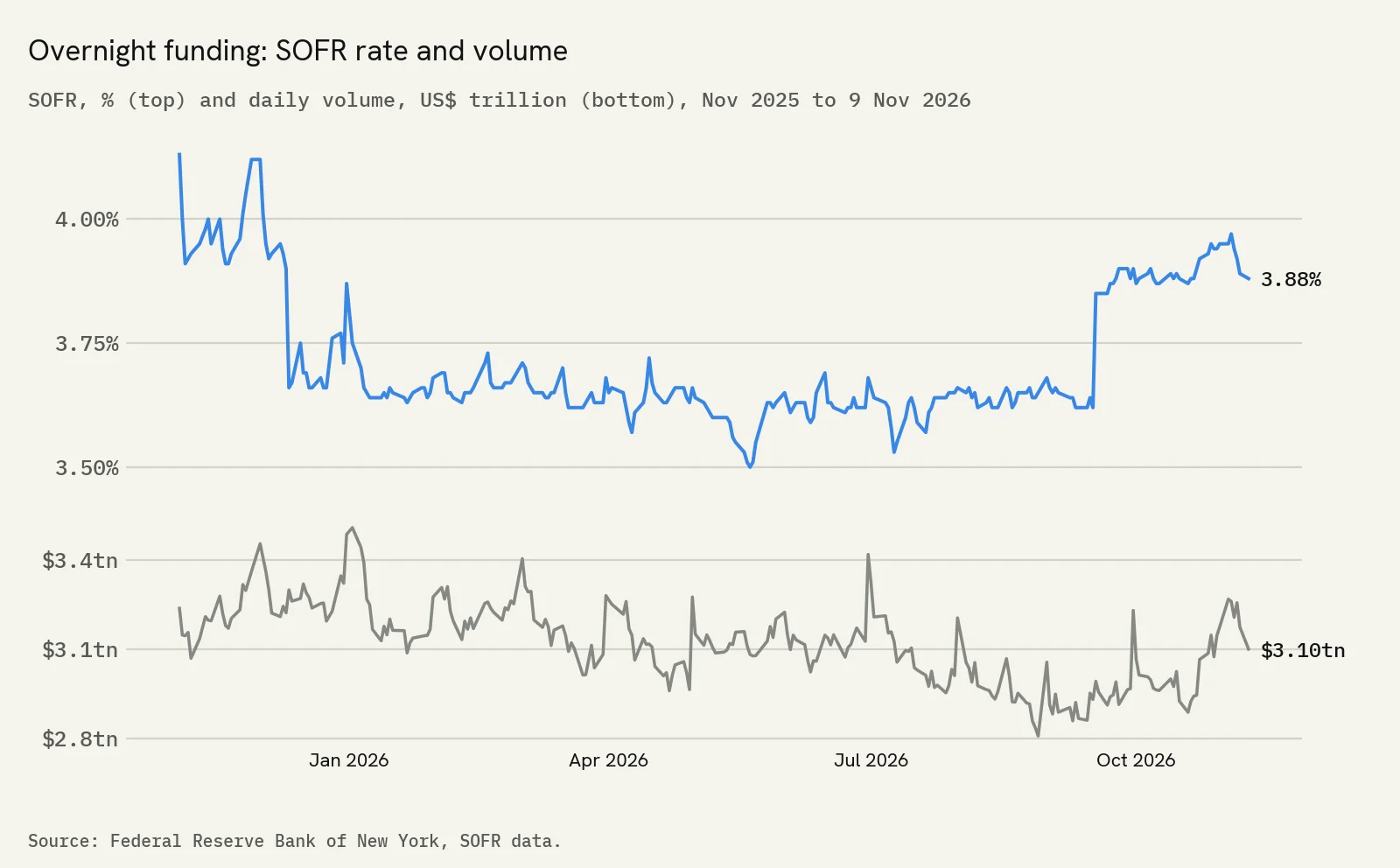
Treasury issuance and market positioning can amplify a selloff, but today’s sharp rise in shorter yields points primarily to inflation and policy repricing, not an imminent Treasury funding crisis. Overnight funding markets are calm: SOFR, the main overnight repo rate, was 3.88% on 9 November on $3.10 trillion of volume, below its early-November level.
If restrictive rates eventually weaken consumption, investment and employment, growth expectations could reverse. Shorter yields could then fall faster than longer yields as investors anticipate rate cuts. That would be bull steepening, the opposite of today’s move. It is a risk, not yet a confirmed outcome.
The danger is that borrowing costs are rising without an equivalent improvement in the economy’s ability to bear them. The bond market is repricing how much economic pain may be required to contain inflation. Today’s surge in yields could be the tightening that precedes a far more serious growth problem.
What higher rates are doing to bank lending, commercial property refinancing and private credit is covered in The Credit Market Is Sending a Warning Beneath the Economic Headlines.
Frequently asked questions
Why did Treasury yields rise on 10 November 2026?
October consumer prices rose faster than expected, and Fed Governor Waller had said a larger December rate hike could be considered if the data came in hot. Traders priced a December hike, pushing short-term yields up most.
What is bear flattening?
Bear flattening is when yields rise across the curve but short-term yields rise faster than long-term ones, so the curve flattens. It usually reflects expectations of tighter monetary policy.
Did the 10-year Treasury yield reach 5%?
It touched about 5% in trading and closed at 4.98%, according to the US Treasury’s official par yield. Its high this year was 5.31% on 5 October 2026.
When is the next Fed meeting?
The Federal Open Market Committee meets on December 8 and 9, 2026.
How we checked the numbers
Closing yields are the US Treasury’s official daily par yields; late-morning levels are market quotes observed at the time of writing and differ slightly from the official close. GDP figures come from the Bureau of Economic Analysis advance estimate for Q3 2026, SOFR from the Federal Reserve Bank of New York, and Waller’s words from Yahoo Finance’s report of his London speech.
- Green: checked against the original source.
- Orange: reported by named media.
- Blue: Ethos Research’s own calculation or interpretation.
- Grey: intraday market quotes observed by Ethos Research.
Sources
- US Treasury, daily par yield curve rates
- Federal Reserve Bank of New York, SOFR
- Bureau of Economic Analysis, GDP (Advance Estimate), 3rd Quarter 2026, 29 October 2026
- Yahoo Finance: Fed’s Waller leans toward quarter-point rate hike in December, open to 50 basis points, 10 November 2026
- US Bureau of Labor Statistics, Consumer Price Index, October 2026
- Federal Reserve, December 2026 calendar
Not investment advice.