
Este artículo solo está disponible en inglés.
The Indiana lender’s failure brings the U.S. tally to seven in 2026. The funding risks exposed in 2023 are still relevant, and the credit data show where pressure is building now.
United Fidelity Bank had $5.9 billion in assets at the end of September. On November 27, the Office of the Comptroller of the Currency closed the Evansville, Indiana, lender and made the Federal Deposit Insurance Corporation its receiver. It was the largest U.S. bank failure by reported assets since Philadelphia’s Republic First closed in April 2024. OCC closure notice · FDIC resolution notice · FDIC failed-bank list
What caught my attention was the cost. The FDIC’s first estimate for United Fidelity was $1.83 billion, about 2.7 times its first estimate for Republic First, a bank of roughly the same size. The 2023 panic taught us how quickly fragile funding can become a problem. I think the question now is where the pressure goes when borrowers have to refinance and lenders start getting more selective. FDIC resolution notice · FDIC 2024 annual report
United Fidelity accounts for most of the estimated 2026 cost
United Fidelity reported $5.4 billion in deposits as of September 30. First Citizens estimates it will assume $4.5 billion in deposits and acquire $3.1 billion in loans, subject to closing adjustments. The agreement includes the 22 branches and subsidiaries such as the real estate development and management business Pedcor Homes. It excludes certain brokered deposits and other accounts. The difference between the two rounded deposit figures leaves the exact amount of excluded brokered money undetermined. FDIC resolution notice · First Citizens transaction terms
First Citizens bid at an asset discount of about $2.6 billion with no deposit premium. The FDIC separately estimates $1.83 billion in costs to its Deposit Insurance Fund. That cost is equivalent to about 31% of United Fidelity’s reported September assets. The OCC said the bank would likely be unable to meet obligations or depositor demands in the ordinary course of business. The closure notice leaves the events that brought it to that point open. First Citizens transaction terms · OCC closure notice


The FDIC said customers whose deposits transferred could keep using checks, debit cards and ATMs. Branches that normally open on Saturdays were scheduled to reopen November 28, with the rest due to open Monday, November 30. The FDIC directed borrowers to keep making payments as usual. FDIC resolution notice
The 2023 panic passed and failures kept recurring
The U.S. went two calendar years without an FDIC bank failure in 2021 and 2022. Then came five failures in 2023, two in 2024, two in 2025 and seven through November 27, 2026. That is 16 since March 2023. The highest count since 2017 comes with a much smaller balance sheet footprint than 2023, when Silicon Valley Bank, Signature Bank and First Republic alone had roughly $549 billion in reported assets on different dates before their failures. FDIC failed-bank list · FDIC 2024 historical tables · FDIC 2023 annual report

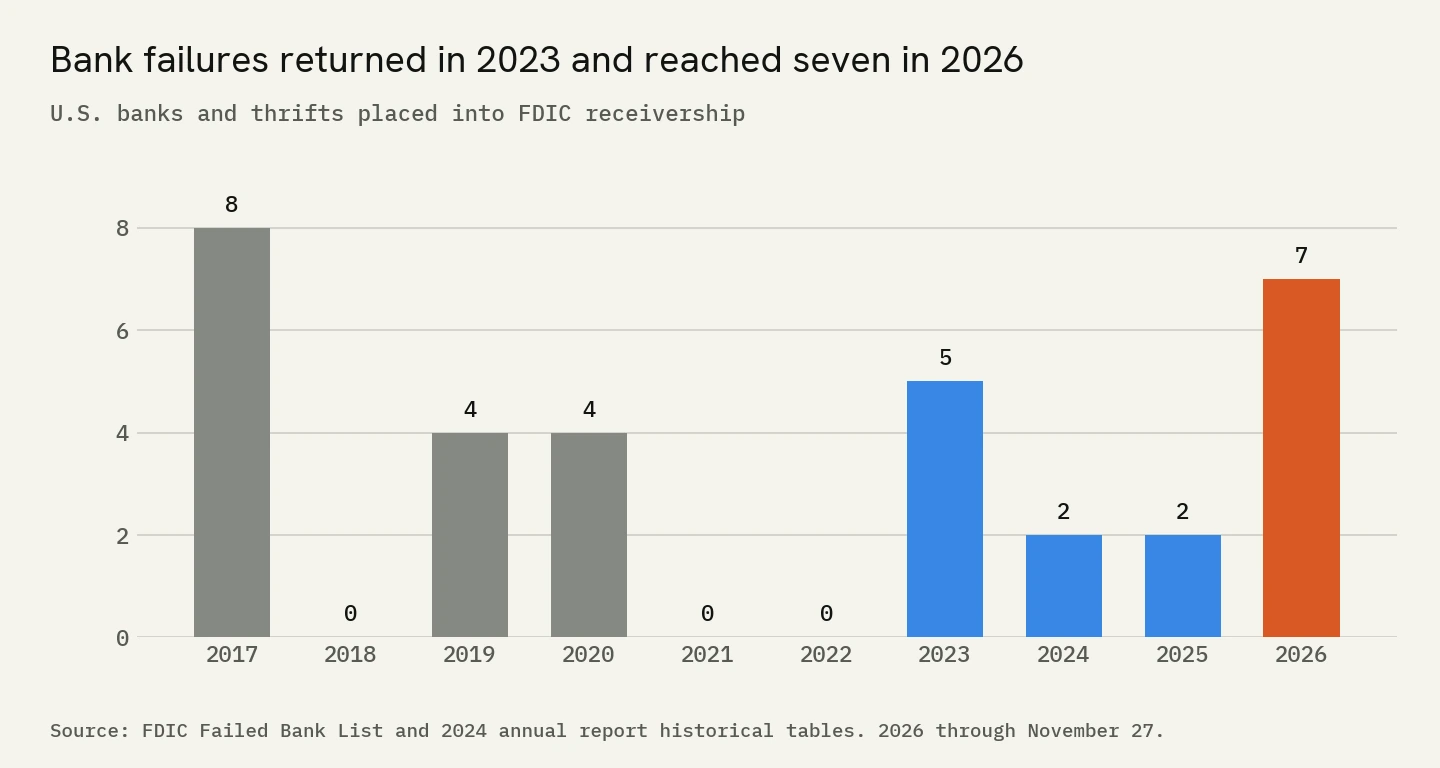
At Silicon Valley Bank, long-dated securities lost value as rates rose, and a concentrated base of mostly uninsured depositors could move faster than the bank could raise cash. Customers withdrew $42 billion on March 9, 2023, in one day. The government invoked a systemic risk exception for SVB and Signature, and First Citizens later took over SVB’s bridge bank loans and deposits. First Republic also suffered a run, with a large portfolio of low-yielding loans harder to fund once deposits left. Fed review of SVB · Fed account of March 9 withdrawals · Joint systemic-risk statement · FDIC review of First Republic
The cases since then have had different triggers. The FDIC attributed both 2025 failures to suspected fraud. The inspector general traced Community Bank & Trust–West Georgia’s 2026 failure to aggressive growth and deteriorating asset quality that depleted its capital. Its Metropolitan Capital review likewise identified concentrated high-risk lending and insufficient reserves for troubled assets. I read those reviews alongside 2023 because they show two ways the same balance sheet can get squeezed. Funding can become harder to replace, or the assets backing it can stop generating the cash the bank expected. Either can narrow a lender’s room to keep extending credit. FDIC 2025 annual report · West Georgia material loss review · Metropolitan Capital failed-bank review
Explore U.S. bank failures since 2023
Early FDIC cost estimates. Balance dates vary by bank. FDIC Failed Bank List
The credit pressure looks different depending on the bank
The FDIC’s third-quarter report gives the counterweight. Across 4,205 insured institutions, domestic deposits rose 0.9% from the previous quarter, their ninth consecutive increase, and loans rose 7.5% from a year earlier. The Fed also found that uninsured deposits as a share of bank assets remained considerably below their 2022 levels. Those are meaningful improvements in the system’s ability to fund itself. FDIC third-quarter banking profile · Fed November 2026 Financial Stability Report
Rates can still expose the gap between the value of a bank’s assets on paper and the cash it could raise by selling them. The FDIC put industry unrealized securities losses at $486 billion in the third quarter, up from $326.7 billion in the second and below the 2023 peak. On the credit side, banks under $1 billion in assets reported a 1.38% past-due and nonaccrual rate on non-owner-occupied, nonfarm nonresidential property loans. That was down from 1.53% in the first quarter of 2026 and still more than twice 0.61% at the end of 2022. At banks above $250 billion, the same measure fell from 4.99% in the third quarter of 2024 to 2.78% in the third quarter of 2026. FDIC third-quarter banking profile, charts 7 and 10
For banks with $1 billion to $10 billion in assets, United Fidelity’s size bracket, the rate climbed from 0.40% at the end of 2022 to 1.12% in the third quarter of 2026. That group rate describes the backdrop for lenders of its size. Determining what went wrong at United Fidelity requires the bank’s own record. FDIC third-quarter banking profile, chart 10
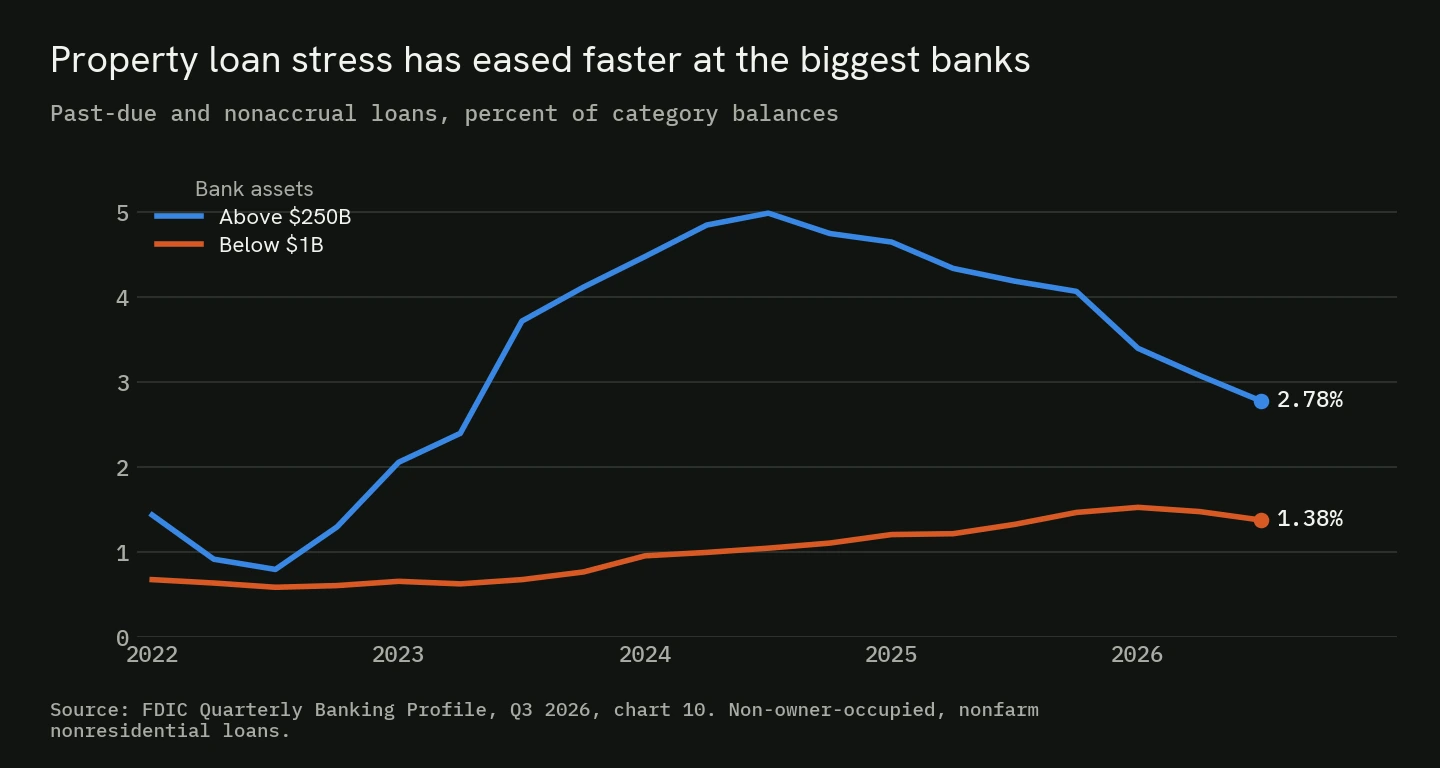

That is the part I would watch. A higher rate on renewal can raise a borrower’s payment at the same time a weaker property valuation reduces what the bank is willing to lend. A borrower can still be current on the old loan and have a problem refinancing it. If that repeats across lenders with similar exposures, credit can get tighter in a region even while the national loan book grows. I covered the changes in bank underwriting in my October lending survey piece. The Credit Market Is Sending a Warning Beneath the Economic Headlines
The Fed surveys show how the pressure reaches borrowers
In the St. Louis Fed’s November survey, Eighth District bankers went from net +11 reporting stronger loan demand in August to net −30 in November. In August they had expected November to stay at +11. The November readings also showed net +13 for tighter standards and +28 for rising delinquencies. Each figure is a balance of responses relative to a year earlier. It tells us how common the change was among respondents. St. Louis Fed Economic Conditions Survey results · My analysis of the 41-point swing
Looking to the next quarter, a net 7% expected weaker loan demand than a year earlier, a net 13% expected tighter credit standards, and a net 25% expected higher delinquencies. The demand figures suggest bankers expected the weakness to become less widespread by the next survey. St. Louis Fed Economic Conditions Survey results
Nationally, the Fed’s October survey showed a turn from easing to tightening in all three commercial real estate loan categories. Construction and land development moved from net 3.7% easing in July to 15.5% tightening in October. Banks also reported tighter standards on every surveyed category of nonbank financial borrower. The November 25 Beige Book described a smaller softening in overall loan demand in the Eighth District, driven by mortgages and auto lending, with modest tightening and some pockets of weaker asset quality. The two regional reports use different questions and time windows. Both point to more selectivity on the next loan. Fed October lending survey · November Beige Book, Eighth District · Ethos Credit Conditions
I’m watching what tighter standards do to investment. If a bank asks for more collateral or offers a smaller credit line, a business can scale back an expansion or put it off. The loan application may never show up even though the business still has a reason to invest.
Explore property credit and regional lending conditions
I’m looking for these signals to move together now. If loan standards keep tightening while more loans go past due and banks have to lean harder on expensive funding, the next round of refinancing becomes harder even for borrowers that have kept up with payments. If those measures improve while deposits and lending keep growing, I’d put less weight on the increase in failures. Friday’s closure tells us how expensive the weakness at one bank became. The lending and funding data will tell us how far it travels. Ethos on bank credit and M2 velocity
The forthcoming rate decision also depends on what is happening to credit outside any one bank. See The Fed Risks Tightening Into a Slowdown.
Frequently asked questions
How many U.S. banks have failed since March 2023?
Sixteen institutions entered FDIC receivership between March 10, 2023, and November 27, 2026. Seven of those closed in 2026. FDIC failed-bank list
What did First Citizens take over?
First Citizens agreed to purchase substantially all United Fidelity assets and assume most deposits. Its preliminary figures include $3.1 billion in loans and $4.5 billion in deposits. Certain brokered deposits and other accounts were excluded. First Citizens transaction terms
What does the $1.83 billion measure?
It is the FDIC’s initial estimate of the cost of resolving United Fidelity to the Deposit Insurance Fund. The estimate can change as the receivership settles claims and recovers money from assets. FDIC resolution notice · FDIC BankFind methodology
How we checked the numbers
The failure universe is U.S. banks and thrifts placed into FDIC receivership. Balance sheet figures come from the reporting date specified in each closure record or annual report. The explorer shows that date and the cost estimate’s basis. The $2.07 billion 2026 total adds seven initial FDIC estimates, using millions of U.S. dollars. The 2.7-times comparison uses the two published initial cost estimates. Annual report totals may use standardized Call Report balances or revised costs. The commercial real estate figures come from chart 10 of the FDIC’s November 24 banking profile, and the regional series comes from the St. Louis Fed’s November 17 workbook. Information available on November 28, 2026.
Sources
- OCC: United Fidelity Bank receiver appointment, November 27, 2026.
- FDIC: United Fidelity resolution and First Citizens: Transaction terms, November 27, 2026.
- FDIC: Failed Bank List and BankFind Suite methodology, accessed November 28, 2026.
- FDIC: Quarterly Banking Profile, third quarter 2026, November 24, 2026.
- Federal Reserve: November Financial Stability Report, November 13, 2026.
- St. Louis Fed: Economic Conditions Survey and results workbook, November 17, 2026.
- Federal Reserve: October lending survey, November 2, 2026, and November Beige Book, November 25, 2026.
Related on Ethos Research
- St. Louis Fed Bankers Expected Loan Demand to Grow. It Fell 41 Points Instead
- The Credit Market Is Sending a Warning Beneath the Economic Headlines
- M2 Velocity Has Turned Lower as Credit Weakens
- Credit Conditions data explorer
Commentary, not investment advice.