
Este artículo solo está disponible en inglés.
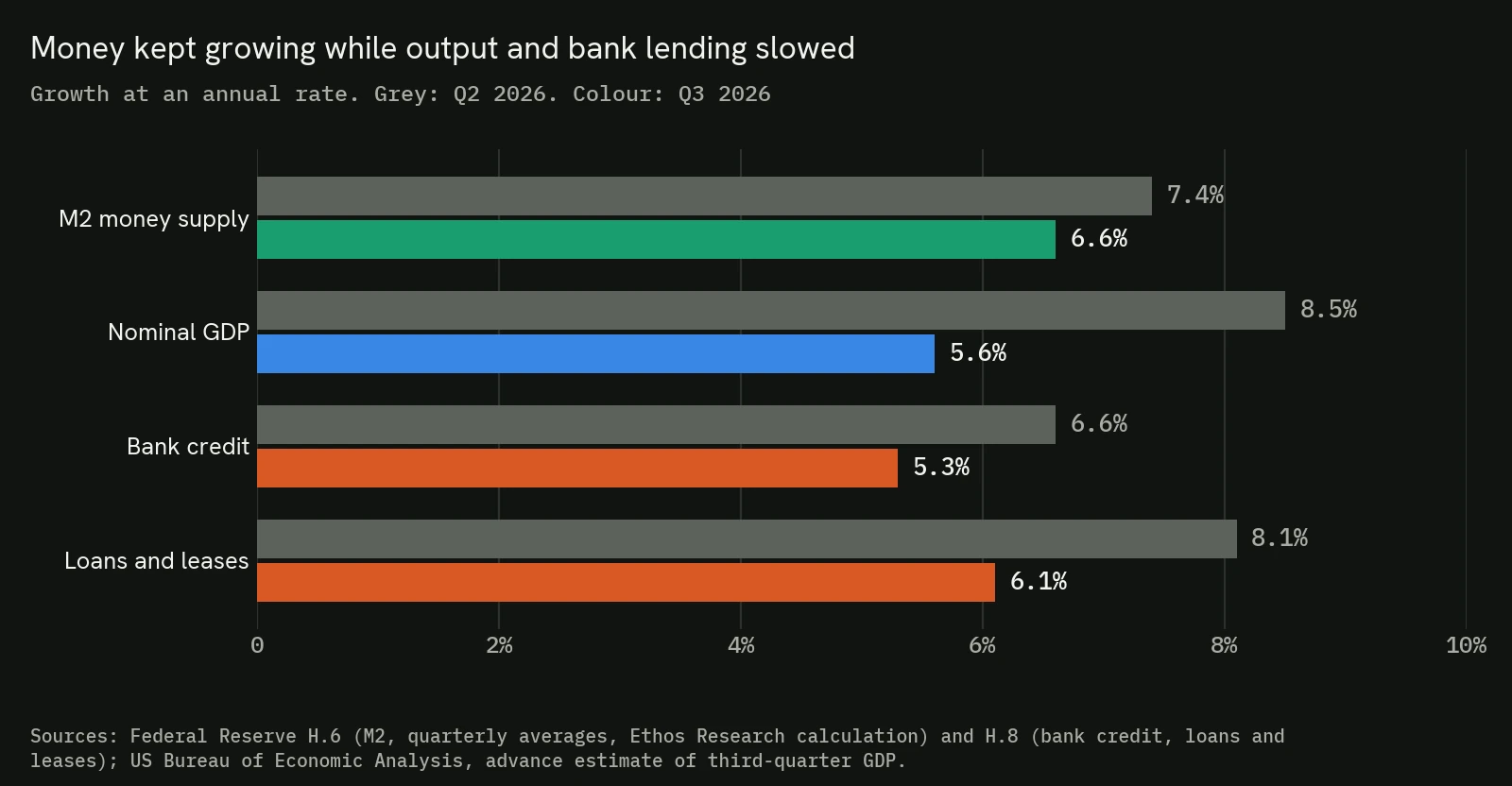
This is exactly the disconnect I’ve been warning about with M2 velocity. Q3 velocity declined from 1.420 to 1.417 after years of recovery, as M2 expanded 6.6% annualized against just 5.6% nominal GDP growth. That decline alone doesn’t establish a liquidity crisis, but it becomes considerably more concerning when examined alongside the deterioration unfolding throughout the credit markets.


What is the credit market showing?
The Fed’s latest lending survey revealed weakening business loan demand, tighter lending standards for small businesses, commercial real estate and nonbank financial institutions, and declining demand for capital investment. Meanwhile, bank credit growth slowed from 6.6% to 5.3% annualized, while loan and lease growth decelerated from 8.1% to 6.1%. The survey is covered in detail in The Credit Market Is Sending a Warning Beneath the Economic Headlines.
Can the money supply grow while liquidity tightens?
Combine that with rising delinquencies, mounting refinancing pressures and surging real yields, and the picture becomes increasingly troubling. The New York Fed puts 5.0% of household debt in some stage of delinquency, up 0.3 percentage points in a single quarter. The 10-year real Treasury yield closed at 2.91% on 13 November, up from 2.60% two weeks earlier.
Money supply can continue expanding while credit availability and market liquidity deteriorate.
Why does Bitcoin matter here?
Bitcoin is particularly important here because it behaves like a high beta liquidity asset, often reacting disproportionately to changes in risk appetite, financing conditions and speculative capital flows.
Unlike traditional economic indicators, which are reported with considerable delays, Bitcoin trades continuously and is highly sensitive to leveraged positioning, margin calls and forced liquidations. That makes its deterioration a potential early warning of tightening speculative liquidity, although not definitive proof of a broader credit crunch.
That deterioration is visible now. Bitcoin fell to about $62,000 on 15 November, its lowest level in at least three months and nearly 15% lower in a week, while about $1.96 billion of leveraged crypto positions were liquidated in 24 hours.
What is the real danger?
If M2 velocity continues rolling over while credit growth weakens and the Fed remains restrictive, the real danger is that financial deleveraging eventually spreads into business investment, hiring freezes, layoffs and a much broader contraction in economic demand.
Frequently asked questions
What is M2 velocity?
It is nominal GDP divided by the average M2 money stock: how many times a dollar of money supply is spent on final goods and services in a year. It falls when money grows faster than nominal output.
Does falling M2 velocity mean a recession is coming?
Not by itself. The third-quarter decline was 0.21%, smaller than the revision to the previous quarter, and velocity has fallen during past expansions. It matters when it falls together with weaker credit, hiring and demand.
Is Bitcoin a reliable indicator of liquidity?
It is a fast one, not a definitive one. Bitcoin trades continuously and is heavily leveraged, so it reacts quickly to tighter financing and lower risk appetite. It also falls for reasons of its own, such as outflows from exchange-traded funds.
How we checked the numbers
The M2, nominal GDP, lending survey and bank credit figures are the ones checked at source for our credit market article: the Fed’s H.6 and H.8 releases, the October 2026 Senior Loan Officer Opinion Survey and the BEA advance estimate of third-quarter GDP. The delinquency share comes from the New York Fed’s household debt report of 10 November. Real yields are the US Treasury’s daily par real yield curve rates. The Bitcoin figures come from market reports, which differ slightly: Bloomberg calls the low a four-month low, other outlets a three-month low, and liquidation totals depend on the tracker and the time window.
The velocity levels (1.420 and 1.417) are the author’s reading of the FRED series M2V, which we could not download at the time of checking. The size of the decline is consistent with the published growth rates of M2 and nominal GDP.
- Green: checked against the original source.
- Orange: reported by the outlets listed below.
- Grey: taken from a secondary reading of the data, not rechecked at source.
- Blue: the author’s interpretation.
Sources
- Federal Reserve Bank of St. Louis, FRED: Velocity of M2 Money Stock (M2V)
- Federal Reserve Board, October 2026 Senior Loan Officer Opinion Survey on Bank Lending Practices, 2 November 2026
- Federal Reserve Board, H.8 Assets and Liabilities of Commercial Banks in the United States
- Federal Reserve Board, H.6 Money Stock Measures
- US Bureau of Economic Analysis, GDP advance estimate, third quarter 2026, 29 October 2026
- Federal Reserve Bank of New York: Household Debt Increased Moderately; Delinquency Transition Rates Remain Flat, 10 November 2026
- US Department of the Treasury, Daily Treasury Par Real Yield Curve Rates
- Bloomberg: Bitcoin Tumbles to Four-Month Low as Liquidations Accelerate, 14 November 2026
- crypto.news: Bitcoin price falls to three-month low, 15 November 2026
- TokenPost: Bitcoin Drops Below $63,000 as Liquidations Reach $1.96 Billion, 15 November 2026
Related on Ethos Research
- St. Louis Fed Bankers Expected Loan Demand to Grow. It Fell 41 Points Instead
- Premarket Turmoil Suggests the AI Selloff Is Becoming a Macro Problem
- Velocity May Be Signaling the Beginning of a Much Bigger Economic Rollover
- The Credit Market Is Sending a Warning Beneath the Economic Headlines
- The 10-Year Treasury Hits 5% as Inflation Forces the Fed Toward a Dangerous Policy Mistake
Commentary, not investment advice.