
Este artículo solo está disponible en inglés.
We are more reachable than ever. But not always more connected.
That is the first line of the Bonded Studio manifesto, and it is the whole problem in two sentences. We can send a message in seconds and match in minutes. Still, something stays hungry: for eye contact, for better questions, for the courage to begin.
Bonded Studio exists for that hunger. This is the story of what it is, who built it, and why a question game is our answer to an industry that taught people to swipe and never taught them what to say next.
A disclosure before anything else. Ethos Research is written by Akis Saramantos, one of the two founders. So this is not a neutral review. It is an invitation, and the facts in it are marked so you can tell them from the opinion.
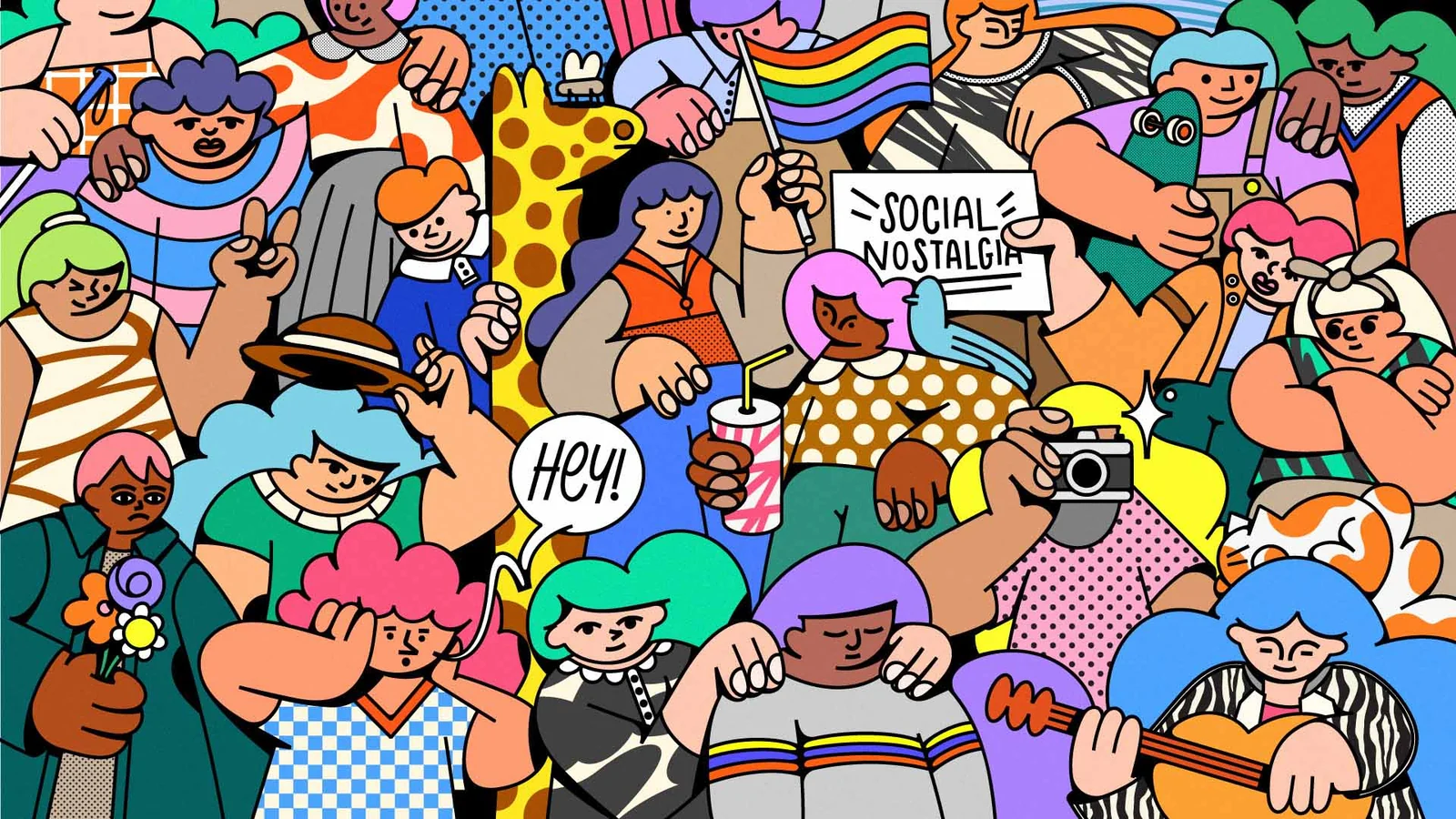
What is Bonded Studio?
Bonded Studio is a studio for human connection. It makes games, apps, objects and experiences that give two people a better reason to turn toward each other.
The forms differ. The purpose does not. There is the Bonded app, a question game for a phone or a browser. There are question decks and printed things that work at a table with no screen at all. There are films, comics and characters, and installations where movement, touch, light and sound turn an audience into participants.
One thing it is not. Bonded is not therapy and not a treatment for loneliness, and the studio says so in plain words. It designs playful, consent-aware rituals that may make connection easier to begin. Not guaranteed. Invited.
Who is behind Bonded?
Two founders from Thessaloniki, one from art and one from markets. They started Bonded Studio together.
Steve Zafeiriou
Steve Zafeiriou (born 1998, Thessaloniki) is a new media artist and technologist, and the founder of Sapphire Labs, the company that powers Bonded. He builds with generative algorithms, electronic circuits and interactive installations, and his work asks how technology shapes the way people see the world and each other.
His installations have been shown at the MOMus Museum of Contemporary Art in Thessaloniki and at the British Art Fair at the Saatchi Gallery in London, and in 2025 he received the Tezos Blockchain Developer Award.
Bonded began in his studio, as art. Nostalgie World was a personal project about mental health, identity, memory and belonging. In his own telling, he started making art about disconnection because he was living it. For years the work was interactive, things you had to touch before anything happened, and every time what mattered was not the system. It was what happened between the people standing in front of it.
Art could expose that. It could not fix it.
Steve Zafeiriou, co-founder of Bonded Studio
So he stopped describing the problem and started building for it. Bonded Studio is what he and Akis Saramantos founded together to do that.
Where to find Steve:
- Website: stevezafeiriou.com, with his biography and exhibitions
- Instagram: @stevezafeiriou
- LinkedIn: Steve Zafeiriou
- X: @rainboydoteth
- GitHub: stevezafeiriou
- YouTube: his channel
Akis Saramantos
Akis Saramantos co-founded Bonded Studio with Steve and leads its commercial side: the business and product plan, the behavioural models, the market research, the positioning, and the partnerships. He studied how people think and behave, works in trading technology, and writes the research on this site. He is from Thessaloniki and lives in Limassol.
The two halves of his work meet in one question: why two people at the same table are both looking at their phones. His answer to where that comes from is the note Loneliness Was Never a Glitch. It Was the Matrix. You can find him on LinkedIn, Instagram and X.
Why is the dating app market broken?
Because it sells the search, and the search is what people are tired of.
Look at the numbers. Dating app downloads rose about 22% in 2025, to 1.1 billion, while spending in the app stores rose 4.8%. People keep trying. They do not keep paying. The three listed dating groups, Match Group, Bumble and Grindr, made $4.89 billion in 2025, exactly what they made the year before. The full series is in our dating app market data.
Tinder has lost 2 million paying users in three years, and has held its revenue by charging the ones who stay more, $17.63 a month by the end of 2025. Bumble agreed in October 2026 to be sold at a price 86% below its 2021 listing, a story told in Bumble the Bubble and the Dating App Fatigue. The one large app still adding payers, Hinge, sells itself as the app designed to be deleted.
The business model explains the fatigue. A dating app is paid while you are looking. The day you find someone, you stop being a customer. A product built that way can be very good at matches and has little reason to care about what happens after one.
One App Store review of Bonded says it in a line: «I’m 30 and honestly, I’m so tired of dating!!!» The same reviewer used the app on a first date and loved it.
That is the gap we work in. A match is contact. It is not closeness. Bonded starts where the dating apps stop: with two people who have already chosen to spend time together, and with the people already in your life. No swiping, no matching, no public profile.
Why do people need to be in the same room?
Because closeness is a physical thing before it is anything else.
Touch runs on its own biology: specialised receptors in the skin that respond to pressure, movement, stretch and vibration. A review of social touch in human-computer interaction calls touch our primary non-verbal channel for intimate emotions, and essential for physical and emotional wellbeing. The same review is clear about the limits of doing it through a device. Technology can carry a few tactile cues. It reproduces only a small part of direct touch and is not its emotional equivalent.
The stakes are not small. A meta-analysis of 148 studies and 308,849 people found that those with stronger social relationships had 50% higher odds of survival over the study periods. That is an association across populations, not a promise about any app. It does say that the hours people spend near each other are not a luxury.
And presence does work that messages cannot. In experiments, people who simply paid attention to the same thing at the same time felt more bonded afterwards. Sharing a moment needs a shared place, even a small one.
So we will say the obvious thing that the industry rarely says. People need to be touched, looked at and listened to by other people. It is a necessity, not a feature, and no notification delivers it. Bonded’s own line is blunter: a phone vibration is not human touch, and a wearable pulse should never be marketed as a replacement for it.
That belief sets the design rule. The screen sets up the moment, then gets out of the way. Screen time is not the win. You read the question, you answer or pass, and then you put the phone down and talk to the person in front of you. The longer argument, with the studies, is in The Science of Human Connection: Why Bonded Is Built Differently, and the note Not Every Advance Is Progress asks the same of technology in general.
How does the Bonded app work?
Start together. It takes a minute.
- Choose a deck. Pick the mood and how deep you want to go.
- Invite someone. Send a link, show a QR code or read out six characters.
- Play live. You both see the same prompt at the same time. Then follow the conversation.
Because both screens show the same question, neither of you has to lead. And you can skip any question without giving a reason. Passing is part of the game.
Only the host needs the app. Guests join free from a browser, two of you or a table of up to six.
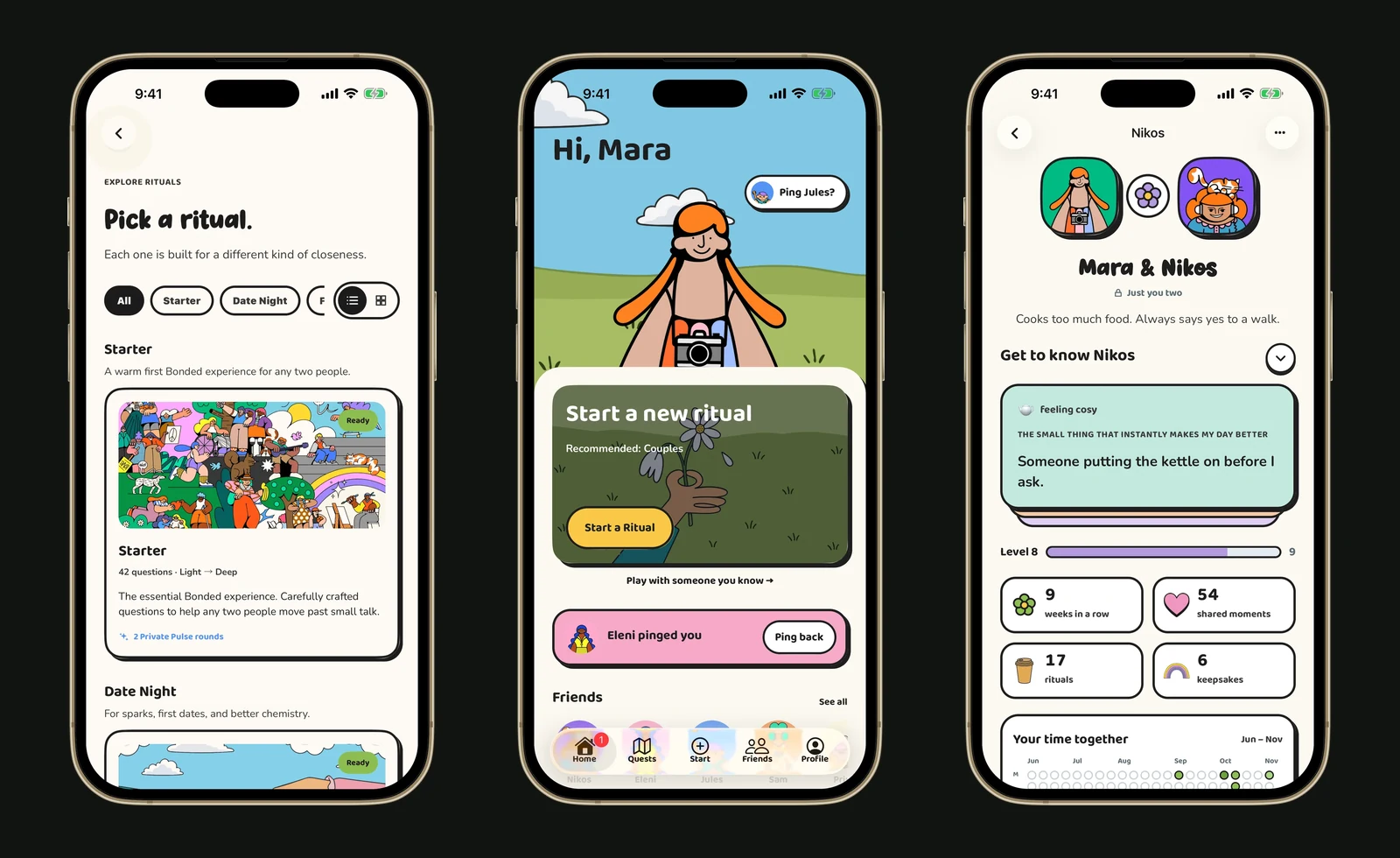
There are eleven decks, from Starter and Date Night to Couples, Friends, Family, Colleagues and 36 Questions, in English and Greek, with a new one planned every month.
Around the questions, a few quiet things:
- An avatar, not a photo. You are recognised by a character you build. Bonded never asks for a picture of your face.
- Private Pulse. Two players each give a private signal from 0 to 100, revealed only if both choose to share it.
- Bonds and keepsakes. Every ritual you finish with someone grows your bond with them. Play once a week to keep your run going. Nobody else sees it, and it counts rituals and shared moments, never what anyone said.
- Memory Capsules. Keep the moments you both recognised as worth carrying. Not a transcript.
On privacy the studio is plain: it does not sell personal data, nothing a player writes is used to train an AI system, and deleting an account is a real deletion. The app is for adults aged 18 and over.
What are Side Quests?
Date ideas you’ll actually do.
A question can open a conversation. A Side Quest moves it out of the house. Side Quests are small real-world things to do together, picked from what the two of you talk about in Bonded. They are the newest part of the app, and the part that follows most directly from the section above: the point of the screen is to get you off it.


They work in four ways:
- Quest right now. Together already? You both see the same quest on your phones. Always free.
- Swipe to match. Eight quests a round. Only the ones you both said yes to show up, so nobody has to be the one who suggested it.
- Pick a day. Suggest up to three times, add it to your calendar, and Bonded can remind you both.
- It grows your bond. A finished quest counts like a ritual and can find you a keepsake.
The quests themselves are small on purpose. Letter Picnic: pick a random letter, shop for a picnic where everything starts with it, eat it outside. Best find takes the last bite. Sixty minutes, low cost.
And the other person does not need the app. Send a quest, or just a date, to anyone with a link. They open it like a letter and answer in their browser. Free accounts get three requests a month, and Premium makes them unlimited.
Where can you download Bonded?
On iPhone, Bonded has been in the App Store since 22 September 2026. It is live in Greece, Cyprus, Ireland, the United Kingdom, Spain and Portugal, and needs iOS 15.1 or later. The rest of the European Union and the United States are next.
The app is free to download, and the Starter plan has no time limit. Premium costs €59.99 for twelve months for one account, and the pricing page has plans for partners and families. One payment. Nothing renews.
Download Bonded on the App Store
How do you join the Android testers on Google Play?
This is where we need you most. Bonded is in closed testing on Google Play, and Google asks new apps to be used by a group of real testers for 14 days before it allows a public release. Every tester who stays for those 14 days brings the Android launch closer.
Three steps, on any phone with Android 7.0 or later:
- Join the Bonded Android testers group on Google Groups, with the Google account you use on your phone.
- Open the tester link on Google Play and choose to become a tester.
- Install the app from its Google Play listing and keep it installed for 14 days in a row.
The app does not appear in Play Store search during testing, so these links are the only way in. The full instructions are on the Android early access page.
What did the Bonded survey find, and how do you take part?
Around the launch, the studio asked people how they talk to each other. Between August and September 2026, 258 people answered.
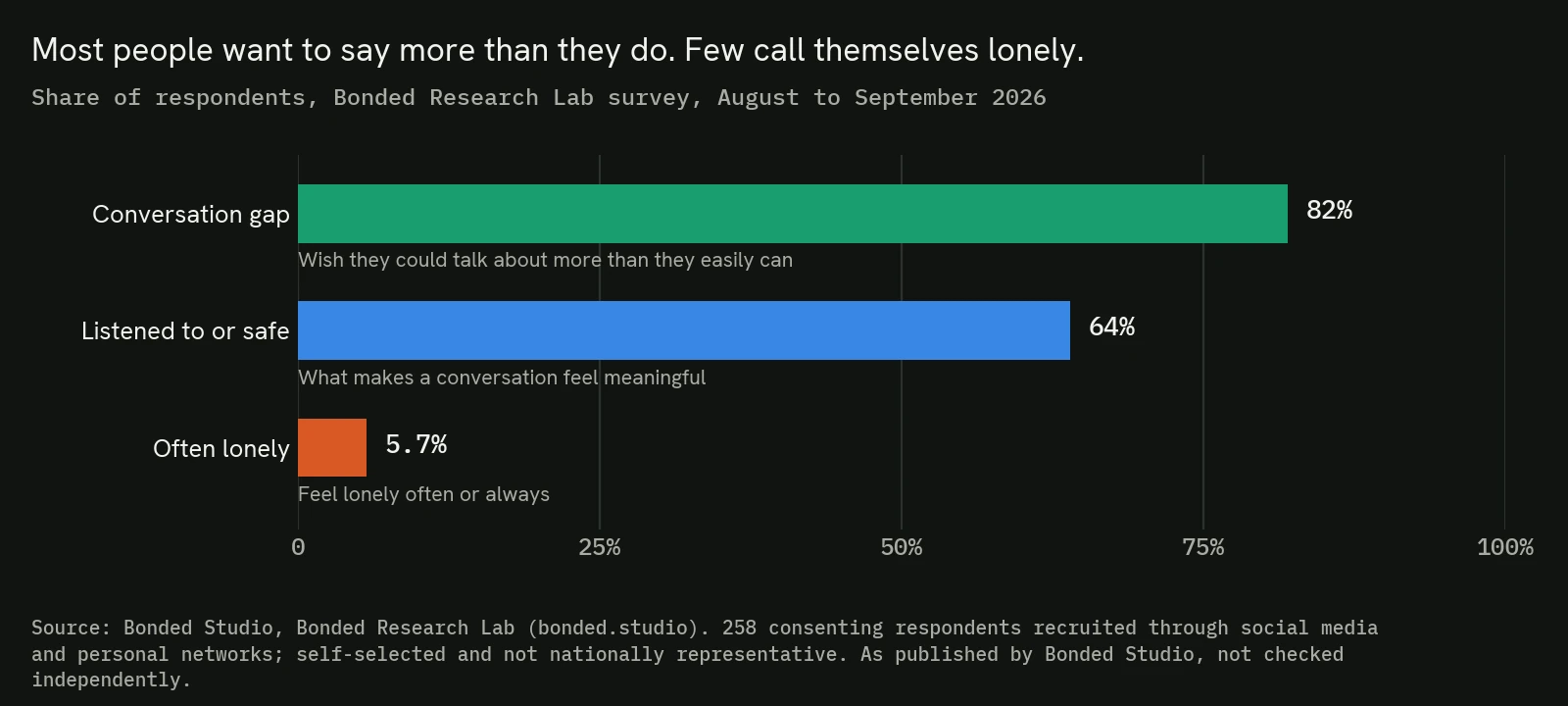
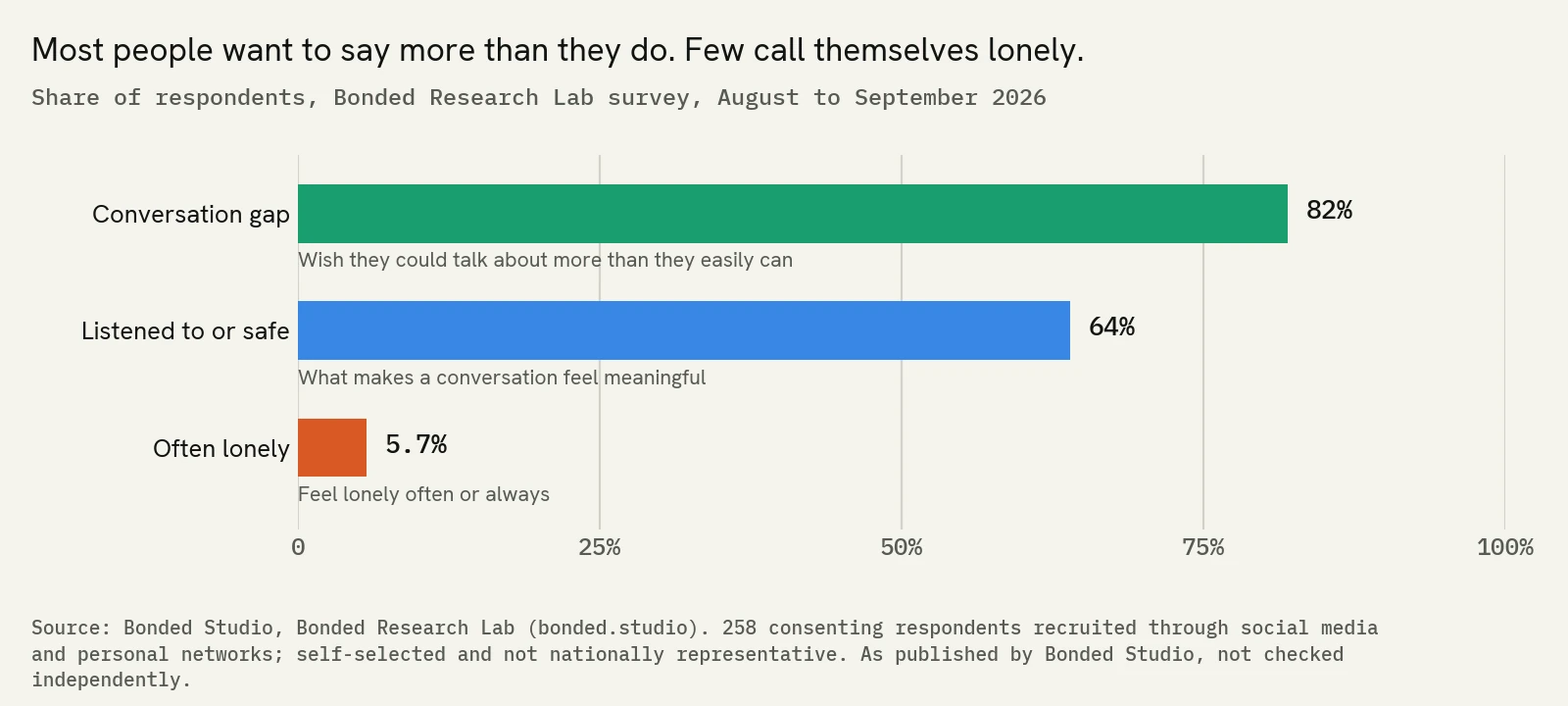
- 82% reported a gap between what they can easily talk about and what they wish they could talk about.
- 64% said a conversation feels meaningful when they feel listened to or safe.
- 5.7% said they feel lonely often or always.
Read the three together. Most of the people who answered were not lonely, and most of them still held things back. The problem is wider than loneliness. Talking is not always the same as connecting. The sample chose itself, through social media and personal networks, so it does not stand for any country’s population.
The studio still invites answers on its site, and each one makes the next round of results more useful. It never publishes a result from fewer than five people.
What is the Bonded Launch Night, and how can a brand sponsor it?
One evening, invite only, in Thessaloniki, the city where the app was born.
The Bonded Launch Night brings together 30 to 50 guests: early players, creators, founders and a few friends from the press. Guests do not pay. The date and the venue are sent privately with each printed invitation.
The space becomes an art installation made for the night. You arrive to a welcome drink and a portrait. The founders launch the app. Then Bonded is played live, with music, food and drinks, and the party stays late. Each guest leaves with a Launch Box: a limited-edition T-shirt, a mini book and a printed Premium Pass.
The night is made possible by its partners. There are three ways for a brand to be in the room.


| Package | Price | Places | What the brand gets |
|---|---|---|---|
| Supporter | €150 | Up to 8 | Group mention on social media, a place on the partner signage and a basic results report |
| Partner | €500 | Up to 5 | A partner feature on social media, a product in the Launch Box, two edited photos and a results report |
| Launch Partner | From €1,000 | Up to 3 | Exclusivity in one category, an activation built into the programme, premium placement in the Launch Box, four edited photos and a short video |
Prices exclude VAT where it applies. Launch Partner categories include wine, cocktails, beer, coffee, food, desserts, mobility, technology, venue, print and beauty, with one brand in each, first come, first served. Partners can take part in cash, in kind or both, and we reply within two working days.
The audience is small and specific. The studio counts more than 565,000 TikTok views across 139 videos since January 2026, and guests who are mostly between 24 and 35. For a local brand the offer is a room full of people who came to talk to each other. That is rarer than reach.
Four ways to take part
Bonded Studio is not here to make people scroll longer. It is here to help people come closer. Here is how to help.
- Play it. Download Bonded on the App Store.
- Test it. Join the Google testers group, then become a tester on Google Play.
- Shape it. Take the Bonded survey.
- Back it. Sponsor the Bonded Launch Night or request an invite.
From contact to closeness.
Frequently asked questions
Who founded Bonded Studio?
Bonded Studio was co-founded by Steve Zafeiriou, a new media artist and technologist, and Akis Saramantos, who leads the commercial side. The studio is based in Thessaloniki, Greece, and grew out of Zafeiriou’s art project Nostalgie World.
Is Bonded a dating app?
No. Bonded has no swiping, no matching and no public profiles. It starts with people who have already chosen to spend time together: couples, dates, friends and family.
What are Side Quests in Bonded?
Side Quests are small real-world things to do together, picked from what two people talk about in Bonded. You can do one right away, or match on one, pick a day and invite anyone with a link. Free accounts get three requests a month.
Is Bonded free?
The app is free to download and has a free Starter plan with no time limit. Guests join a game free from a browser, and only the host needs the app. Premium costs €59.99 for twelve months for one account.
Is Bonded available on Android?
Not publicly yet. Bonded is in closed testing on Google Play. You can install it today by joining the Google testers group and opting in through the tester link, on Android 7.0 or later.
How many people can play Bonded?
Two to six. A game can be played by a couple or by a table of up to six people.
When and where is the Bonded Launch Night?
It takes place in Thessaloniki, Greece. It is invite only, and the date and venue are sent privately with each invitation. Brands can take part through one of three partner packages, from €150.
How we checked the numbers
The author is a co-founder of Bonded Studio, so read this as the studio speaking. Orange marks facts as stated by Bonded Studio and Steve Zafeiriou on their own pages, read on 15 November 2026 and not checked independently; the survey sample is self-selected. Green marks figures from published studies and from company filings, the latter through our own dating market pages. Grey marks a study’s own summary of its field. Blue marks opinion. Prices, countries and places can change, so the linked pages are the reference.
Sources
- Bonded Studio: home page and Bonded Research Lab results
- Bonded Studio: the Bonded app and Side Quests
- Bonded Studio: manifesto, about and our story
- Bonded Studio: the science of connection
- Bonded Studio: Android early access
- Bonded Studio: Bonded Launch Night and partner page
- Bonded Studio: press kit and privacy policy
- Steve Zafeiriou: biography, exhibitions and awards
- Holt-Lunstad, J., Smith, T. B., & Layton, J. B. (2010). Social relationships and mortality risk: A meta-analytic review. PLOS Medicine, 7(7), e1000316. doi.org/10.1371/journal.pmed.1000316
- Roudaut, Y., and others (2012). Touch sense: Functional organization and molecular determinants of mechanosensitive receptors. Channels, 6(4), 234–245. doi.org/10.4161/chan.22213
- van Erp, J. B. F., & Toet, A. (2015). Social touch in human–computer interaction. Frontiers in Digital Humanities, 2, 2. doi.org/10.3389/fdigh.2015.00002
- Wolf, W., Launay, J., & Dunbar, R. I. M. (2016). Joint attention, shared goals, and social bonding. British Journal of Psychology, 107(2), 322–337. doi.org/10.1111/bjop.12144