Reaching someone has never been easier. Feeling close to them has not become easier at the same rate. A notification tells you that someone reacted, a match tells you that two profiles approved of each other, and a feed can hold two people’s attention for hours. None of it can produce the moment that matters: one person says something true, the other stays with it, and the conversation changes.
This article sets out the research Bonded Studio draws on, how that research shapes the design of the Bonded app, and where the evidence runs out. It is a design essay built on published studies. It is not a systematic review or a clinical evaluation, and Bonded has not shown therapeutic outcomes.
Connected, but not close
You can know what someone ate, watched, bought and reposted today without knowing the question they are afraid to ask you. Digital systems made contact cheap and constant. The conditions that closeness depends on (time, attention, trust, reciprocity and presence) did not get cheaper.
That is why “is technology good or bad for connection?” is the wrong question. Technology is the room people meet in: the lighting, the invitation, and sometimes the interruption. What it does to a relationship depends on what it asks people to do.
A 2025 study of 1,632 young adults in the UK, followed since childhood, makes the point. Total time online was linked to more loneliness, but use of the big social platforms on its own was not. What stood out were particular experiences. People who used technology compulsively, or who had been victimised online, were lonelier on average. Use of Reddit and dating apps went with more loneliness, and use of WhatsApp with less. The study observed people rather than testing an intervention, so it cannot say which way the effect runs.
The finding on dating apps is worth holding next to the size of that industry, covered in our dating app market data and the piece on dating app fatigue. For Bonded, the lesson is that the kind of experience matters more than the category of app. The aim is not to keep people scrolling through content about connection. It is to set up a moment between two people, then step back so the people matter more than the interface.
Connection also deserves to be taken seriously. A meta-analysis of 148 studies covering 308,849 people found that those with stronger social relationships had 50% higher odds of survival over the study periods. That is an association across populations, not proof that any game or app improves anyone’s health. It does show why the places where relationships happen are worth designing with care.
Evidence · 01 / 03
Social ties and survival
Meta-analysis of 148 studies, 308,849 people
+50%
higher odds of survival with stronger social relationships
Source: Holt-Lunstad, Smith & Layton, 2010
Evidence · 02 / 03
Online life and loneliness
UK cohort followed since childhood, mean age 26
1,632
young adults: compulsive use and online abuse, not social media itself, went with loneliness
Source: Matthews et al., 2025
Evidence · 03 / 03
Paced, reciprocal questions
36 questions in three sets of rising depth
45 min
was enough to produce more closeness than small talk between strangers
Source: Aron et al., 1997
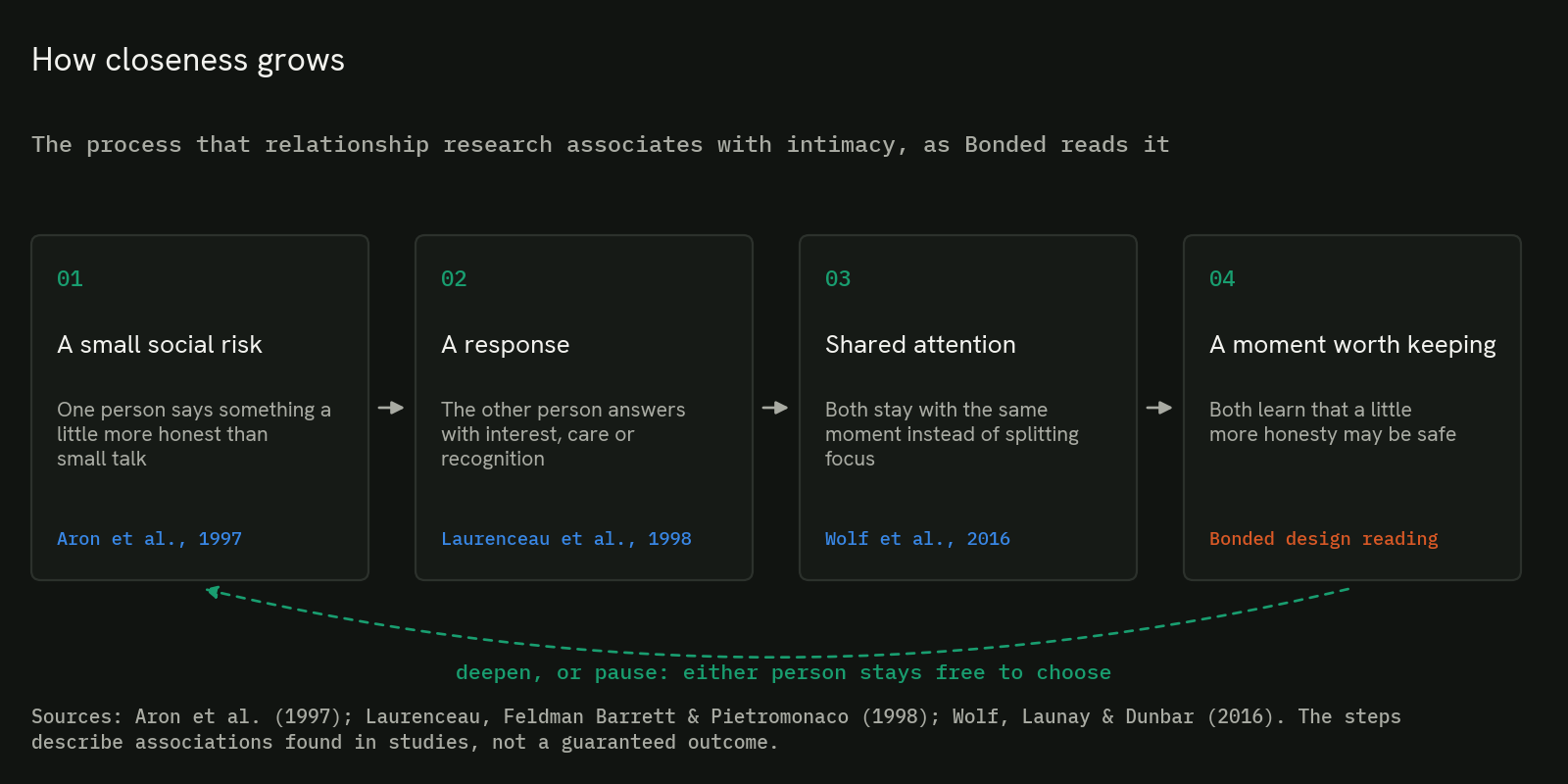
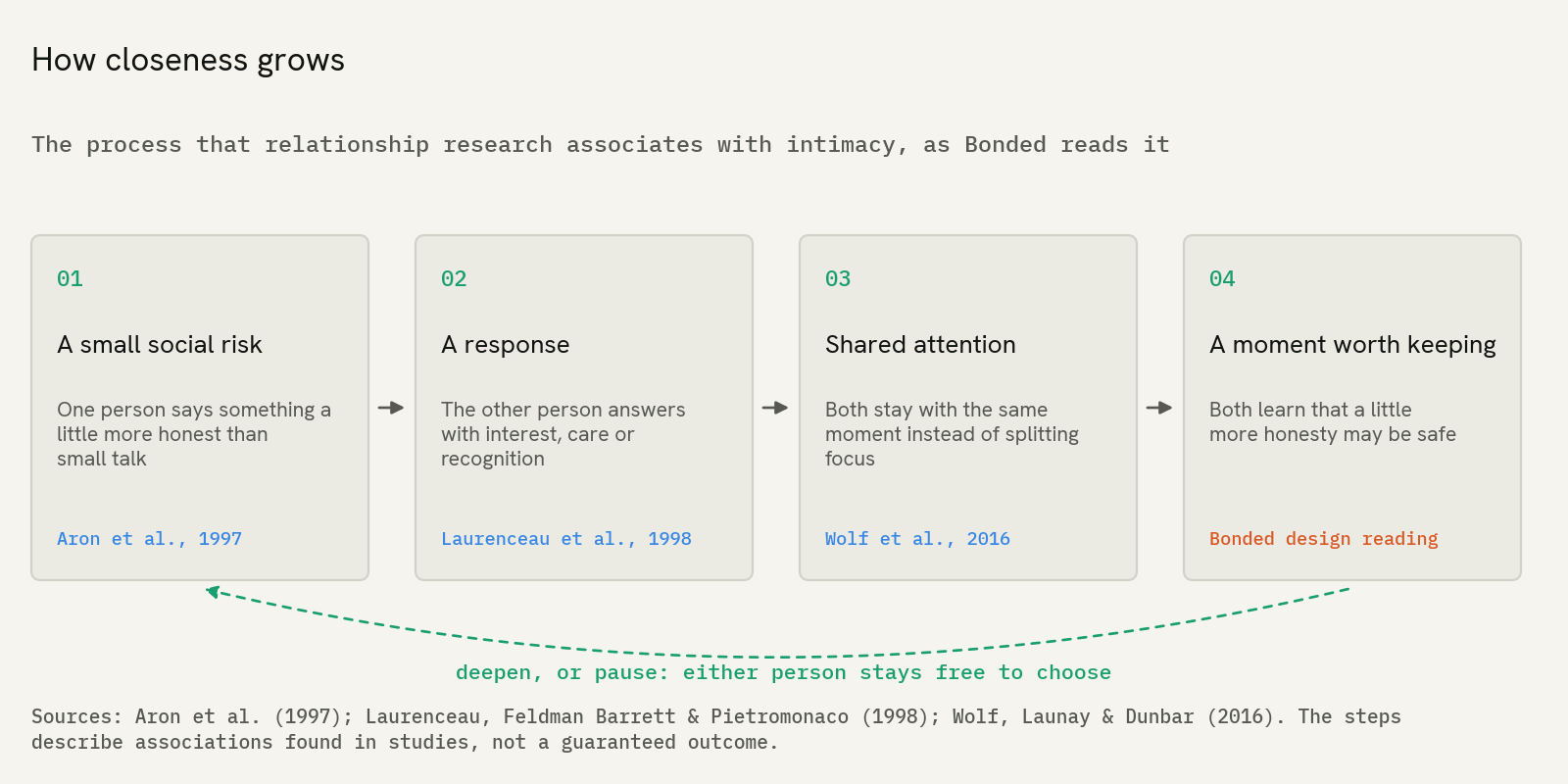
Closeness is a process
Chemistry and sparks are real experiences, but describing closeness only in those terms makes it sound like luck. Research offers a more useful picture: at least part of intimacy builds through a sequence that repeats.
- One person takes a small social risk.
- The other responds with interest, care or recognition.
- Both learn that a little more honesty may be safe.
- The conversation can go deeper or pause, and both people stay free to choose.
That sequence cannot promise friendship, love or compatibility. It can guide how a question is written, how a game is ordered, how quickly things are revealed and how someone can decline without awkwardness.
What the research says
Disclosure works best when it builds slowly
In 1997 Arthur Aron and colleagues published a procedure in which pairs of strangers worked through 36 questions in three sets over about 45 minutes, each set more personal than the last. In their first study, pairs who followed the sequence felt closer afterwards than pairs given small-talk tasks. The study is often described as “36 questions to fall in love”. It found nothing of the kind. What it showed is that disclosure can be paced on purpose, and studied.
The pacing matters as much as the questions. Asking for a private truth before someone feels settled creates pressure, not closeness. Staying on the surface keeps a conversation pleasant and forgettable. A good sequence starts easy, earns its depth and keeps both people at the same level.
That is why Bonded uses decks and depth levels rather than treating every “deep question” as interchangeable. A first date, a friendship, a long relationship and a reconnection start in different places. It is also why the Questions and Dares library is sorted by mood and situation instead of being one long list.
Reciprocity takes the weight off one person
A good conversation is not one person opening up while the other judges. When both people get the same prompt, neither has to pick the topic, interview the other or carry the emotional temperature alone. The question becomes a third thing in the room that both can approach together.
In Bonded, both people see the same guided question, both can answer and both can pass. Reciprocity does not mean matching answers word for word. One answer can be funny and the other serious, and one person may need longer. What counts is that both take part.
Responsiveness is what makes disclosure feel like being known
Saying something personal is half of intimacy. The response decides what that honesty meant. Jean-Philippe Laurenceau, Lisa Feldman Barrett and Paula Pietromonaco asked people to record their everyday conversations in diaries. Their own disclosure, and their partner’s, predicted how intimate an exchange felt, and part of that link ran through whether they felt understood, accepted and cared for. The participants were mostly US college students and the design was correlational, so it shows a pattern, not a cause.
A later study of married and cohabiting couples in the United States and Japan found that feeling your partner is responsive went with higher well-being in both countries, more strongly in the US.
For product design this shifts the question. It is not only “how do we help someone say more?” but “how do we help the other person notice what mattered?” Bonded’s Resonance Moments answer the second question. Each person can privately mark a prompt that mattered to them. When both mark the same one, the app shows it as shared. It reflects a choice both made, and it does not score the relationship.
Shared attention gives the moment edges
Attention tells someone, “for now, I am here with you.” Most apps break it apart: one person types, the other waits, a notification arrives, and the conversation competes with everything else on the phone.
In an experiment by Wolf, Launay and Dunbar, pairs who attended to the same part of a screen rated each other as closer afterwards than pairs looking at opposite sides. Giving them a shared goal had no effect on its own. That supports joint attention as one ingredient of bonding. It does not show that synchronised app screens create intimacy.
A blind-date study took a different route. Couples whose heart rate and skin conductance moved in sync were more likely to report attraction, while visible cues such as smiles, laughter and gaze did not predict it in the same way. The finding is striking, but it is an association. It is not a chemistry detector, and Bonded does not infer attraction from anyone’s body or behaviour. In Bonded, synchronised pacing is a design choice informed by this research: the app creates a shared pause and lets two people enter a question together. Timing alone says nothing about what they feel.
From research to design
Research does not hand over a finished interface. It gives findings, limits and mechanisms that still have to be translated with care. The table shows how Bonded does that today, and where each feature stops.
| Bonded feature | What it does | Basis | Where it stops |
|---|---|---|---|
| Decks and depth levels | Move from easy openers to more personal prompts | Research: progressive disclosure | A deeper answer is not automatically a healthier one |
| The same question for both | Both people answer the same guided prompt | Research: reciprocity | Matching answers do not prove compatibility |
| Passing | Either person can skip, with no reason and no penalty | Ethical principle: consent | Passing does not mean avoidance or lack of care |
| Resonance Moments | Shows when both privately marked the same prompt | Research: responsiveness | It is not a relationship score |
| Private Pulse | Each person chooses whether a private signal is shown | Ethical principle: voluntary visibility | A signal does not reveal hidden feelings |
| Synchronised sessions | Coordinates timing so both enter a question together | Design reading of shared-attention research | Timing does not measure attraction |
| Memory Capsules | Keep chosen moments, not full transcripts | Ethical principle: chosen memory | A saved moment does not quantify intimacy |
Passing protects honesty
Vulnerability without choice is exposure. Letting either person pass without explaining is an ethical decision, not a scientifically proven route to intimacy. There is no score for bravery and no penalty for holding a boundary, and the app does not assume that deeper is always better.
The same rule shapes the order of questions. A session should not jump from “what made you laugh this week?” to the worst moment of someone’s life because intensity gets a bigger reaction. Intensity and value are different things. The goal is disclosure that fits a moment both people still want to share.
Keep what you choose, not a transcript
A transcript keeps everything because a system can. Memory Capsules keep only the moments the two people chose to carry forward. That is a decision about privacy and memory. It is not evidence that a relationship improved.
Questions are the start, not the whole
Wanting a better conversation is common. Coordinating one is the hard part: who asks first, how personal is too personal, and what happens when one person wants depth and the other wants to laugh. A shared question removes some of that negotiation. Then the app should get out of the way. Bonded is not trying to be the most interesting thing in the room.
Closeness is not only built through serious disclosure. People also come closer through laughter, surprise, teasing and making something together. That is why Bonded Studio makes games for couples, date-night experiences, dares, physical products such as the Closeness Deck, media and installations alongside the app.
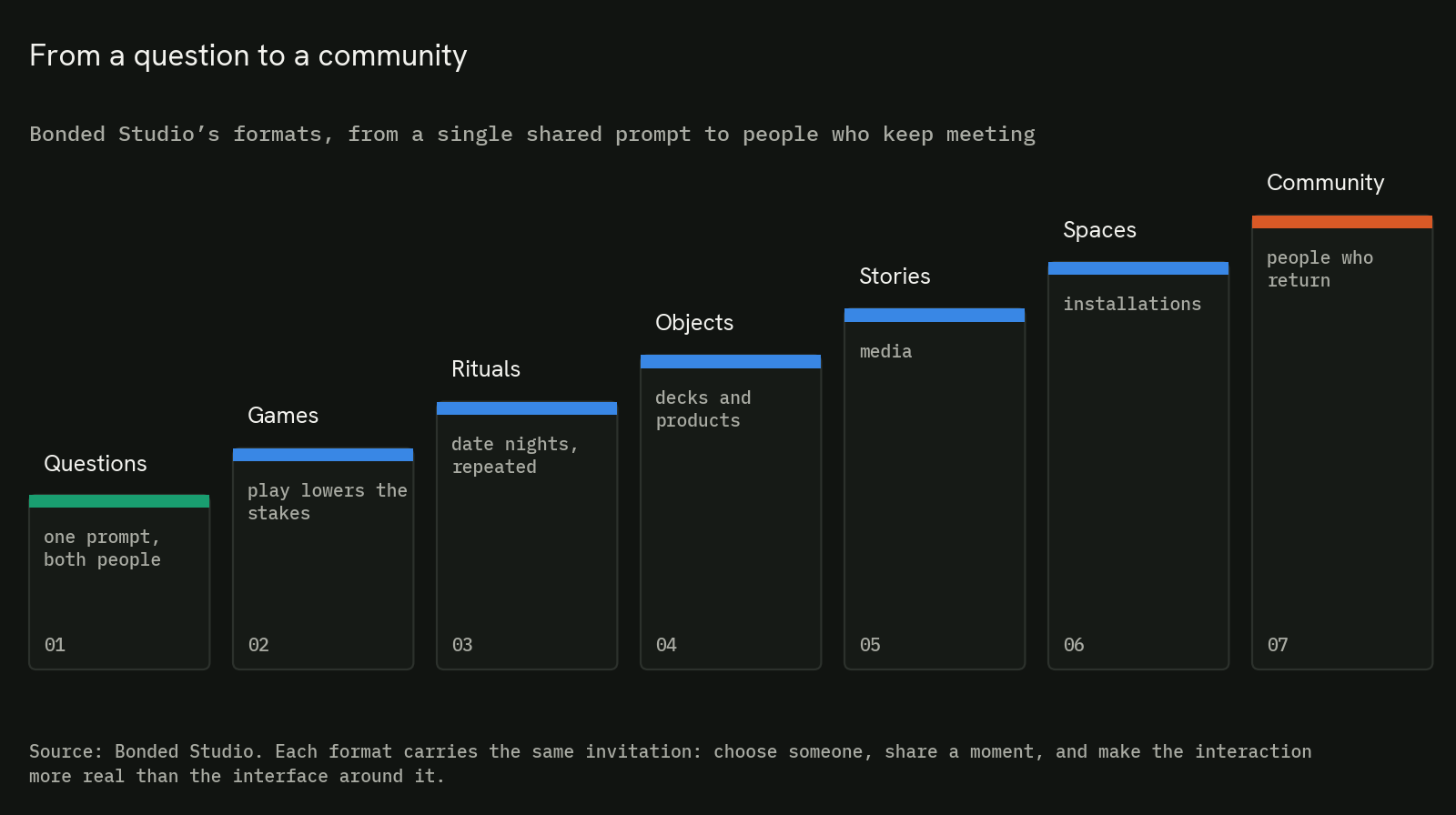
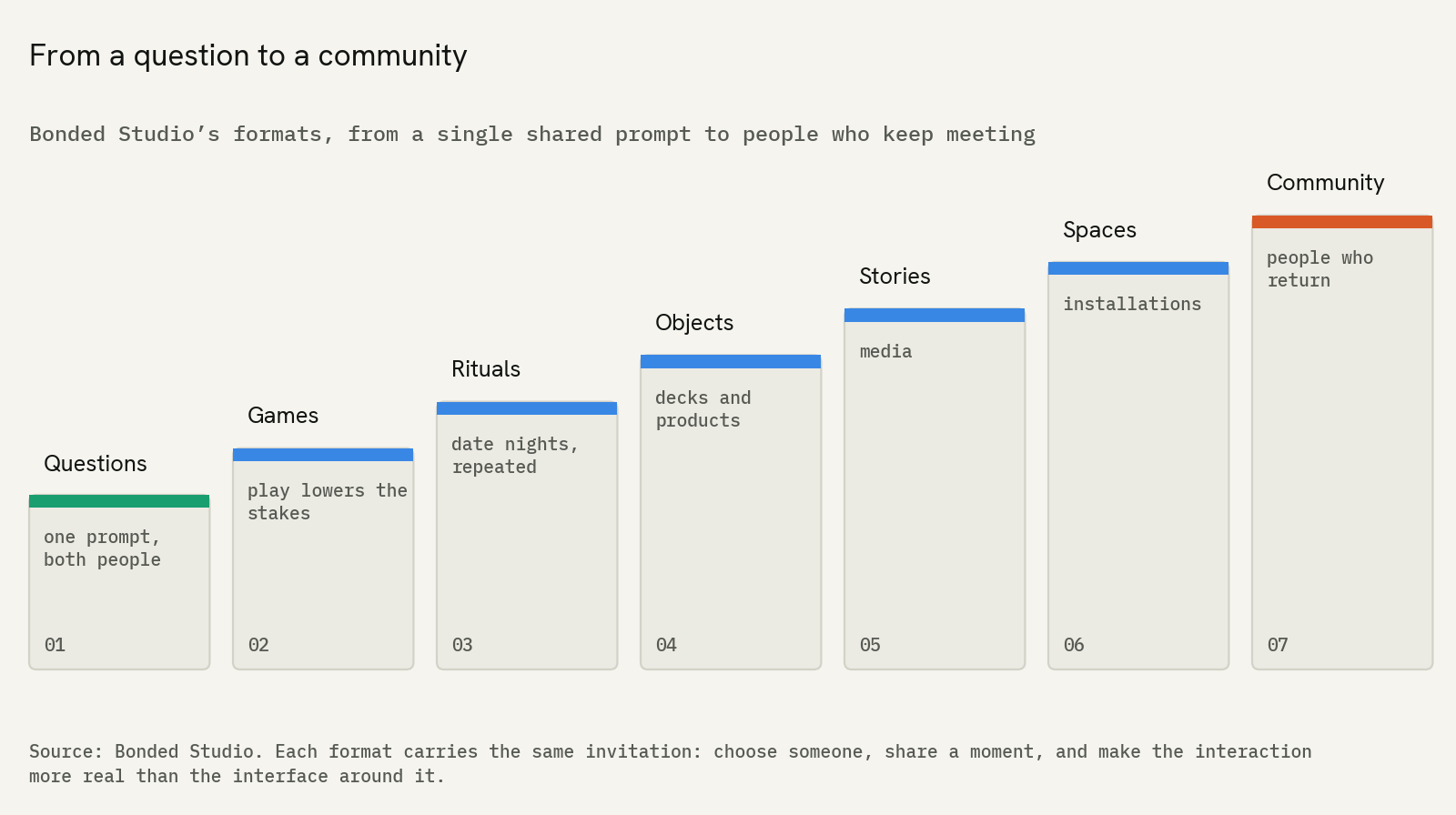
The format changes. The invitation stays the same: choose someone, share a moment, and make the interaction more real than the interface around it.
From interactive art to a connection studio
Bonded grew out of Steve Zafeiriou’s practice as a new media artist. His work started with sensing physical change and turning it into data, then moved through biometrics, responsive installations, performance systems and research on behaviour, with real-time data and human input as the material. His artist biography describes that path.
I spent years using interactive art to study how technology shapes people. Bonded Studio began when I reversed the question: instead of only exposing how systems fragment attention or mediate emotion, could I build systems that support presence and closeness?
Steve Zafeiriou
Nostalgie World began after he experienced panic attacks. It was never meant as treatment. It is an interactive world for stories about mental health, identity, memory and attention, and it deliberately avoids profiling visitors or trying to keep them coming back. It won the 2023 Doncaster People’s Choice Award and was later shown at the MATAROA Awards 2025. A 2025 direction, Sensit, explores biometric and haptic wearable art for connection between people. It is a research and prototyping line, not a controlled study or a product. His exhibition record has the full list.
Bonded is the applied side of that work: a move from systems that observe behaviour to systems that support presence. Art can stay ambiguous. A consumer product also has to be safe, clear, consent-aware, reliable and useful. Our Story on bonded.studio tells the longer version, and the Bonded Manifesto sets out the principles. The same question about loneliness runs through Akis Saramantos’s note Loneliness Was Never a Glitch.
Touch, haptics and what comes next
Touch rests on a complex set of specialised receptors that respond to pressure, movement, stretch and vibration. Devices that transmit touch at a distance can carry some tactile cues and may help people feel each other’s presence, but the field is young, results depend heavily on context, and few findings have been replicated. These systems reproduce only a small part of direct touch and are not its emotional equivalent.
A phone vibration is not a hand on your arm, and a wearable pulse should never be sold as one. Haptics can still add a private layer of timing: a shared cue, a signal that you are ready, a small ritual felt rather than seen. Bonded is exploring this as research, not promising it in the current app.
Future work on helping people find each other follows the same limits. It may explore guided interactions between consenting adults, based on context, preferences and boundaries they state themselves. It will not claim to predict love, hidden attraction or compatibility. Any biometric research would be separately opt-in, limited to a stated purpose, explainable and tested.
What Bonded does not claim
Being clear about limits makes the rest more credible. Bonded does not claim that:
- an app can cure or solve loneliness;
- a question can guarantee intimacy;
- disclosure is always good, or should always go deeper;
- matching answers prove compatibility;
- Resonance Moments measure the quality of a relationship;
- response time reveals how someone feels;
- biometrics can detect chemistry or attraction;
- haptic feedback can replace human touch;
- Bonded is therapy, medical advice or a substitute for professional support.
The claim Bonded does make is smaller and easier to defend: it designs prompts, games and shared rituals around processes that research has linked to closeness, while protecting consent and being honest about what is still unknown.
Frequently asked questions
Can an app create intimacy?
No app can guarantee it. Research links closeness to processes such as gradual self-disclosure, responsive listening and shared attention. An app can make those easier to attempt, for example by giving two people the same question and letting either pass, but the closeness itself comes from the people.
Is Bonded based on the “36 questions that lead to love”?
Partly. Arthur Aron’s 1997 study used 36 questions of increasing depth over about 45 minutes and found they produced more closeness than small talk. It did not show that the questions make people fall in love. Bonded takes the idea of paced, reciprocal disclosure from that work and adds consent rules, such as passing without explanation.
Does Bonded use biometrics or measure attraction?
No. The current app does not read heart rate, skin response or any other body signal, and it does not infer attraction from timing or behaviour. Any future biometric research would be opt-in, limited to a stated purpose and tested before use.
Is Bonded a form of therapy?
No. Bonded is a set of tools for conversation and play. It is not therapy, medical advice or a substitute for professional support.
How we checked the numbers
Each study cited here was checked against its journal record through Crossref, and the figures for the 2025 loneliness study and the joint-attention experiment were read from the published abstracts. Green marks findings confirmed in the original studies; blue marks Bonded’s reading of what they mean for design. This article is adapted for Ethos Research from the original on bonded.studio. Bonded’s next research guide, Why Vulnerability Creates Intimacy Faster Than Small Talk, looks at disclosure and pacing in more depth. To follow future guides, join the Bonded newsletter.
Sources
- Aron, A., Melinat, E., Aron, E. N., Vallone, R. D., & Bator, R. J. (1997). The experimental generation of interpersonal closeness: A procedure and some preliminary findings. Personality and Social Psychology Bulletin, 23(4), 363–377. doi.org/10.1177/0146167297234003
- Holt-Lunstad, J., Smith, T. B., & Layton, J. B. (2010). Social relationships and mortality risk: A meta-analytic review. PLOS Medicine, 7(7), e1000316. doi.org/10.1371/journal.pmed.1000316
- Laurenceau, J.-P., Feldman Barrett, L., & Pietromonaco, P. R. (1998). Intimacy as an interpersonal process. Journal of Personality and Social Psychology, 74(5), 1238–1251. doi.org/10.1037/0022-3514.74.5.1238
- Matthews, T., Arseneault, L., Bryan, B. T., Fisher, H. L., Gray, R., Henchy, J., Moffitt, T. E., & Odgers, C. L. (2025). Social media use, online experiences, and loneliness among young adults: A cohort study. Annals of the New York Academy of Sciences, 1548(1), 194–205. doi.org/10.1111/nyas.15370
- Procházková, E., Sjak-Shie, E. E., Behrens, F., Lindh, D., & Kret, M. E. (2022). Physiological synchrony is associated with attraction in a blind date setting. Nature Human Behaviour, 6, 269–278. doi.org/10.1038/s41562-021-01197-3
- Roudaut, Y., Lonigro, A., Coste, B., Hao, J., Delmas, P., & Crest, M. (2012). Touch sense: Functional organization and molecular determinants of mechanosensitive receptors. Channels, 6(4), 234–245. doi.org/10.4161/chan.22213
- Taşfiliz, D., Selçuk, E., Günaydın, G., Slatcher, R. B., Corriero, E. F., & Ong, A. D. (2018). Patterns of perceived partner responsiveness and well-being in Japan and the United States. Journal of Family Psychology, 32(3), 355–365. doi.org/10.1037/fam0000378
- van Erp, J. B. F., & Toet, A. (2015). Social touch in human–computer interaction. Frontiers in Digital Humanities, 2, 2. doi.org/10.3389/fdigh.2015.00002
- Wolf, W., Launay, J., & Dunbar, R. I. M. (2016). Joint attention, shared goals, and social bonding. British Journal of Psychology, 107(2), 322–337. doi.org/10.1111/bjop.12144