
Эта статья доступна только на английском языке.
Learn what long calls and short calls on futures mean, how they work, and the key differences between them. A complete 2025 guide for traders and investors.
Introduction
Ever wondered how professional traders profit from future price movements without owning the asset?
Welcome to the world of options on futures one of the most flexible tools in modern trading!
According to the CME Group, global futures trading surpassed 65 billion contracts in 2024, a record that highlights the explosive growth in derivatives markets.
In this guide, we’ll break down long calls and short calls on futures what they mean, how they work, and when traders use them.
By the end, you’ll know exactly how to approach these strategies, manage risk, and take advantage of opportunities in the 2025 market environment.
What Are Futures and Options on Futures?
Before we dive into calls, let’s set the foundation.
- Futures contracts are agreements to buy or sell an asset (like gold, oil, or an index) at a specific price on a future date.
- They’re standardized and traded on exchanges like the Chicago Mercantile Exchange (CME).
- Options on futures give traders the right, but not the obligation to buy or sell a futures contract at a set price (the strike price) before expiration.
- These instruments allow for strategic flexibility — traders can profit whether markets rise, fall, or stay flat.
In short: futures fix a commitment; options on futures give you the choice.
What Is a Long Call on Futures?
A long call means buying a call option on a futures contract. It’s a bullish strategy — you expect the underlying futures price to rise.
Here’s how it works:
If the market falls or stays flat, your maximum loss is limited to the premium paid.
You pay a premium to buy the call.
You gain the right to buy the futures contract at the strike price before expiration.
If the market rises above your strike price, you can exercise the option or sell it for a profit.
Example: Short Call on Gold Futures (October 2025 – GCV25)
Underlying: COMEX Gold Futures (GCV25)
Date: 28 October 2025
Futures Price: ≈ US $4,080 / oz
Contract Size: 100 troy ounces per contract
Trade Setup
You sell (write) 1 October 2025 gold futures call option with:
- Strike Price: US $4,100 / oz
- Premium Received: US $80 / oz (so US $80 × 100 oz = US $8,000 received upfront)
- Position Type: Uncovered (short call)
Why this setup?
This is a neutral-to-slightly-bearish play you expect gold prices to stay below $4,100 until expiration, letting you keep the premium.
Outcomes at Expiration
| Scenario | Gold Settlement Price | Intrinsic Value of Call | Option Seller P/L (1 contract) |
|---|---|---|---|
| A. Below Strike | $4,000 / oz (below $4,100) | $0 (option expires worthless) | +$8,000 (keep premium) |
| B. At Breakeven | $4,180 / oz ($4,100 + $80) | $80 × 100 = $8,000 | $0 (breakeven) |
| C. Moderately Higher | $4,200 / oz | $100 × 100 = $10,000 | −$2,000 loss |
| D. Sharp Rally | $4,400 / oz | $300 × 100 = $30,000 | −$22,000 loss |
| E. Extreme Spike | $4,600 / oz | $500 × 100 = $50,000 | −$42,000 loss |
Analysis
- Breakeven Price: $4,100 + ($80 premium) = $4,180 / oz
- Maximum Profit: $8,000 (premium collected)
- Maximum Loss: Unlimited (if gold keeps rising)
- Margin Required: Typically $15,000–$25,000 per contract (depending on broker and volatility)
- Use Case: Short-term income strategy for a flat or declining gold market
Risk and Context
- At $4,080, gold is near record highs for late 2025; selling a call this close to the money is risky.
- A $100 move in gold equals $10,000 per futures contract — small price swings can erode premium quickly.
- To limit risk, many traders create a bear call spread (e.g., short $4,100, long $4,200) so maximum loss is capped at $10,000 minus net credit.
Summary
Always monitor volatility, margin, and news (headlines on rates and inflation can move gold fast).
Short call = premium income strategy with unlimited risk.
At current GCV25 pricing ($4,080), a $4,100 strike is reasonable for illustration.
Breakeven ≈ $4,180; anything above that turns loss-making for the seller.
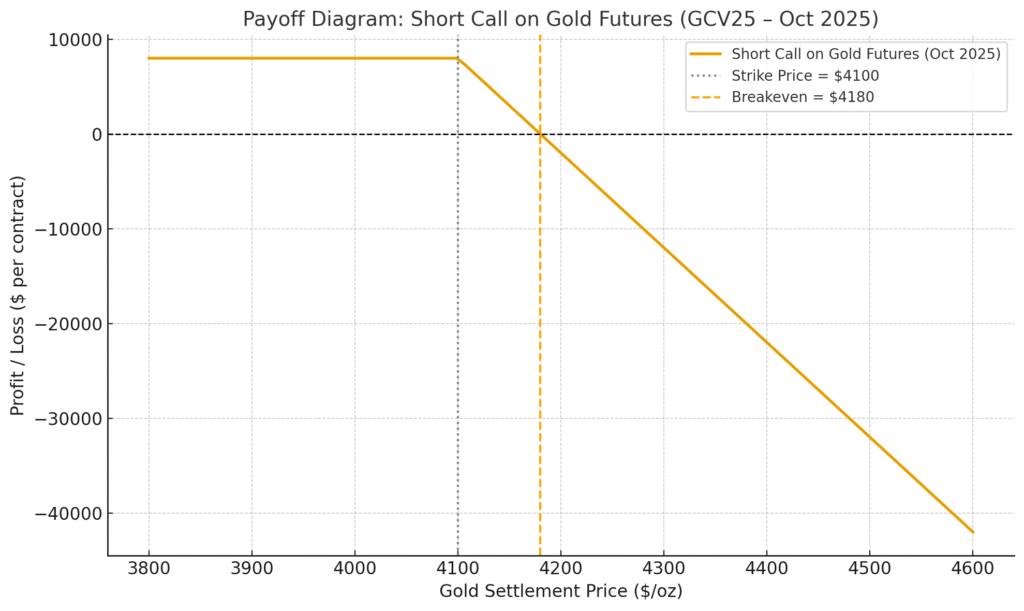
Beyond that, losses increase linearly as gold prices rise.
The horizontal line at $8,000 (left side) shows your maximum profit — the premium collected.
The breakeven occurs at $4,180/oz (strike $4,100 + premium $80).
Key Differences Between Long Call and Short Call on Futures
| Feature | Long Call | Short Call |
|---|---|---|
| Market Outlook | Bullish | Bearish/Neutral |
| Position | Option Buyer | Option Seller |
| Right or Obligation | Right to Buy | Obligation to Sell |
| Maximum Loss | Premium Paid | Unlimited (if uncovered) |
| Maximum Profit | Unlimited | Limited to Premium Received |
| Ideal For | Speculators expecting price increases | Traders expecting flat/declining prices |
These two strategies are opposite sides of the same coin one bets on a rise, the other on stability or decline. Understanding both allows traders to tailor their approach to different market conditions.
When to Use Long Calls and Short Calls in Futures Trading
Use a Long Call When:
- You’re bullish on the underlying asset.
- You want to limit downside risk.
- You prefer leverage without full margin exposure.
- You expect high volatility in the near term.
Use a Short Call When:
- You’re neutral or slightly bearish on the market.
- You want to generate income through premiums.
- You have a covered position (own the underlying futures).
- You’re confident the market will stay below a certain level.
Timing and volatility are everything. Successful traders use technical analysis and volatility indicators to identify ideal entry points.
Advantages and Risks of Trading Futures Options
Advantages:
- Leverage: Control large positions with limited capital.
- Defined risk (for buyers): You can only lose the premium.
- Flexibility: Multiple strategies for any market condition.
- Hedging potential: Protect existing futures positions.
Risks:
- Unlimited risk (for sellers): Losses can exceed initial margin.
- Time decay: Option value erodes as expiration nears.
- Complexity: Requires understanding Greeks like delta and theta.
- Margin calls: Especially risky for uncovered short calls.
Options on futures are not for beginners they demand discipline, strategy, and strong risk control.
Common Mistakes Traders Make
- Confusing options on futures with futures contracts themselves.
- Ignoring implied volatility changes before entering trades.
- Selling naked calls without understanding margin exposure.
- Failing to use stop-loss or exit plans.
- Over-leveraging small accounts in volatile markets.
The best traders focus on capital preservation first, profits second.
How to Analyze and Execute Long/Short Call Strategies
Monitor daily: Futures options move fast — stay alert!
Pick your market: e.g., crude oil, S&P 500 E-minis, gold, etc.
Choose a strike price: Based on technical support/resistance levels.
Select expiration: Align with your trading horizon (weekly, monthly, quarterly).
Check implied volatility: Avoid overpaying for premium when volatility is high.
Use risk management: Define maximum loss and exit conditions.
Example 1: Long Call on E‑mini S&P 500 Futures (ESZ25) (Dec 2025 contract)
Underlying futures price: ~ 6,888 on 27 Oct 2025. Yahoo Finance+3Investing.com+3CME Group+3
(Note: there’s no October contract for ES; the next active is December 2025.)
Real-Life Examples & Case Studies:
- Buy 1 call option (on ES futures) with strike = 6,900.
- Premium paid: $1,000.
- You expect the index to rise above 6,900 before expiration.
Outcome A – Mark-to-market exit:
- Suppose the option value rises to $2,500 (due to the futures rising & implied vol increasing) and you close out.
- Profit = $2,500 − $1,000 = $1,500 (a 150% gain on premium).
Outcome B – At expiration:
- If ESZ25 settles at 7,100, then intrinsic value = (7,100 − 6,900) × $50 = $10,000.
- Net profit = $10,000 − $1,000 premium = $9,000.
- Breakeven = strike + (premium ÷ $50) = 6,900 + (1,000 ÷ 50) = 6,920.
Analysis:
- The above numbers assume multiplier $50 per index point.
- Time decay (theta) and volatility (vega) will affect the option before expiry.
- Risk: premium paid is your max loss.
- Use stop-loss (e.g., exit if option falls to 40% of entry) or roll if you want to extend.
Example 2: Short Call on WTI Crude Oil Futures (CL) (Front‐month around 28 Oct 2025)
Underlying futures price: ~ $61.20 per barrel for WTI crude. Investing.com+2Reuters+2
(Each contract = 1,000 barrels.)
Setup:
- Sell (write) 1 call option with strike = $65/barrel.
- Premium received: $1.00/barrel (so $1 × 1,000 barrels = $1,000).
- Expect crude to stay at or below $65 until expiration.
Outcome A – If price ends below strike (e.g., $60):
- Option expires worthless → you keep the premium → +$1,000 profit.
- Breakeven = $65 + (premium ÷ 1,000) = $66.
Outcome B – If price ends above strike (e.g., $70):
- Intrinsic value = (70 − 65) × 1,000 = $5,000.
- Your net loss = intrinsic − premium = $5,000 − $1,000 = −$4,000.
Analysis:
Better risk control: use covered call (long futures + short call) or bear call spread (short strike + long higher strike) to cap losses.
Short call risk is unlimited (in crude’s case, large).
Margin & collateral must be sufficiently large.
Conclusion
Understanding the long call and short call on futures can revolutionize how you view trading. Long calls let you profit from rising prices with limited risk, while short calls provide income potential in flat or falling markets — but with significant risk exposure.
In 2025, as market volatility remains high and global events shift rapidly, these strategies remain essential tools for savvy traders. The key is education, risk management, and patience.
Whether you’re hedging or speculating, start small, learn the mechanics, and practice on a demo account before going live. You’ll soon find that mastering calls on futures can open up a world of trading opportunities!