
Эта статья доступна только на английском языке.
Everyone seems to want lower rates. Homeowners want them, stock buyers want them, and the president has said rates should be at 1% or below. But what happens historically when the Fed is eventually forced to cut because the economy is deteriorating? Unemployment rises, layoffs accelerate, credit conditions tighten, and businesses pull back on investment.
People celebrating the prospect of lower rates seem to be overlooking the reason those cuts may become necessary. And the history here isn’t subtle.
The last two cutting cycles started after the damage did
On 3 January 2001 the Fed cut its target by half a point, the first move in a cycle that took the rate from 6.5% down to 1% by June 2003. Unemployment was 4.2% that month. It didn’t peak until June 2003, at 6.3%, two and a half years after the first cut and long after the recession had officially ended in November 2001.
The 2007 cycle was worse. The Fed made its first cut on 18 September 2007 with unemployment at 4.7%, and by December 2008 it had taken its target all the way to zero. Unemployment kept climbing anyway, to 10.0% in October 2009.

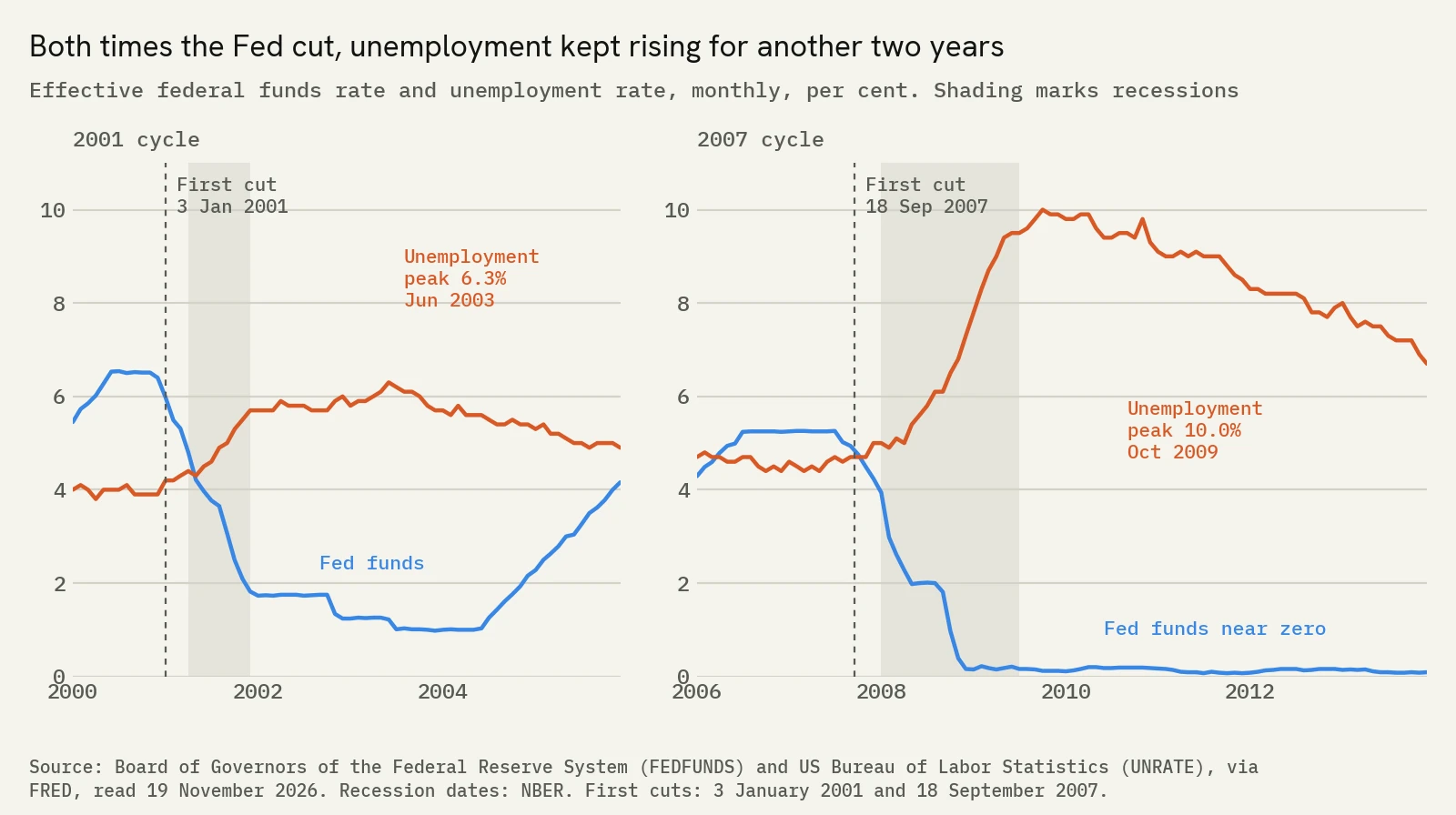
Think about what that means for anyone waiting on cheap money to fix things. The cuts didn’t stop the layoffs. They came because the layoffs had already started, and the job market kept getting worse for two more years with rates on the floor.
The bond market moved before the Fed did
The bond market often anticipates that deterioration long before policymakers acknowledge it. You can see it in the 2-year Treasury yield, which moves with where traders think the Fed’s rate is heading over the next couple of years.
In June 2000 the 2-year’s monthly average slipped below the fed funds rate, and it stayed below for the seven months until the first cut. In July 2006 it did the same thing and stayed below for 14 months before the Fed finally moved in September 2007. By the month before each first cut, the gap had grown to a full percentage point in 2000 and 0.7 points in 2007.


Both times the Fed said it was watching inflation, and both times bond traders were already pricing the slowdown. That’s the signal I’d want to see before believing the cutting story now.
Today the 2-year is pricing hikes, not cuts
Trump picked Kevin Warsh to bring rates down. The Senate confirmed him on 13 May, Trump has kept pushing for much lower rates ever since, and the Fed raised them in September anyway. The committee voted 12 to 0 on 16 September to lift its target by a quarter point to 3.75% to 4.00%, because inflation was still running too hot. It held in October, and the minutes released on 18 November showed almost everyone around the table expecting more hikes.
So the Fed keeps signaling hikes, while plenty of traders are betting the other way, that the bond market will start cutting before the Fed ever does. If they’re right, falling prices drag yields down and bring real estate back to life months before the Fed catches on, and then the Fed gets to take the credit.
I’d like that to be the setup, but it isn’t what the 2-year says today. On 17 November it yielded 4.80% against an effective fed funds rate of 3.88%. That’s a gap of about 0.9 points in the wrong direction, so traders aren’t front-running cuts at all. They’re pricing more hikes.

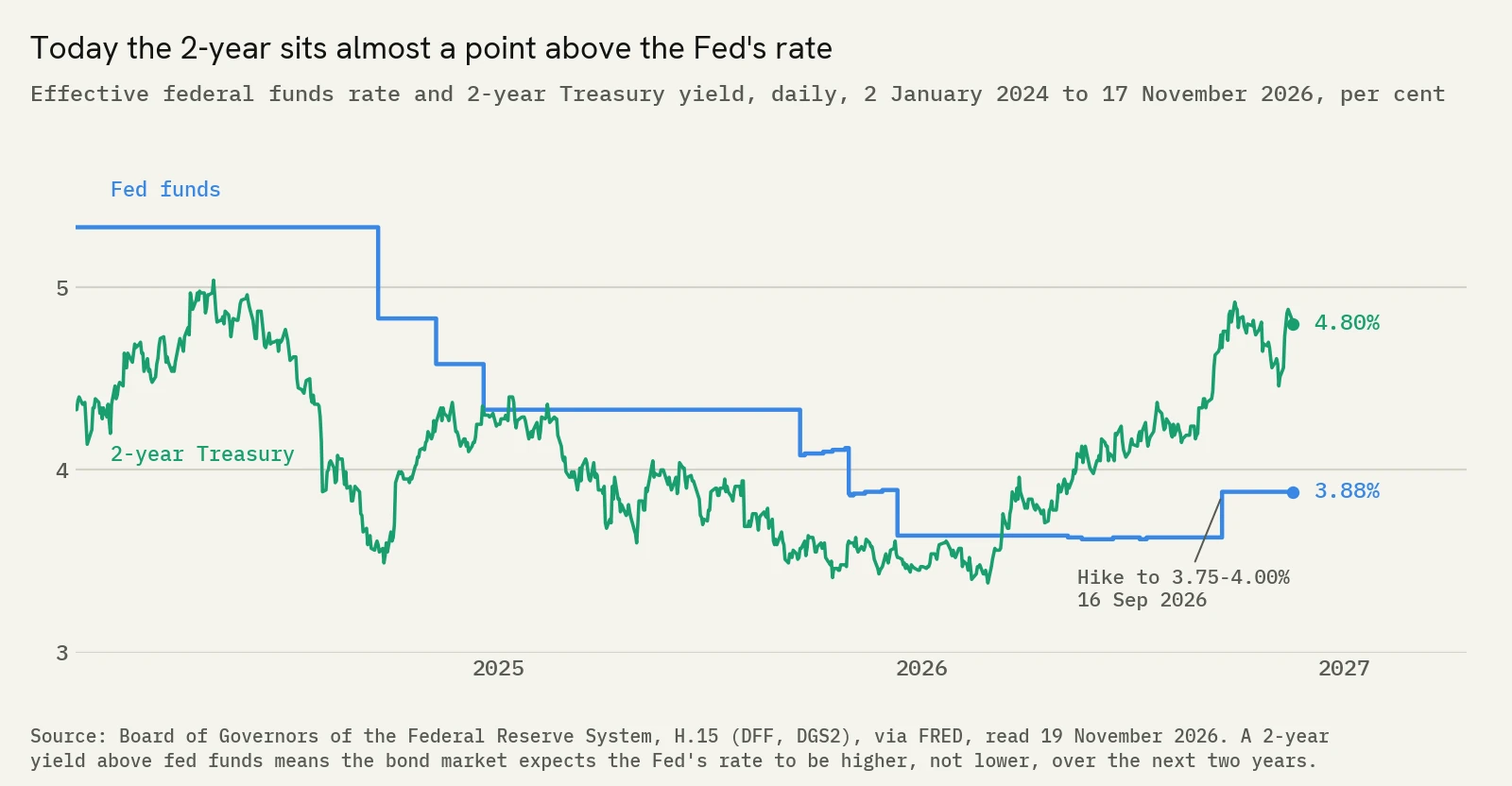
So the warning that fired early in 2000 and 2006 hasn’t fired this time. When the 2-year drops back under the Fed’s rate and stays there for a few months, I’ll take the cutting story seriously, and I’ll want to know what broke. For the run-up in yields that got us here, see The 10-Year Treasury Hits 5% and October CPI Reveals Persistent Inflation.
Lower mortgage rates won’t bring buyers back on their own
Lower mortgage rates won’t magically restore housing demand when people are worried about losing their jobs, and 2008 showed it. Between September 2007 and April 2009 the average 30-year mortgage rate fell from 6.38% to 4.81%, while housing starts fell from 1.18 million to 478,000 a year. A cheaper loan doesn’t help much if you’re not sure you’ll have a paycheck next year.
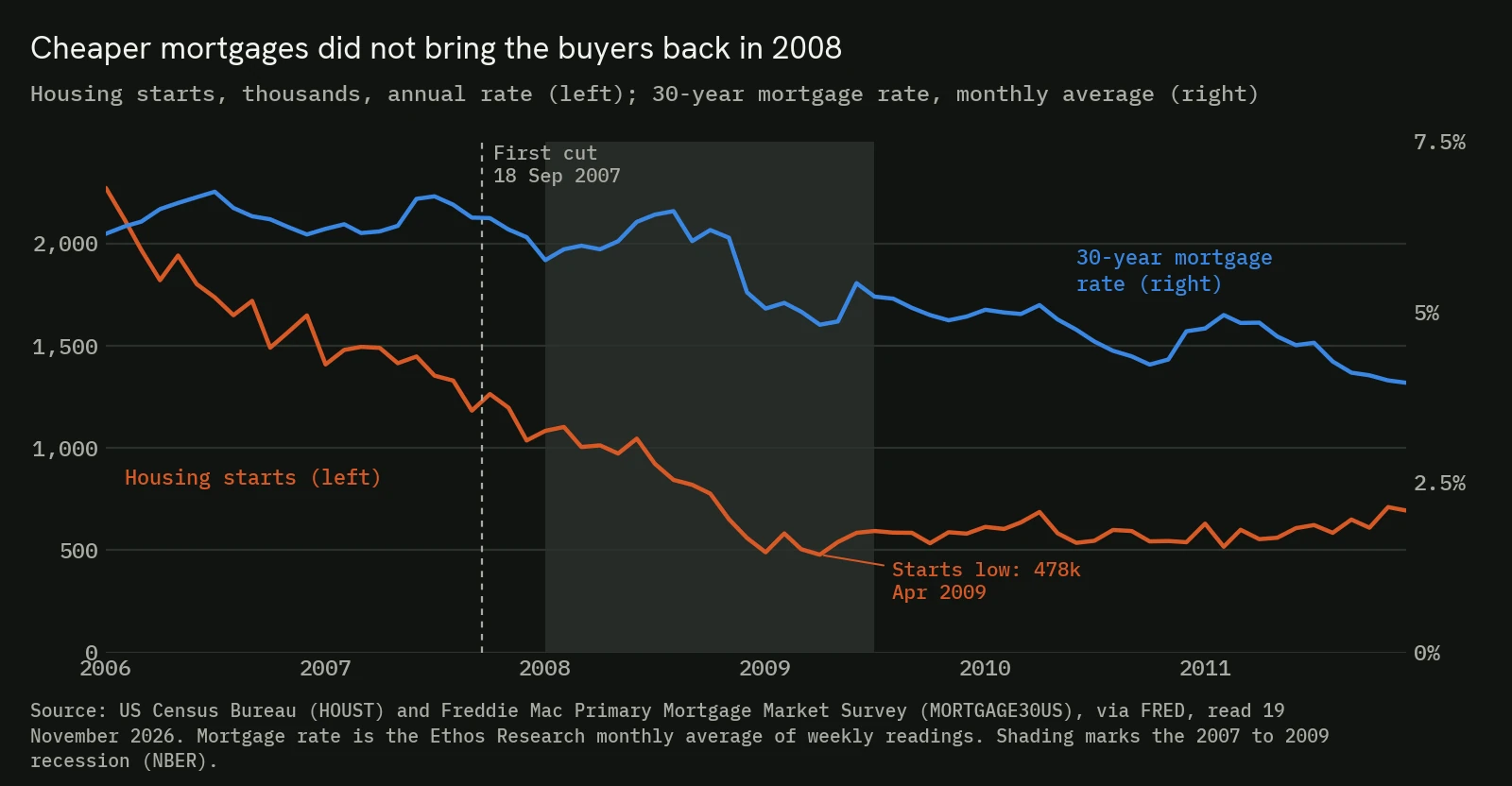

Today the strain shows up in borrowing costs, not yet in jobs. The 30-year mortgage rate hit 7.40% in October, its highest since November 2023, and was still 7.11% on 12 November. Housing starts ran at 1.31 million a year in October, down from 1.52 million in March. Unemployment, though, was 4.1% in October, below the 4.5% of November 2025.
That’s the fair counterpoint, and it deserves its due. The Fed cut by 1.75 points between September 2024 and December 2025 and no recession followed, so not every cut is a distress call. The cuts that matter are the ones the Fed is forced into.
What would change my mind
I suspect the economy is cracking the way it usually does, in housing and credit first, with the jobs data last to admit it. The 2-year is the first thing I’d watch. If it falls back below fed funds while unemployment rises for several months in a row, the market will be telling us the Fed has hiked into a slowdown.
When the cuts finally come, plenty of people will celebrate cheaper mortgages. I’d ask a different question first, because a rate cut is the Fed admitting something broke, and by the time it admits that, the damage is usually well underway.
Frequently asked questions
Do Fed rate cuts mean a recession is coming?
Not always. The cuts that began in January 2001 and September 2007 came with recessions, and unemployment kept rising for more than two years after each first cut. The Fed also cut by 1.75 points between September 2024 and December 2025, and no recession followed; unemployment peaked at 4.5% in November 2025.
Why does the 2-year Treasury yield matter for Fed rate cuts?
The 2-year yield reflects where traders expect the Fed’s rate to be over the next two years. Before the 2001 and 2007 cutting cycles it fell below the fed funds rate months ahead of the first cut. On 17 November 2026 it was about 0.9 points above it, which points to more hikes rather than cuts.
What is the Fed’s interest rate now?
The federal funds target range has been 3.75% to 4.00% since the Fed raised it on 16 September 2026. The effective rate was 3.88% on 17 November. The next decision is due on 9 December 2026.
Did lower mortgage rates help housing in 2008?
No. The 30-year mortgage rate fell from 6.38% in September 2007 to 4.81% in April 2009, but housing starts fell from 1.18 million to 478,000 a year over the same period.
How we checked the numbers
Unemployment, the fed funds rate, Treasury yields, housing starts and mortgage rates come from the official series published on FRED, read on 19 November 2026. Monthly comparisons of the 2-year yield and fed funds use monthly averages; the count of months runs from the first monthly average below fed funds to the month of the first cut. Mortgage rates for a month are our average of Freddie Mac’s weekly readings. Recession dates are the NBER’s.
Green dots mark figures checked against the underlying source. Orange marks news reports. Blue marks our own calculations and analysis. First-person judgments are the author’s and are not marked.
Sources
- FRED: Unemployment Rate (UNRATE), US Bureau of Labor Statistics
- FRED: Federal Funds Effective Rate, monthly (FEDFUNDS) and daily (DFF), Board of Governors of the Federal Reserve System
- FRED: 2-Year Treasury yield, monthly (GS2) and daily (DGS2)
- FRED: New Privately-Owned Housing Units Started (HOUST), US Census Bureau
- FRED: 30-Year Fixed Rate Mortgage Average (MORTGAGE30US), Freddie Mac
- NBER: US Business Cycle Expansions and Contractions
- Federal Reserve: FOMC statement, 3 January 2001
- Federal Reserve: FOMC statement, 18 September 2007
- Federal Reserve: FOMC statement, 16 September 2026
- FXStreet: Fed Minutes keep further rate hikes firmly on the table, 18 November 2026
- Al Jazeera: Kevin Warsh confirmed as new US Federal Reserve chair amid controversy, 13 May 2026
- Yahoo Finance (The Motley Fool): Fed Chair Kevin Warsh Fired Back at President Donald Trump’s Interest Rate Critiques, 8 October 2026
Not investment advice.