
מאמר זה זמין באנגלית בלבד.
Monday's Nvidia rally was already fading before Tuesday's open, and this time the selling reached copper, credit and the cost of keeping the AI build-out running.
On Monday, November 23, Nvidia closed about 31.5% higher after the board brought Jensen Huang back as chief executive, adding close to $1 trillion of market value in a single session. It's tempting to read a day like that as the market deciding the AI story is fine again. By Tuesday morning, before the U.S. open, Nvidia was about 4.8% lower and the rest of the chip complex was falling with it. So what was Monday, a verdict or a relief rally? CNBC on Huang's reinstatement · Yahoo Finance live coverage · NVIDIA's Form 8-K · Nvidia's intelligence crisis on Ethos Research
I think the more useful question is what else was falling. Chips, copper, aluminum, bitcoin and credit all came under pressure the same morning, while the Fed is still expected to raise rates in December. When that many markets move together, the problem usually isn't one company's leadership. It's the financing behind a whole investment cycle.
Investors are starting to separate AI revenue from AI returns
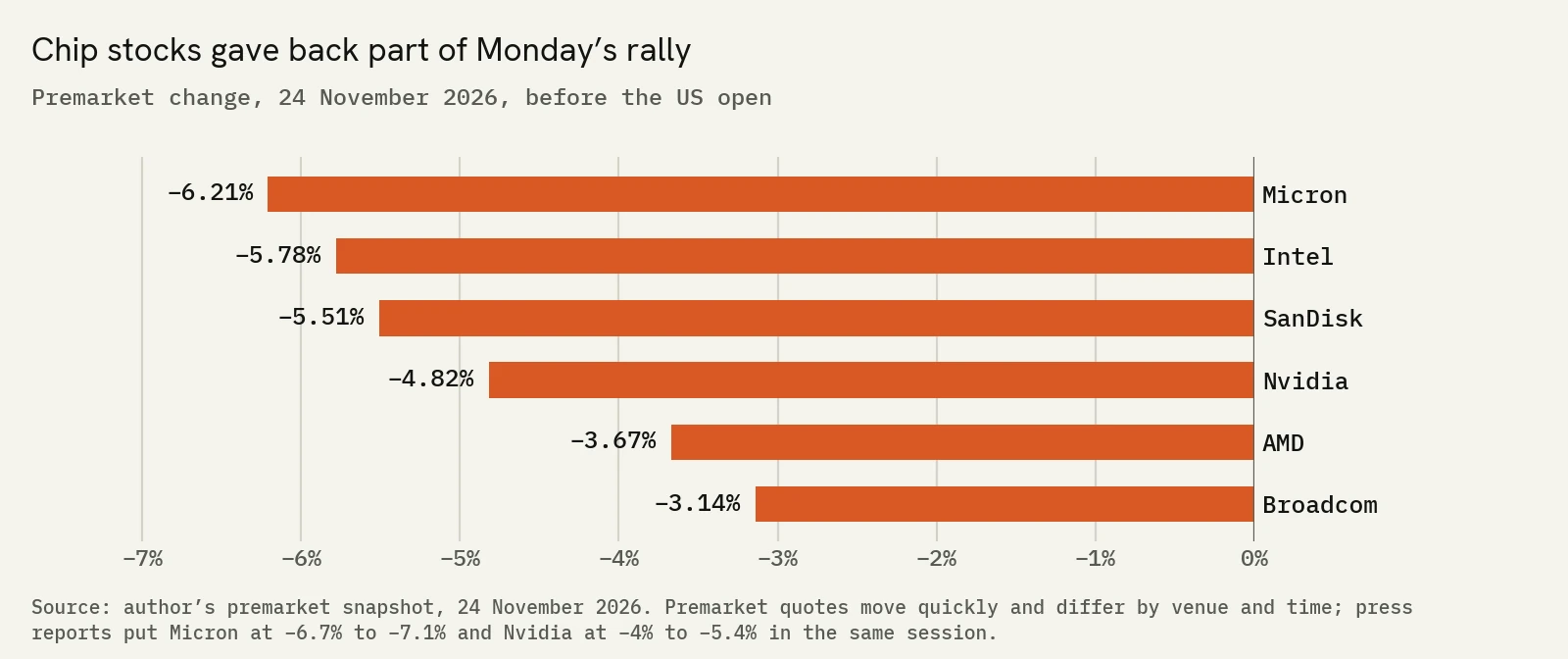
The premarket screen I looked at on Tuesday had the hardware names down between about 3% and 6%. Micron was the weakest at 6.21%, followed by Intel, SanDisk and Nvidia. Amazon and Alphabet, two of the biggest buyers of that hardware, were down less than 1%. Press reports from the same session put Micron down 6.7% to 7.1% and Nvidia down 4% to 5.4%, so treat my figures as a snapshot of a fast tape. Investing.com on chip stocks premarket · CNBC live coverage
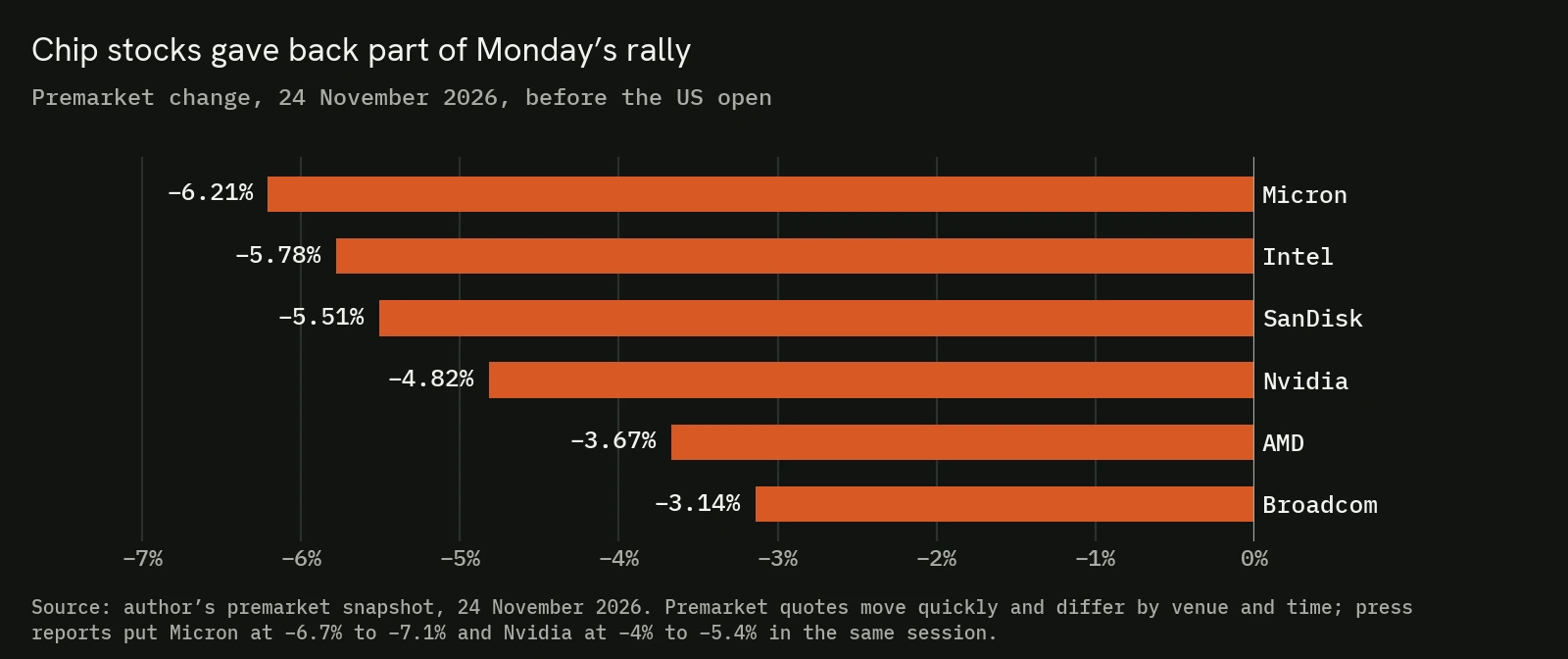
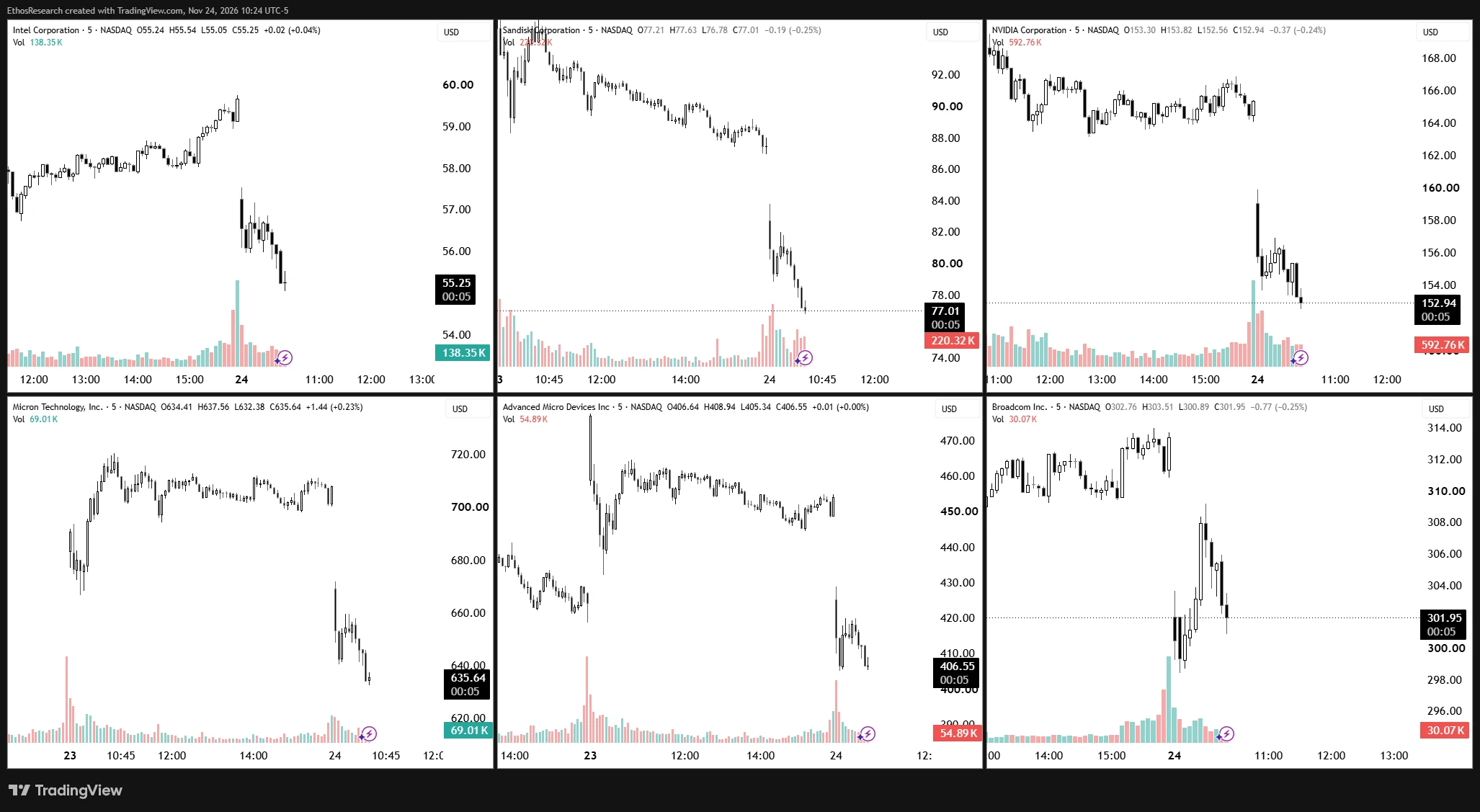
That gap between the companies that sell the hardware and the companies that buy it tells me where the market thinks the risk sits. If AI spending slows, the buyers can delay orders and protect their cash, while the sellers are left with inventory, capacity and the bills for both.
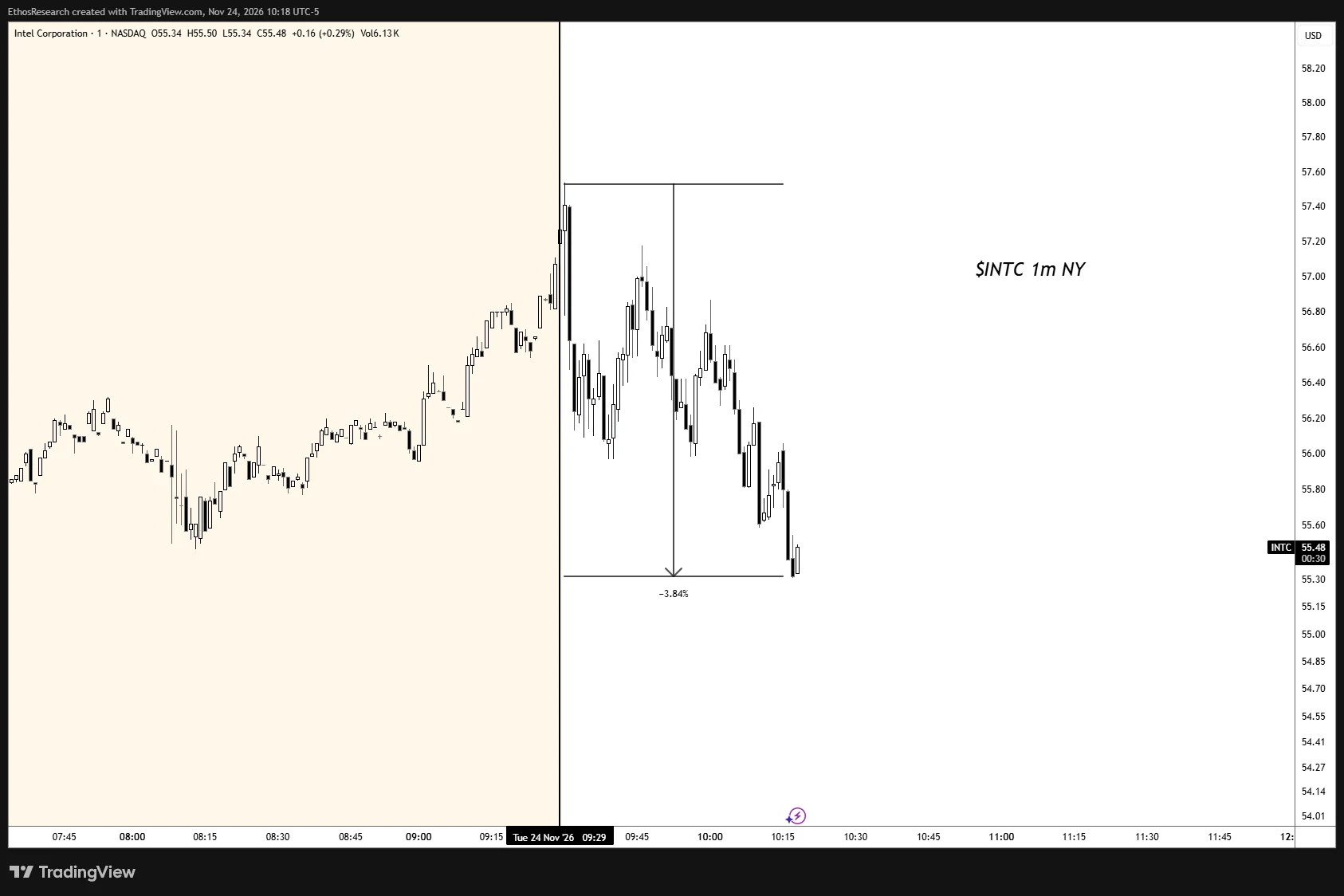
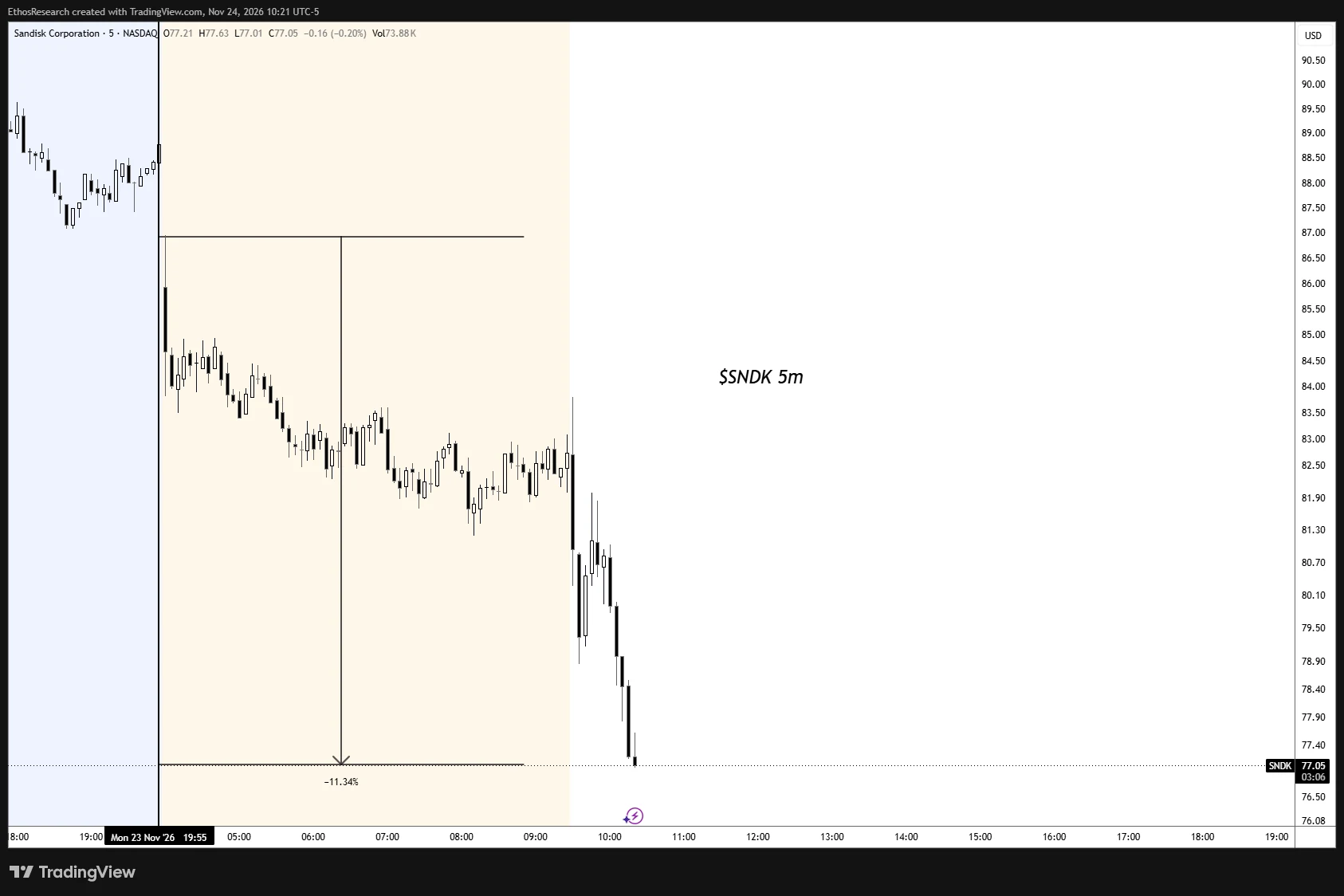


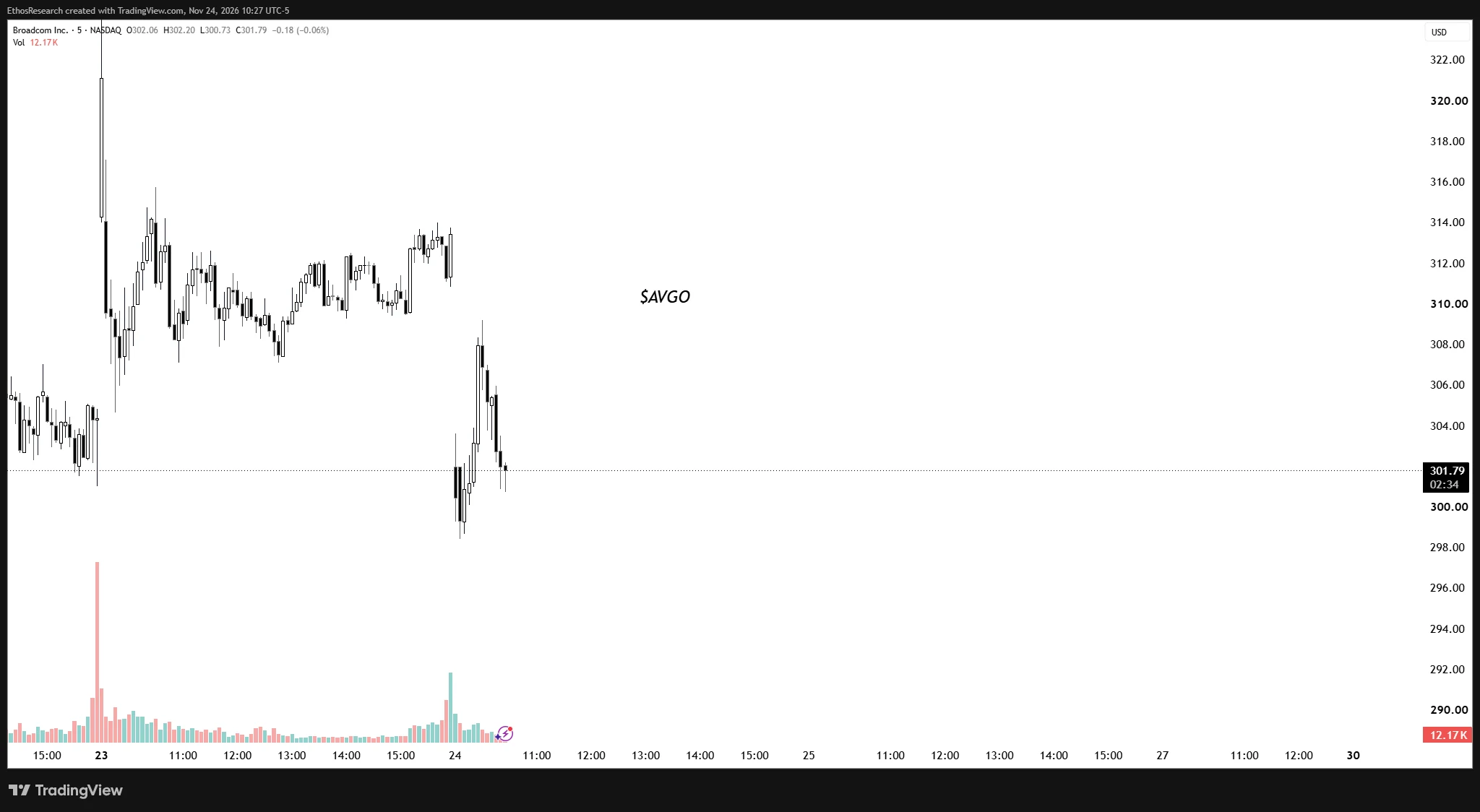
HPE and Semtech made the point with their own results. HPE reported fourth-quarter revenue of $14.5 billion, up 50% from a year earlier, with server revenue up 94.7%. Operating cash flow was $2.3 billion, $0.1 billion lower than a year earlier, and adjusted gross margin fell 2.2 percentage points from the previous quarter to 38.2%. Semtech reported record quarterly net sales of $423.0 million, up 58%, and pointed to a record backlog in its FiberEdge, CopperEdge and photonics products. Both stocks traded between about 10% and 12% lower before Tuesday's open. HPE's fourth-quarter release · Semtech's third-quarter release · CoinCentral on HPE shares · Benzinga on Semtech shares
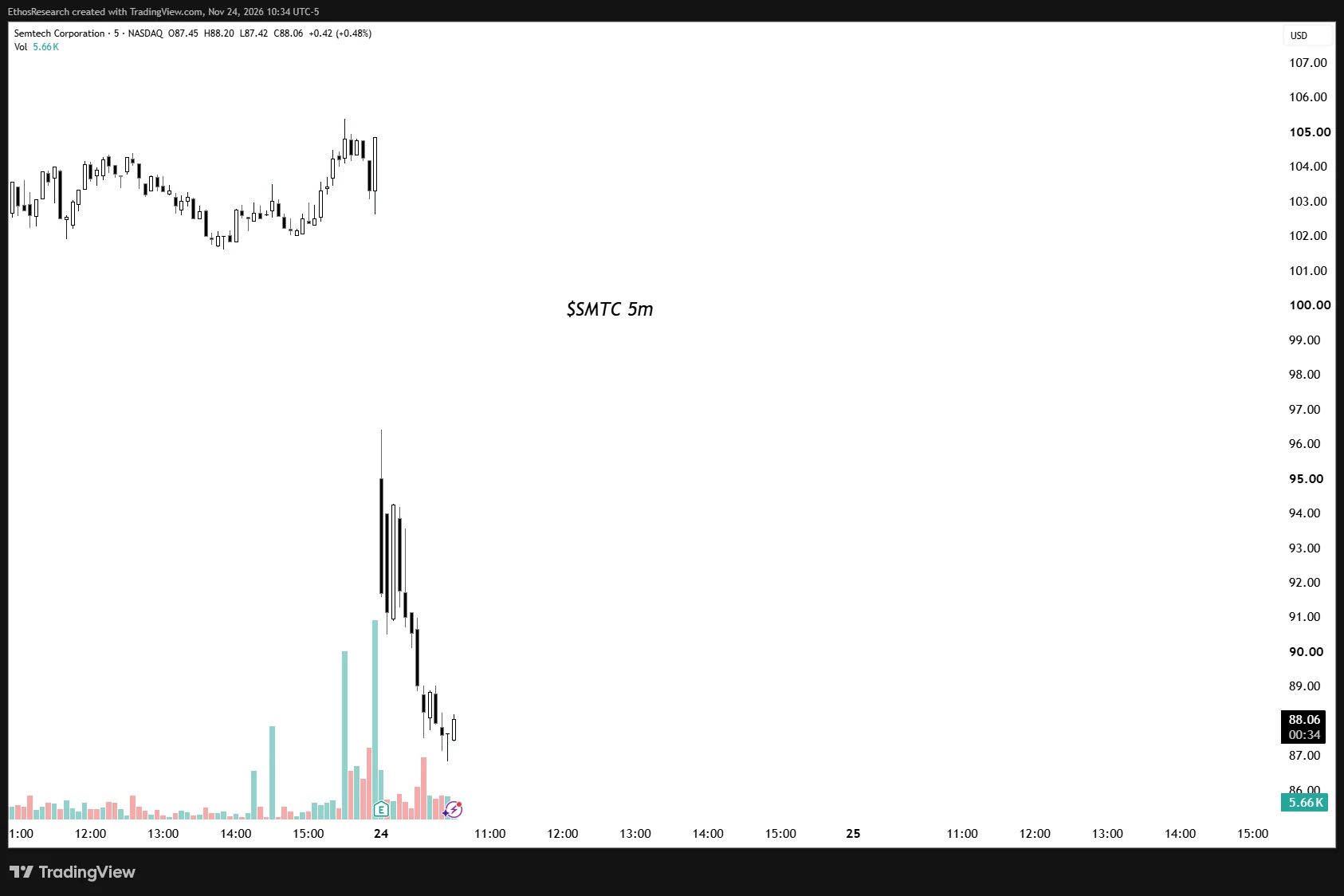
Think about what a 50% revenue jump with lower cash flow actually means. A company can ship more servers than ever and still have less cash at the end of the quarter, because the AI mix carries thinner margins and ties up more money in components. For most of the last two years, investors paid for that growth without asking. On Tuesday they asked.
Washington added to the pressure. The Commerce Department put seven companies on its Entity List on November 23, led by Singapore's Megaspeed and including an Alibaba unit, over the risk of advanced AI chips reaching buyers the U.S. hasn't approved. Singapore's prime minister said the country's own investigation will continue. A TSMC unit also told Texas officials that a property-tax abatement would be a deciding factor in whether it builds a proposed $22.6 billion chip plant in the state. Neither story changes this quarter's demand, but both add cost and uncertainty to the supply chain that AI spending pays for. StockAnalysis on the Entity List additions · Forbes Middle East on Singapore's probe · The Star on TSMC's Texas request
Copper and aluminum are trading like part of the AI build-out
The metals moved the same way. On my screen Tuesday morning, copper futures were down 4.04%, platinum 3.13%, silver 2.88%, aluminum 2.63% and palladium 2.61%, while gold lost only 0.68%. Three-month copper fell 3.5% to $12,054 a ton in official London Metal Exchange trading after briefly dipping below $12,000, and aluminium fell 2.4% to $2,787, its weakest level since October 2025, according to a market report. Copper and aluminium report
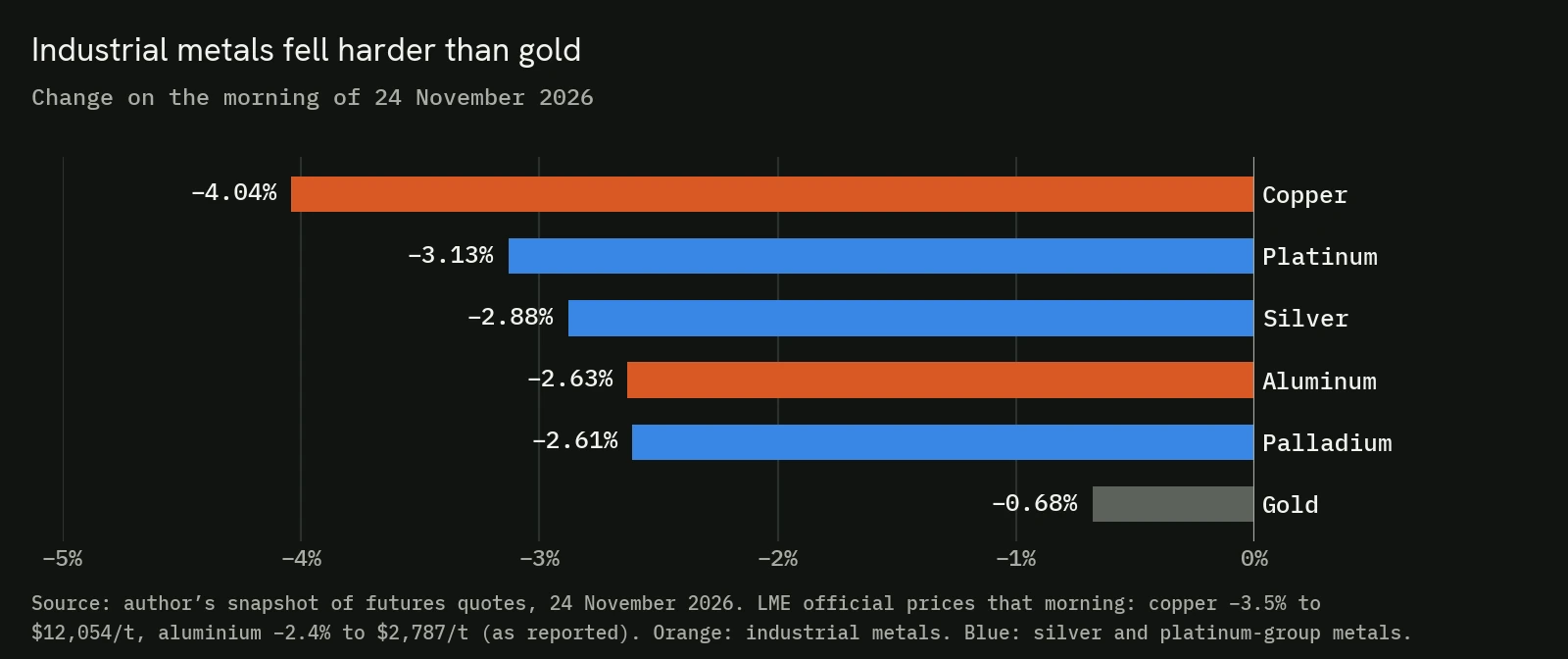
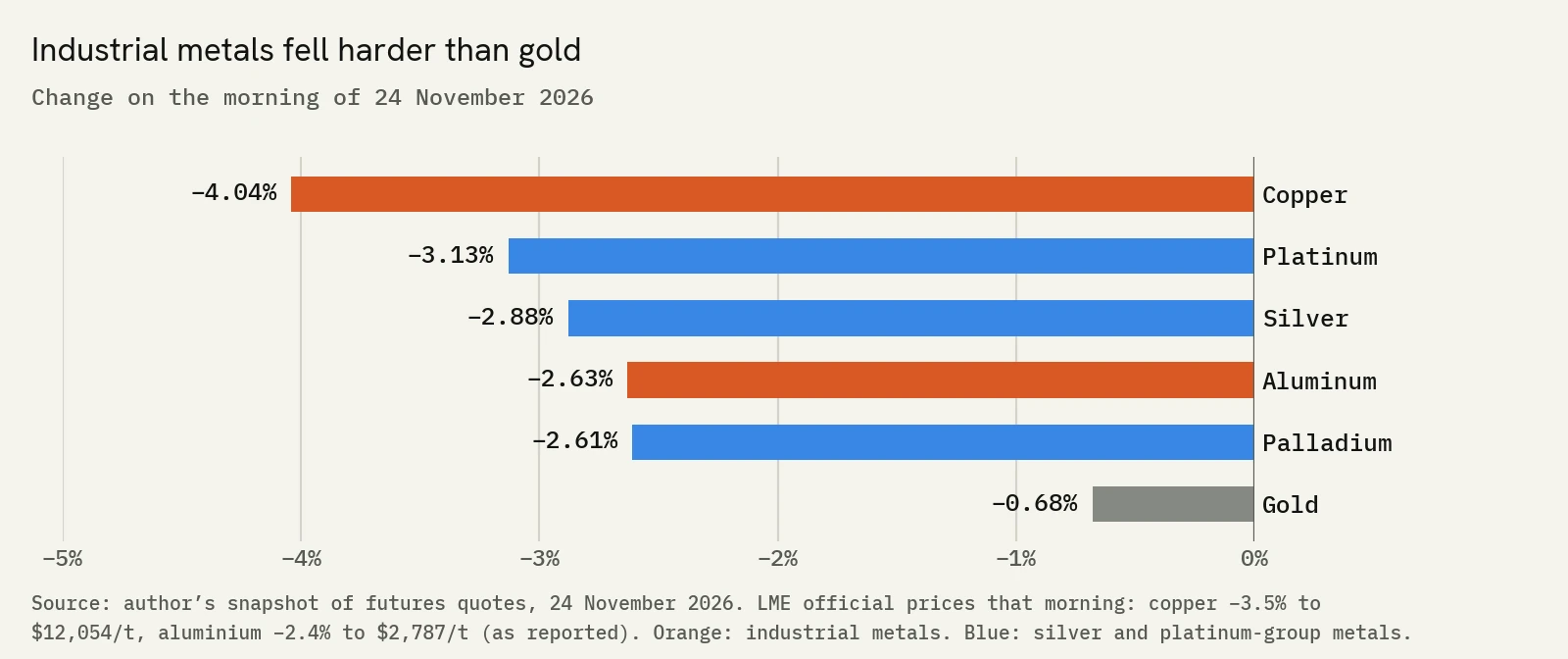
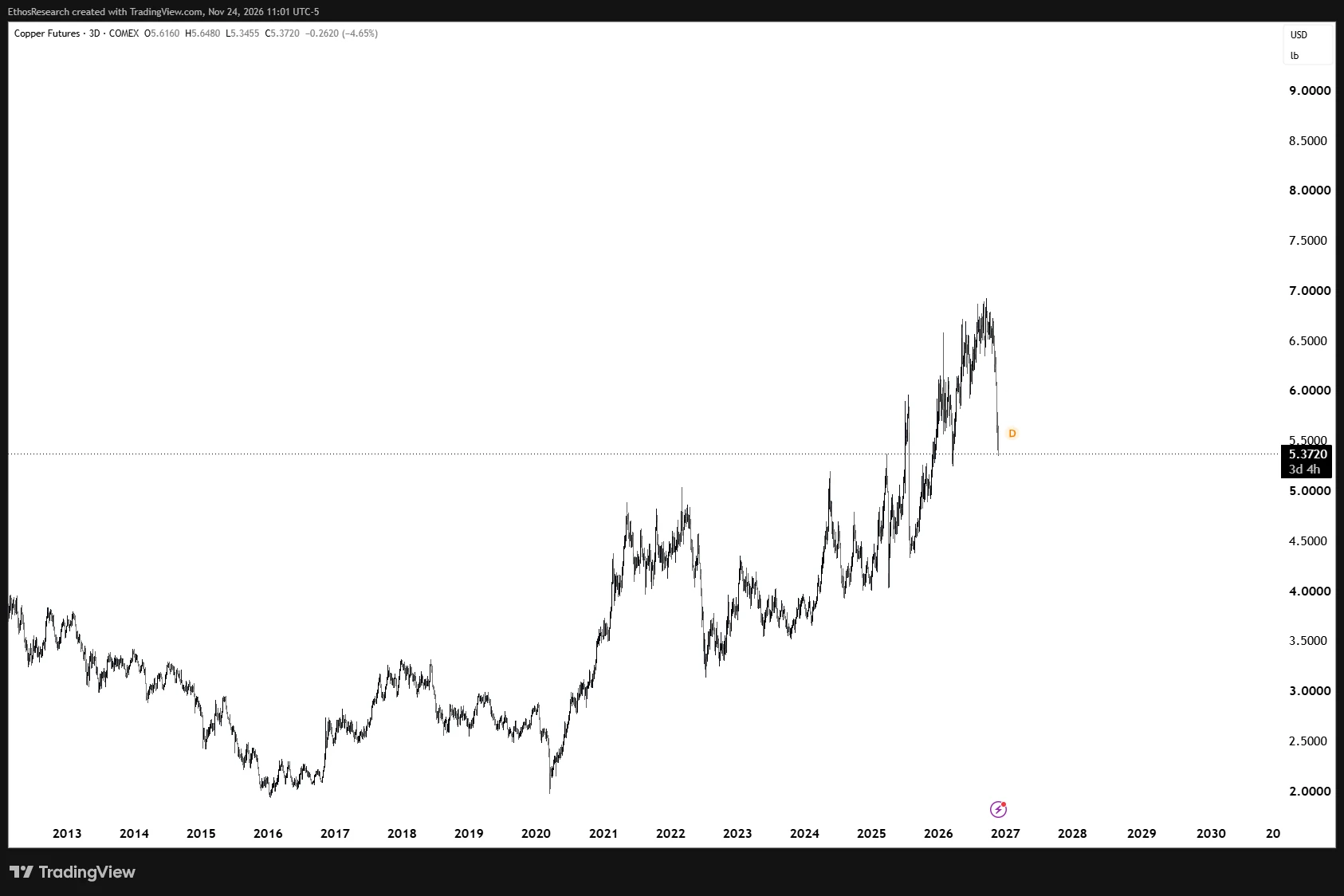
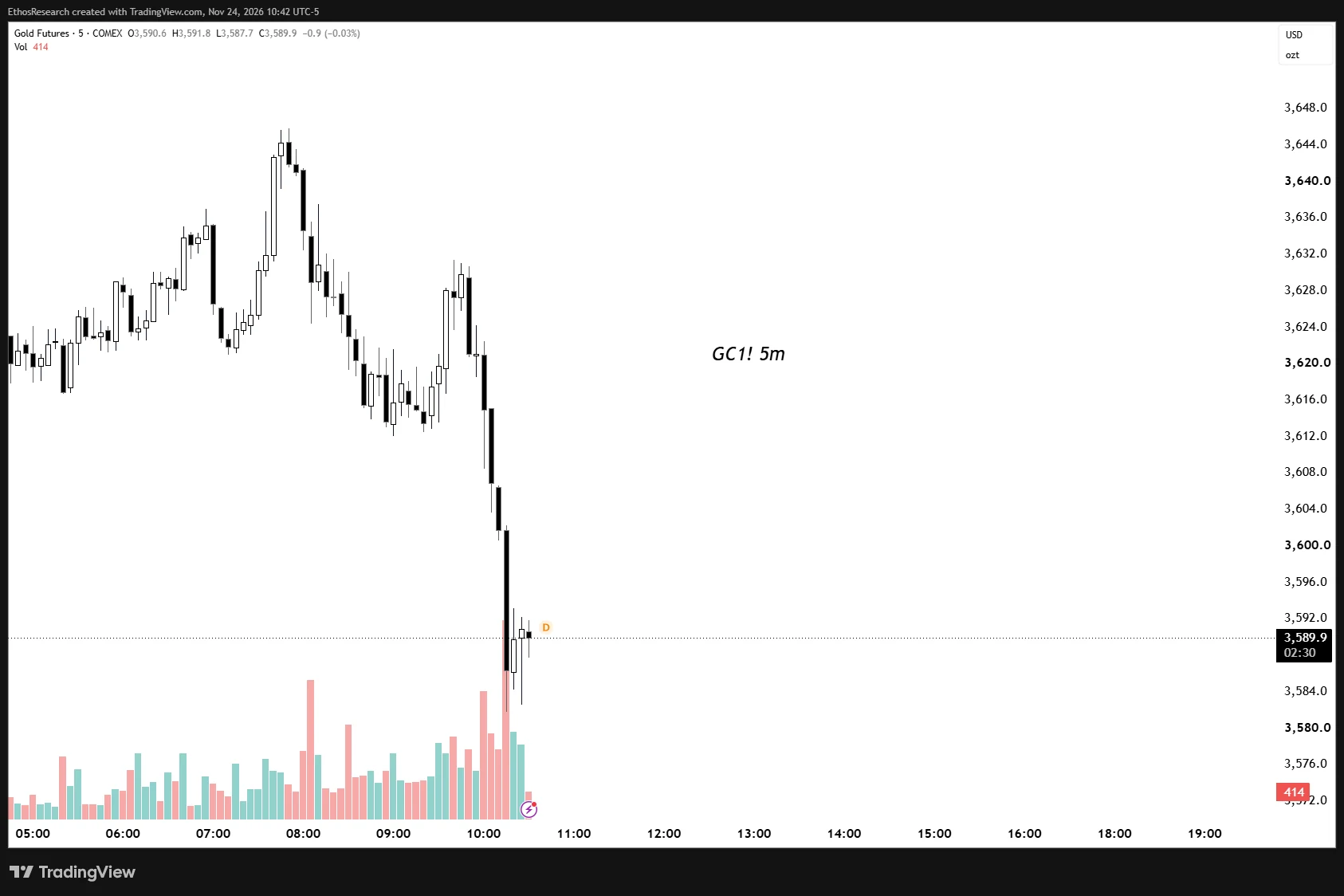

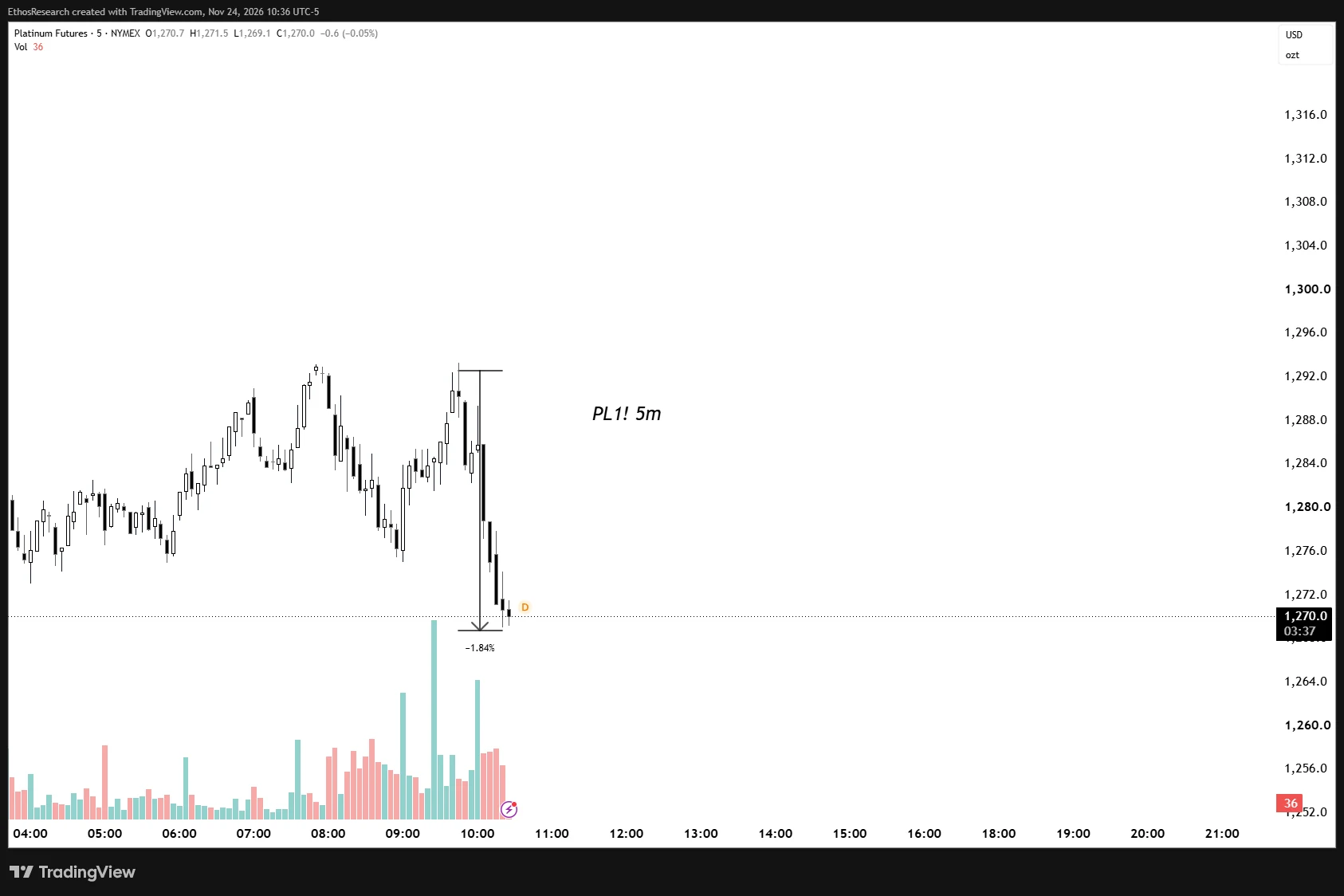
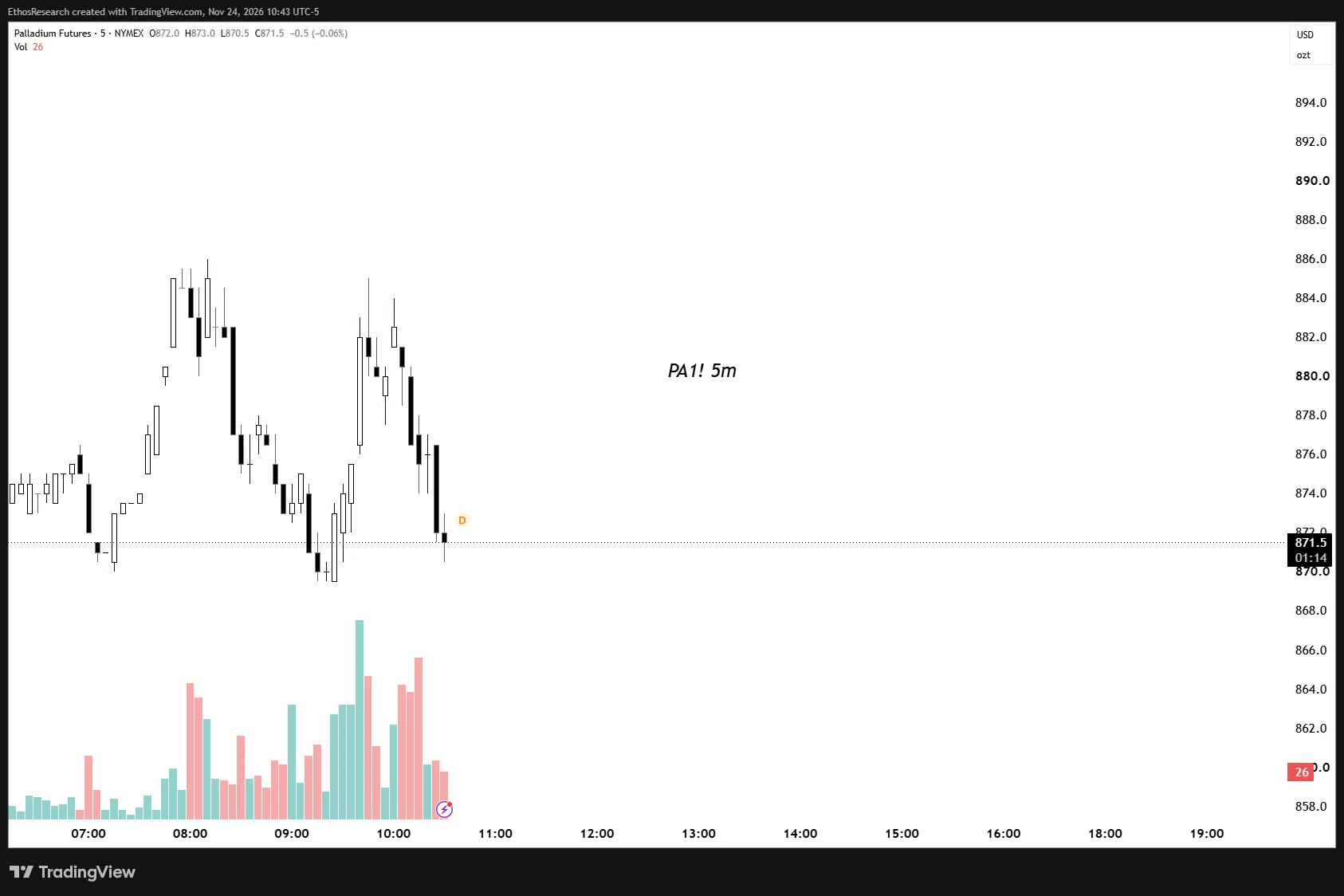
I read the order of that list as a vote on future construction. A data center needs copper for power distribution and cooling, aluminum for structures and cabling, and transformers and transmission lines before a single chip is switched on. Gold has no such link, which is why it held up. If investors start to doubt how much will actually get built, the demand premium in industrial metals is the first thing they'd take out, and they don't need AI spending to fall for that to happen. A slower pace is enough.
Precious metals had already been through a rough week before this. I wrote on Monday about the chance that leveraged funds were selling gold and silver to raise cash, and the Commitments of Traders report for November 17 showed managed money holding a net long of only 1,280 COMEX silver contracts. Are Big Hedge Funds Being Forced to Sell Precious Metals?

Building AI may get cheaper while running it stays expensive
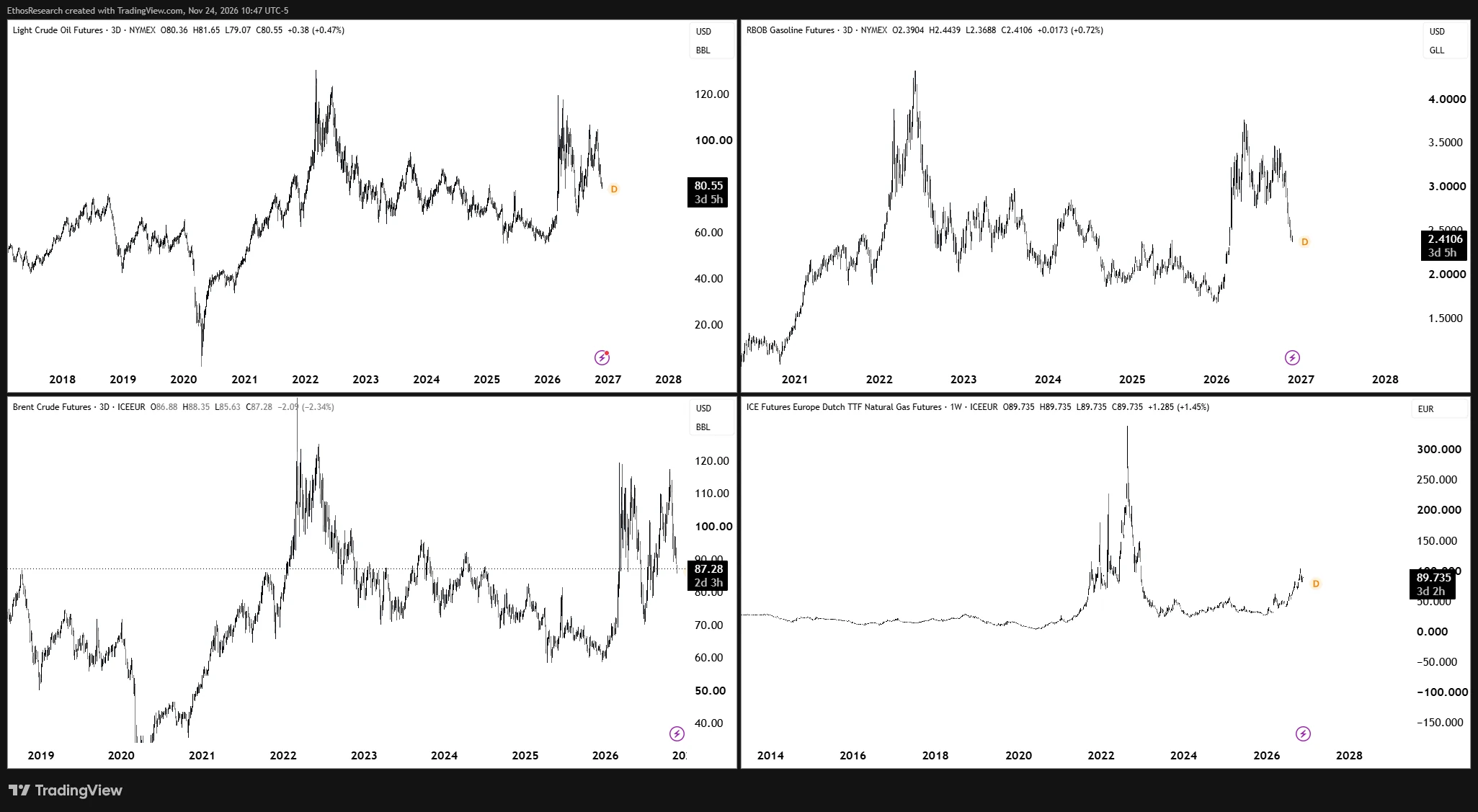
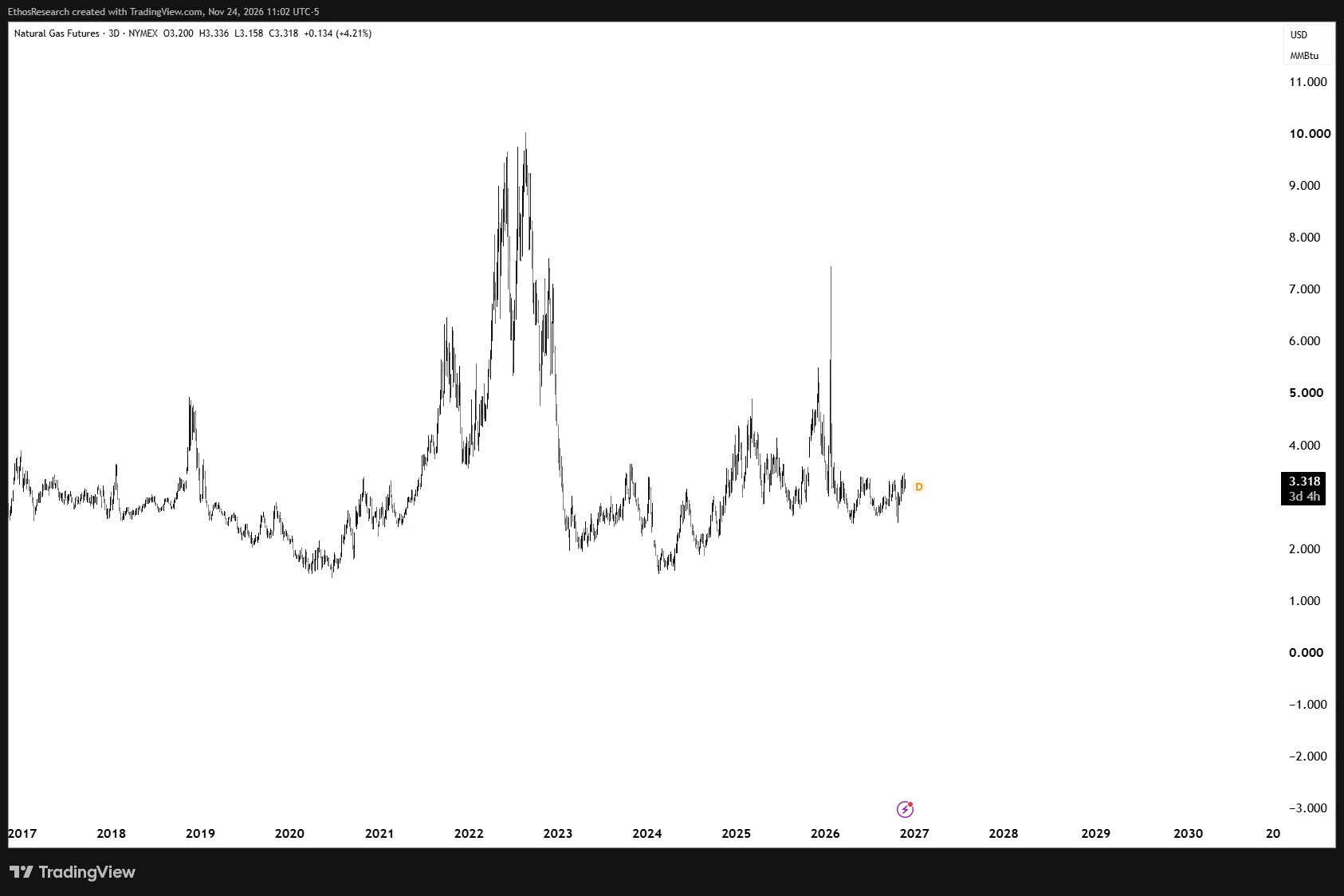
Energy is where the picture splits. Oil rose on Tuesday morning, but the one-month moves on my screen still showed the size of the reversal since late October.
| Market (Ethos COT chart) | One-month change, my screen on November 24 |
|---|---|
| WTI crude | −20.8% |
| Brent crude | −22.0% |
| Gasoline futures | −24.5% |
| Diesel futures (NY Harbor ULSD) | −25.2% |
| European natural gas | −3.9% |
| U.S. natural gas | +19.6% |

Refining margins have come down, but not evenly. Using the Energy Information Administration's weekly Gulf Coast spot prices, the diesel crack spread fell from a peak of $111.84 a barrel in the week of September 18 to $84.11 in the week of November 13, while the gasoline crack fell from $72.12 to $16.45. That leaves gasoline margins roughly back at their 2006–2025 average of $15.33. Diesel is still nearly four times its long-run average of $22.39, and close to three times its 2021–2025 average. EIA weekly spot prices · Ethos Oil Monitor
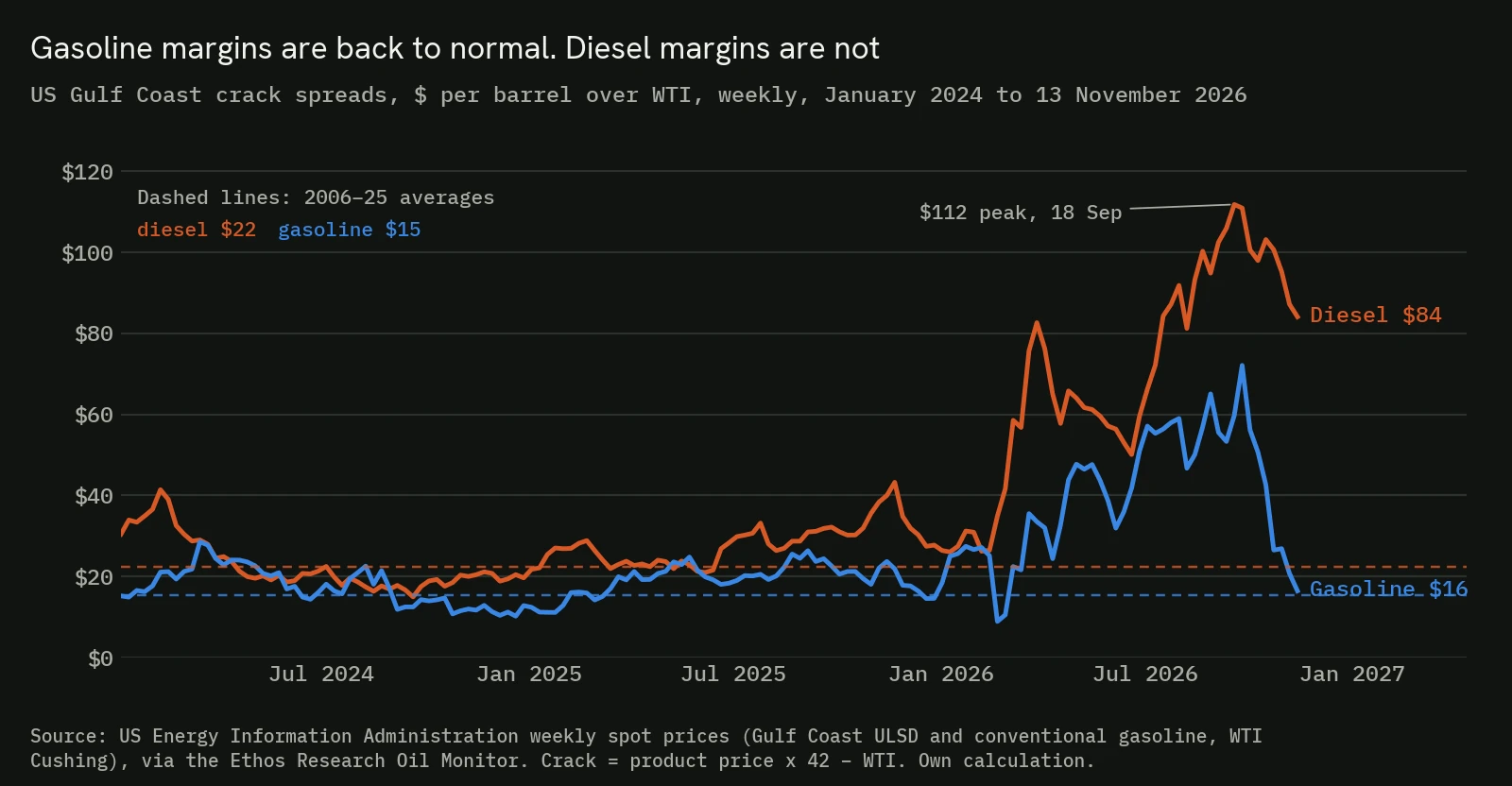
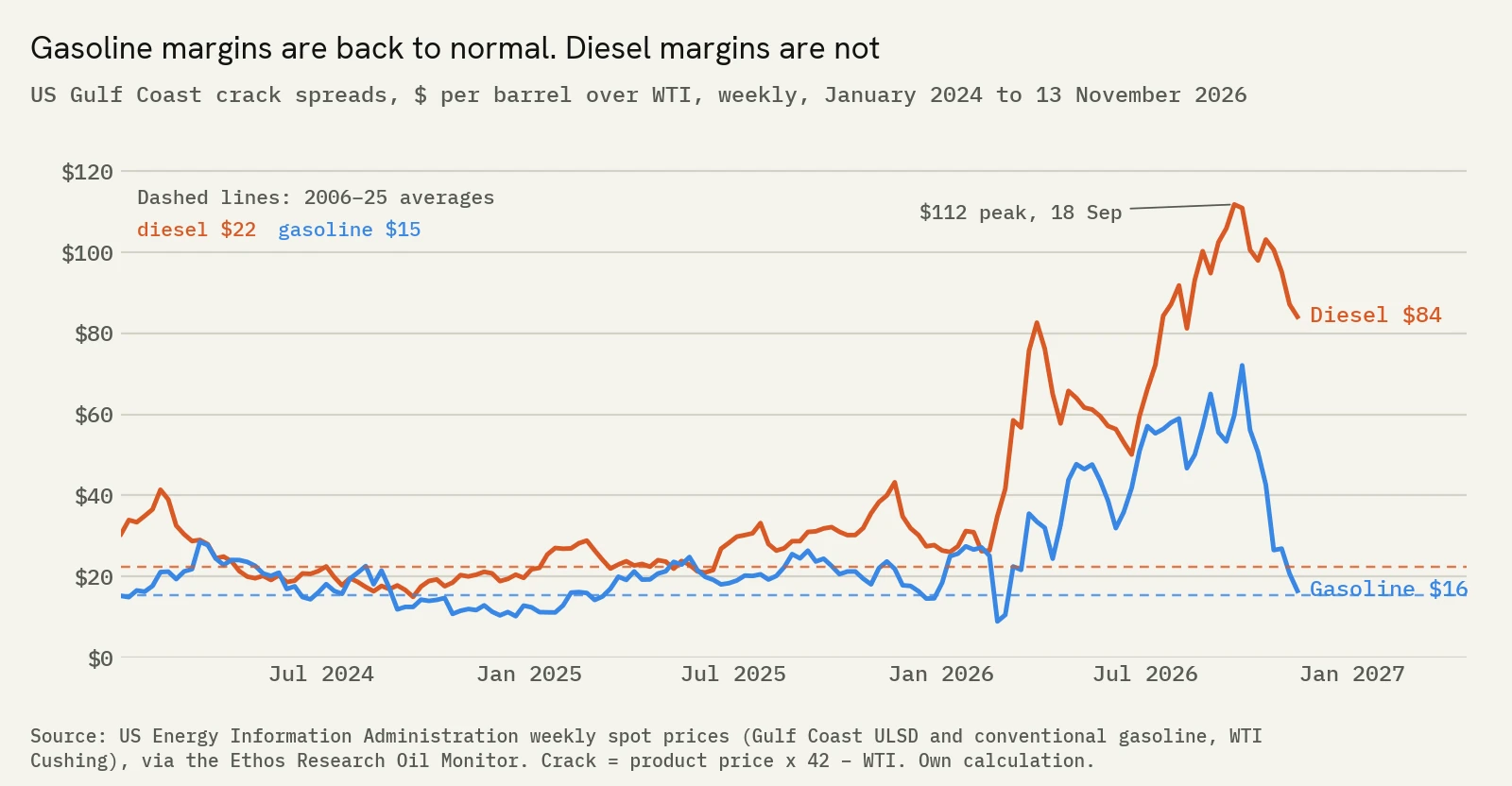
That's why a lower oil price hasn't reached the people who move goods. The U.S. average retail price of diesel was $5.937 a gallon on November 16, up 53.5% from $3.868 a year earlier. Picture a trucking company with fewer loads to haul and a fuel bill that's still half again what it was last winter. Its revenue weakens long before it gets any relief at the pump. EIA retail diesel prices · Oil Is the Bargaining Chip
Supply hasn't normalized either. UKMTO reported tanker incidents near the Strait of Hormuz on November 20, 21 and 22, and the European Union's gas storage was 68.9% full on November 22, a record low for late November with colder weather arriving. Weekly ship transits through Hormuz are tracked in the Shipping and Trade tool, and the daily context is in Iran Intel. gCaptain on the UKMTO reports · IntelliNews on EU gas storage
Here's where it connects back to AI. Data centers run on electricity, not crude, and in the U.S. a lot of that electricity is priced off natural gas, which rose about 20% in a month on my screen while oil fell. The materials needed to build the next data center may be getting cheaper. The power needed to run the ones already built isn't, and that hits the same profit margins investors started questioning on Tuesday.
Credit is tightening into a Fed that is still hiking
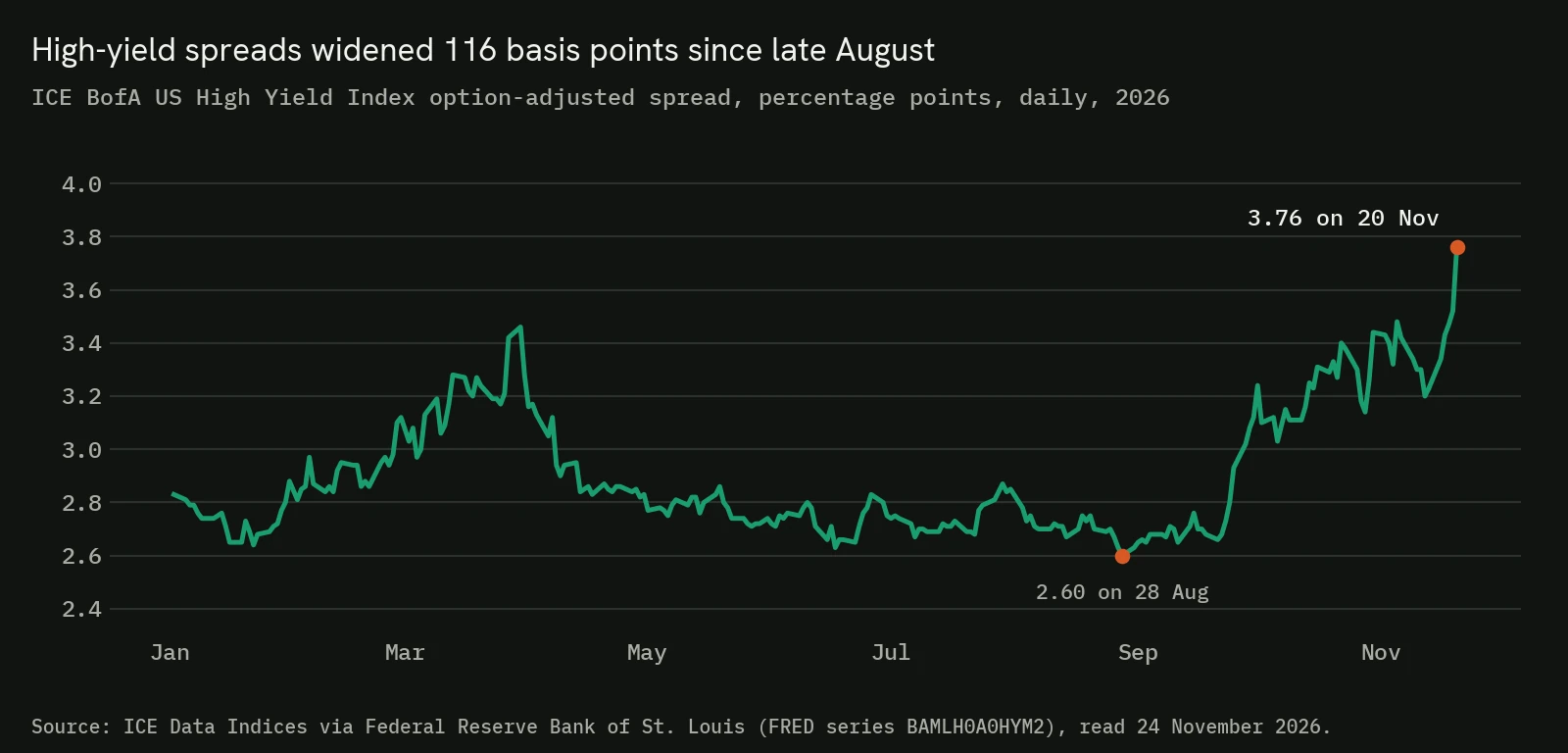
The ICE BofA U.S. high-yield spread was 3.76 percentage points on November 20, up from 2.60 on August 28. That's 116 basis points of extra cost for riskier borrowers in less than three months, and 24 of those basis points came on November 20 alone. FRED high-yield spread · Ethos Credit and Financial Conditions

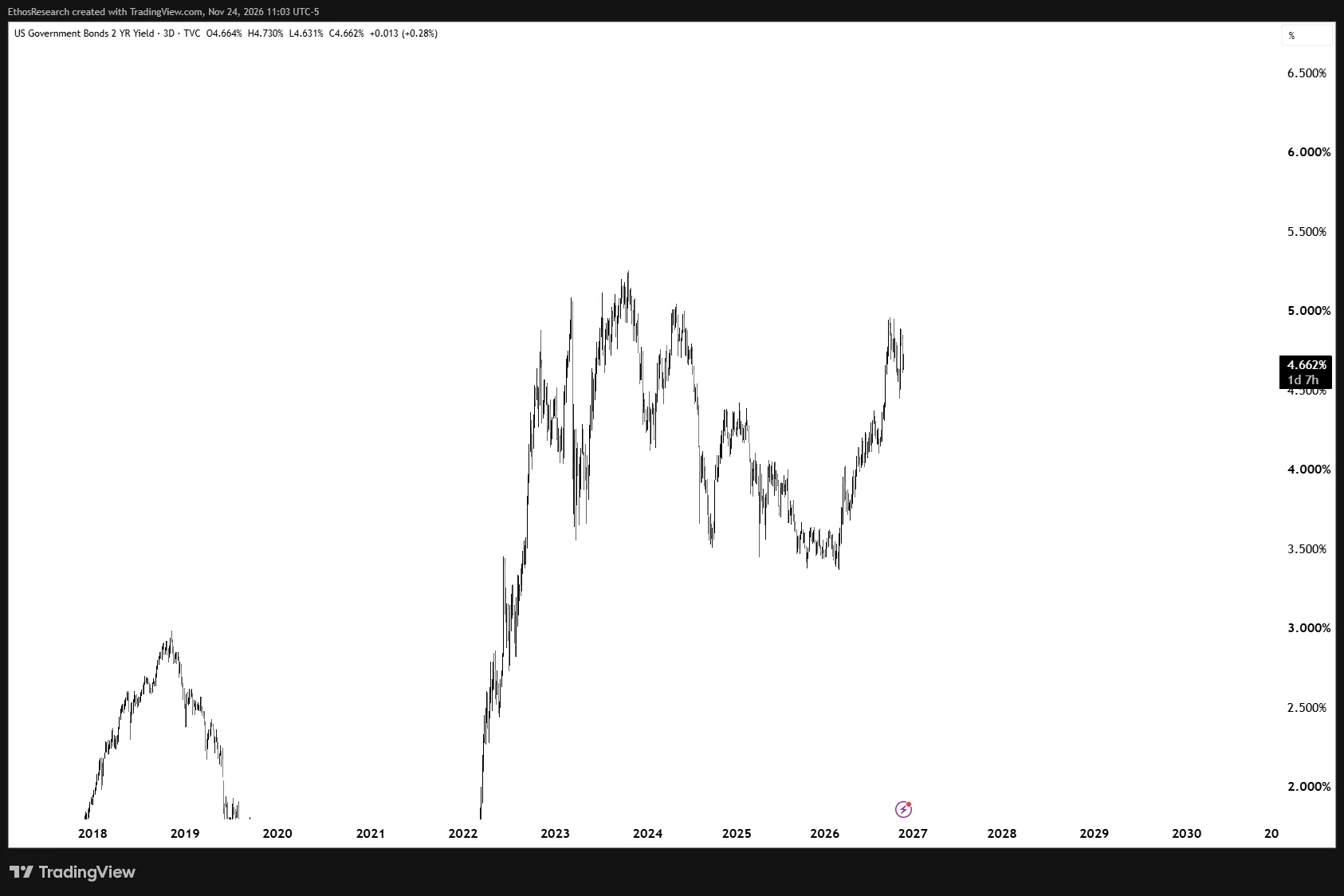
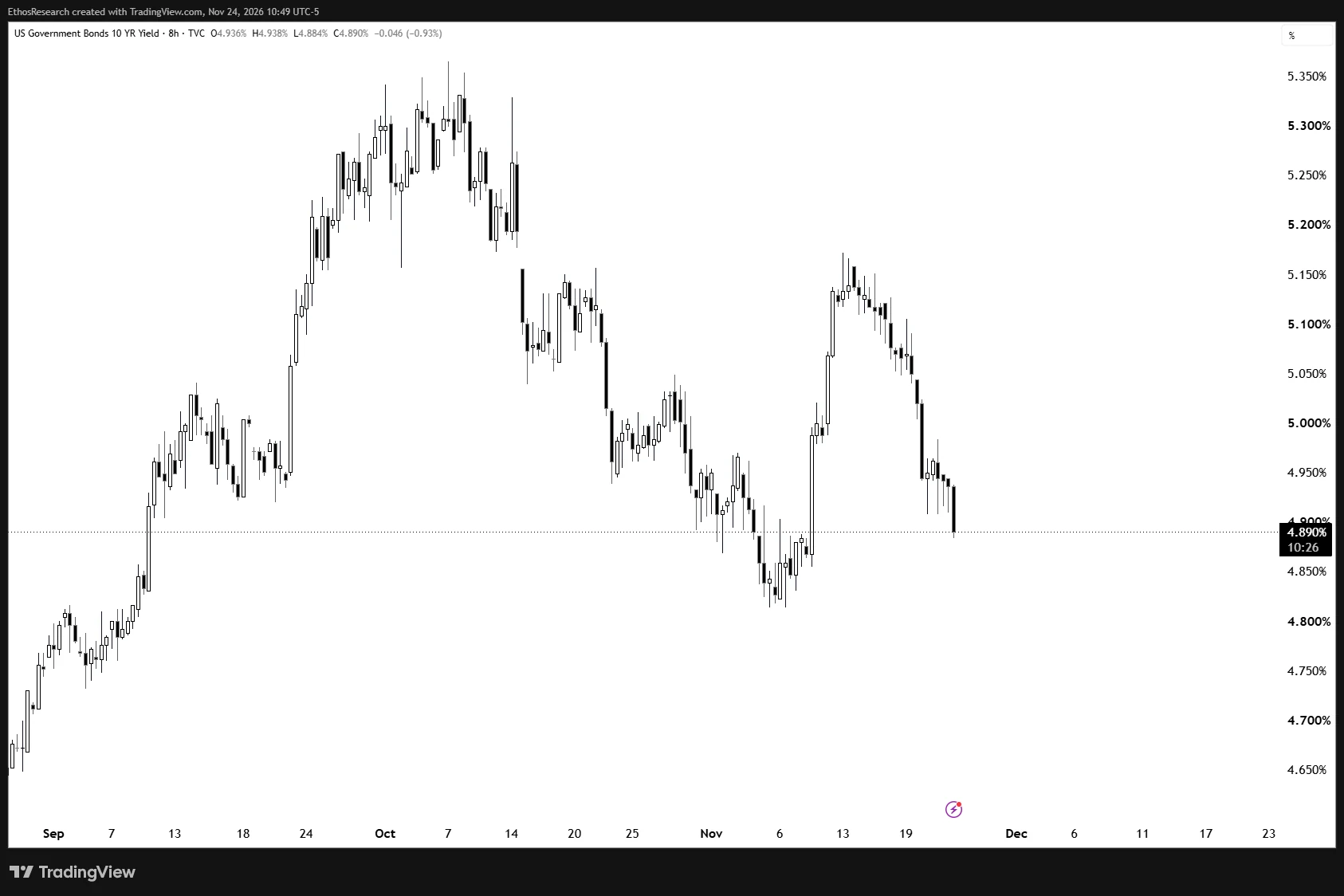
Rates aren't offering relief. The two-year Treasury yield closed at 4.63% on November 23, up from 4.34% on August 28, and the 10-year closed at 4.92%. Both were trading near 4.67% and 4.91% on my screen Tuesday morning. The Fed's target range is 3.75% to 4.00%, and CNBC reported on Monday that fed funds futures put the chance of a quarter-point hike at the December 9 meeting at about 98%. Treasury daily yield curve · CNBC on rate-hike odds · Ethos Fed Watch · Ethos Yield Curve Explorer
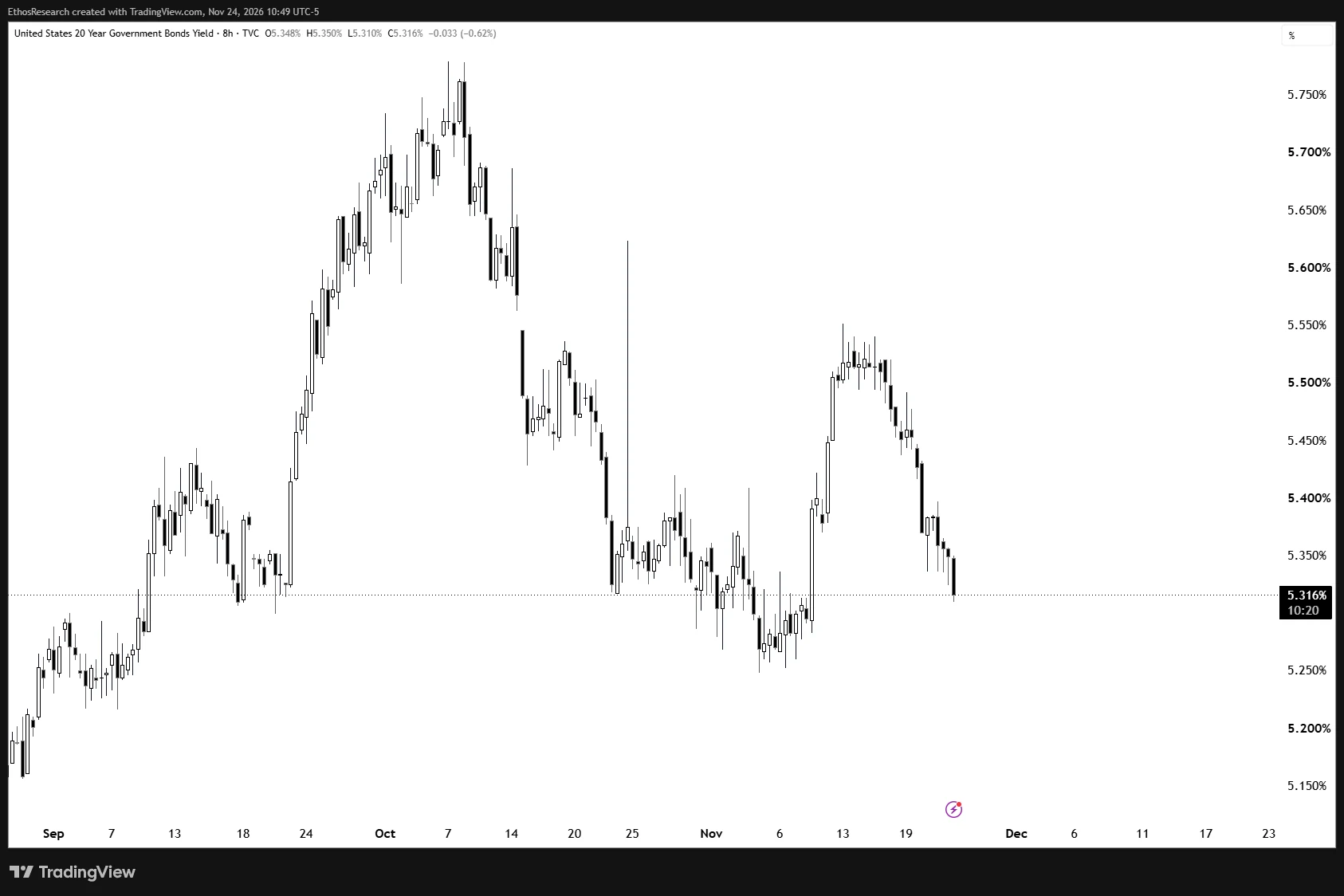
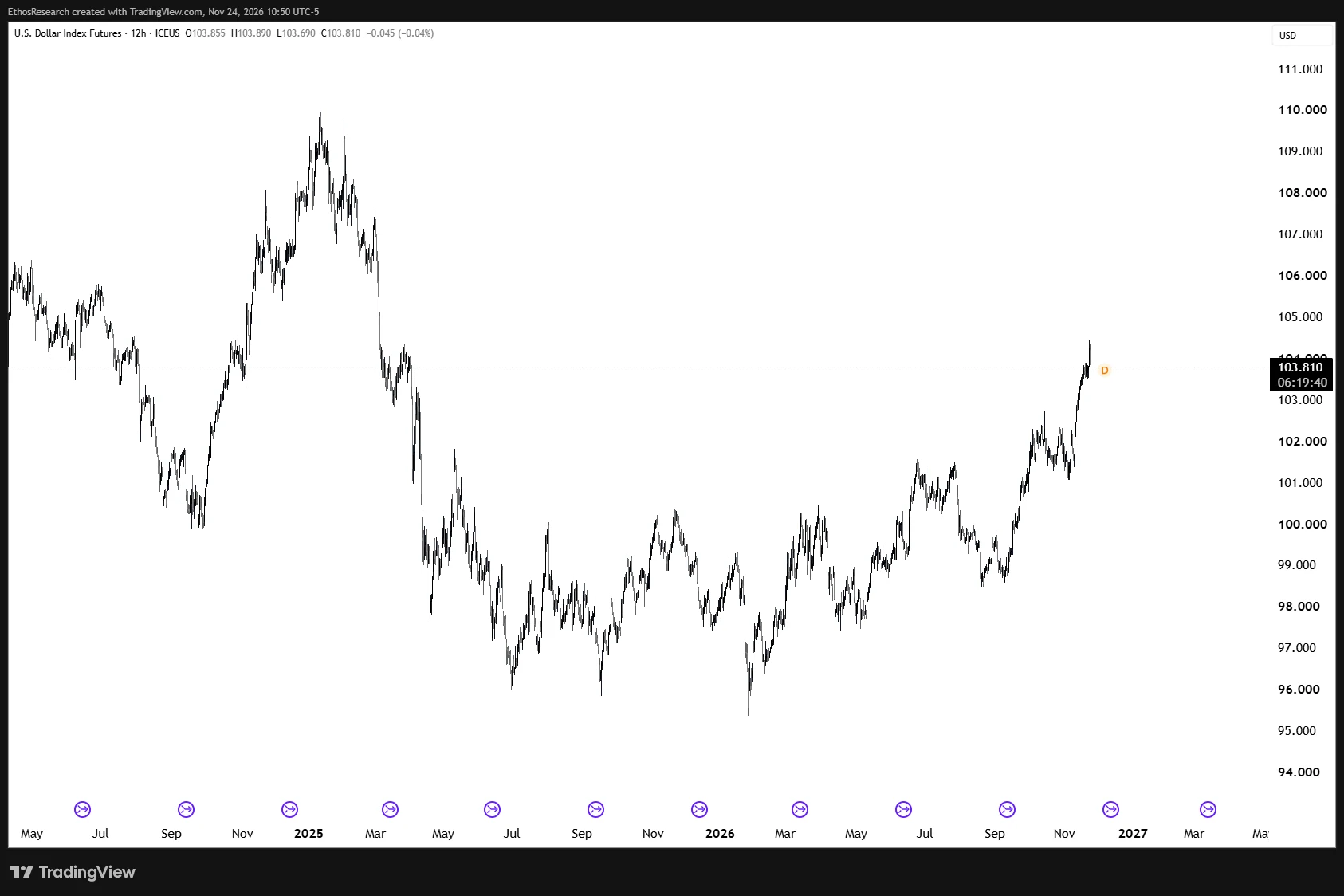
The dollar is adding to it. The Fed's broad trade-weighted dollar index reached 123.60 on November 20, its highest level since April 15, 2025. Bitcoin slipped back below $60,000 on Tuesday after briefly breaking that level for the first time since July on November 20. I've argued before that bitcoin tends to show liquidity stress early, so I don't treat that as a side story. FRED broad dollar index · CoinDesk on bitcoin · Ethos Crypto Derivatives · M2 Velocity Has Turned Lower as Credit Weakens

Follow the money through the AI build-out and you find borrowing at almost every step. Chipmakers expand capacity, data center developers raise debt, and buyers finance servers they expect to pay off from future AI revenue. A hike in December would raise the cost of every one of those steps at the moment investors have started asking when the returns show up. AI Bonds Reach Treasury Yields Through Three Channels
Revenue growth can still destroy shareholder wealth
The wider economy is giving the AI trade less support than it did a year ago. M2 velocity was 1.417 in the third quarter of 2026, down from 1.420 in the second, the first decline since early 2025. Banks told the Fed in October that demand for commercial and industrial loans had weakened across firm sizes. Money is moving through the economy more slowly, companies are borrowing less, and the cost of the borrowing they do is rising. FRED M2 velocity · Federal Reserve lending survey · The Credit Market Is Sending a Warning
That doesn't mean AI demand is weak. It's still extraordinary, and HPE's server numbers prove it. But an industry can grow revenue at an extraordinary pace while destroying shareholder wealth, if the capital it needs, the energy it burns and the interest it pays end up larger than the returns. Tuesday's premarket was the first time I saw chips, copper, credit and the Fed all point to that cost side at once. Monday told us who runs Nvidia. Tuesday asked who pays for the build-out, and at what rate.
Frequently asked questions
Why did chip stocks fall the day after Nvidia's 31% rally?
Monday's move was about leadership at one company. Tuesday's selling followed earnings at HPE and Semtech that showed strong revenue with weaker cash flow or margins, plus new export restrictions, so investors went back to asking about returns on AI spending.
Why would copper fall with semiconductor stocks?
Data centers need large amounts of copper and aluminum for power, cooling and transmission, so expected AI spending has become part of the demand story for industrial metals. When investors mark down that spending, they mark down the demand premium in those metals too.
Why is diesel still expensive when crude oil has fallen?
Refining margins for diesel are still far above normal. The Gulf Coast diesel crack was $84 a barrel in the week of November 13, against a 2006–2025 average of about $22, while gasoline margins have returned close to their average.
What does a December Fed hike mean for the AI build-out?
Much of the build-out is financed with debt, from data center projects to server purchases. A higher policy rate and wider credit spreads raise that financing cost at the same time as investors are demanding proof of returns.
How we checked the numbers
This article uses information available on November 24, 2026, before the U.S. market open. The premarket stock moves, the metals moves, the one-month energy changes and Tuesday morning's Treasury yields come from my own screen that morning. Premarket quotes are thin and change minute to minute, so I've shown press reports from the same session next to them where they exist. Those snapshot figures carry an orange dot. The TradingView charts were captured by Akis Saramantos between 6:59 and 11:04 a.m. ET on November 24, mostly after the open, so their prices are later than the premarket figures in the text; the percentages drawn on them measure moves between the marked levels.
Crack spreads are my own calculation from EIA weekly spot prices stored in the Ethos Oil Monitor: the U.S. Gulf Coast ultra-low-sulfur diesel or conventional gasoline price in dollars per gallon, multiplied by 42, minus the WTI Cushing spot price. The long-run averages use every week from June 2006 to December 2025 (1,020 weeks). These are not the same benchmarks as NYMEX futures cracks, so the levels differ from figures quoted elsewhere. The retail diesel change compares EIA's U.S. average for November 16, 2026, with November 17, 2025.
The high-yield spread, broad dollar index and M2 velocity were read from FRED on November 24. Treasury yields for November 23 are the Treasury's daily par yield curve. HPE and Semtech figures are from their earnings releases filed with the SEC. HPE's gross margin change is the adjusted (non-GAAP) figure; the GAAP margin fell 2.1 points.
Green marks data checked against the original record. Orange marks attributed reporting and my own market snapshots. Blue marks calculations and judgments.
Sources
- CNBC: Jensen Huang reinstated as Nvidia CEO, stock skyrockets 31%, November 23, 2026. Yahoo Finance: Stock market today, November 23, November 23, 2026. NVIDIA: Form 8-K, event dated November 22, 2026.
- Investing.com: U.S. chip stocks fall premarket after Nvidia-led rally on Huang's return, November 24, 2026. CNBC: Stock market live updates, November 23–24, 2026.
- Hewlett Packard Enterprise: Fiscal 2026 fourth quarter results, Form 8-K exhibit 99.1, November 23, 2026. CoinCentral: HPE stock falls 10% as margin outlook offsets earnings beat, November 24, 2026.
- Semtech: Fiscal 2027 third quarter results, Form 8-K exhibit 99.1, November 23, 2026. Benzinga: Semtech stock falls despite earnings beat, November 24, 2026.
- StockAnalysis: US blacklists an Alibaba unit and Nvidia partner Megaspeed, seven companies in all, November 2026. Forbes Middle East: US blacklists Singapore's Megaspeed amid Nvidia chip diversion investigation, November 2026.
- The Star: TSMC unit seeks Texas property tax limit for proposed $22.6 billion chip making facility, November 24, 2026.
- Rallies.ai: Copper gives up AI rally gains; aluminium hits 13-month low, November 24, 2026.
- U.S. Energy Information Administration: Weekly spot prices and Gasoline and Diesel Fuel Update, observations through November 16, 2026, via the Ethos Oil Monitor.
- gCaptain: UKMTO reports two tanker attacks in Strait of Hormuz, November 2026. Euronews: Tanker incident involving military forces reported in Strait of Hormuz, November 22, 2026.
- IntelliNews: EU gas stores sink to record low for late November as the cold returns, November 2026.
- ICE BofA US High Yield Index Option-Adjusted Spread (FRED BAMLH0A0HYM2), Nominal Broad U.S. Dollar Index (FRED DTWEXBGS) and Velocity of M2 Money Stock (FRED M2V), read November 24, 2026.
- U.S. Treasury: Daily Treasury par yield curve rates, November 2026.
- CNBC: 2-year Treasury yield jumps as stocks rebound, November 23, 2026. Federal Reserve: Open market operations.
- CoinDesk: Bitcoin falls below $60,000 as rally on Jensen Huang's Nvidia return fades, November 24, 2026.
- Federal Reserve: Senior Loan Officer Opinion Survey on Bank Lending Practices, October 2026.
- Ethos Research: Commitments of Traders explorer, report of November 17, 2026.
Related on Ethos Research
- From the Dotcom Bust to the AI Boom, History Warns of a Growing Credit Risk
- St. Louis Fed Bankers Expected Loan Demand to Grow. It Fell 41 Points Instead
- Did the AI Bubble Pop? A Critique of the Bull Case
- Are Big Hedge Funds Being Forced to Sell Precious Metals?
- The Economy Is Barely Breathing, But Wall Street Keeps Buying The AI Story
- M2 Velocity Has Turned Lower as Credit Weakens. Is Bitcoin the Early Warning?
- Oil Is the Bargaining Chip: Why Refineries Burn When Peace Talks Get Close
Commentary, not investment advice.