
Αυτό το άρθρο είναι διαθέσιμο μόνο στα αγγλικά.
Grindr launched Edge worldwide on 17 November 2026 at $120 a month. The pitch is less searching. The bet is that a small group will pay a lot without the free app, the part everyone actually uses, getting worse.
Dating apps used to sell you more people. Grindr’s new pitch is fewer. Edge, launched worldwide on 17 November 2026 at an introductory $120 a month, uses AI to recommend profiles, summarize old conversations and show you who other people tend to message. Grindr says it’s built to make finding someone easier. Grindr’s Edge announcement · Q3 shareholder letter
A shorter search could well be worth paying for. But a better-matched profile isn’t a reply, and a reply isn’t a date. What I want to know is who Edge really serves: the person paying $120, or a company that needs more money from the same crowd.
What does Grindr Edge offer for $120 a month?
Three AI features, all aimed at less browsing and easier openers. Grindr’s launch announcement
Recommendations mix a curated selection of new profiles with people you’ve contacted before. Discover shows up to five personalized recommendations a day.
Reconnect brings old conversations back into view, with AI summaries so you remember where you left off.
Insights picks out patterns in whom someone usually contacts, including age groups, sexual positions and the profile communities Grindr calls tribes.
Grindr tested Edge in Australia and New Zealand, then in Canada and selected US cities, before the worldwide rollout on 17 November 2026. At the introductory price, a year of Edge would cost $1,440. That’s my arithmetic; Grindr hasn’t advertised an annual plan. Grindr’s launch announcement · Grindr Q3 shareholder letter
Grindr says nearly 400,000 people registered for early access in the 72 hours after sign-ups opened on 20 October 2026. It plans to cap membership at 1% of global monthly active users and expects subscribers to reach roughly 0.3% to 0.7% within three to four years. Grindr Q3 shareholder letter
Four hundred thousand sign-ups in three days sounds like demand. I’d call it curiosity. Nobody had paid yet, and I suspect a good share of the people who eventually do are already paying for another tier.
Is Grindr losing users or growing more slowly?
Growing more slowly. The average number of active devices went up every year from 2021 to 2025. What fell was the pace. Grindr 2022 Form 10-K · 2025 Form 10-K
| Year | Average monthly active devices | Annual growth |
|---|---|---|
| 2021 | 10.799 million | — |
| 2022 | 12.246 million | 13.4% |
| 2023 | 13.268 million | 8.3% |
| 2024 | 14.248 million | 7.4% |
| 2025 | 14.985 million | 5.2% |
In 2022 the yearly average rose by about 1.45 million devices. By 2025 it rose by 737,000. Grindr annual filings


The UK gives an outside view, and it looks flatter. Ofcom’s Ipsos iris data counted about 924,000 UK adult Grindr visitors in May 2023 and 913,000 in May 2024, and its 2025 report rounds the May audience to about 900,000 in every year from 2023 to 2025. Time spent per visitor fell from 7 hours 2 minutes in May 2024 to 6 hours 27 minutes in May 2025. That’s a monthly average, not a daily one. Ofcom Online Nation 2024 · Online Nation 2025
Less time in the app could mean people are bored. It could also mean they found someone faster. The number can’t tell you which.
Grindr has also made the picture harder to read. In May 2026 it stopped reporting precise quarterly user figures, and it estimated that age-assurance rules and app-store restrictions abroad could leave its 2026 average about 400,000 below the path it would otherwise have expected. Grindr Q1 shareholder letter That’s the gap between two forecasts, not a count of people who left. So 2025 is still the last clean comparison, and slower growth by itself doesn’t prove the app got worse.
Why does Grindr depend on a small paying minority?
Because that’s where the money is. Most people on Grindr never pay, but most of Grindr’s revenue comes from the ones who do. That leaves the company leaning a little harder every year on conversion, pricing and keeping its payers.
Between 2021 and 2025, revenue roughly tripled, from $145.8 million to $439.9 million. The average audience grew about 39% over the same years. Grindr 2022 Form 10-K · 2025 Form 10-K
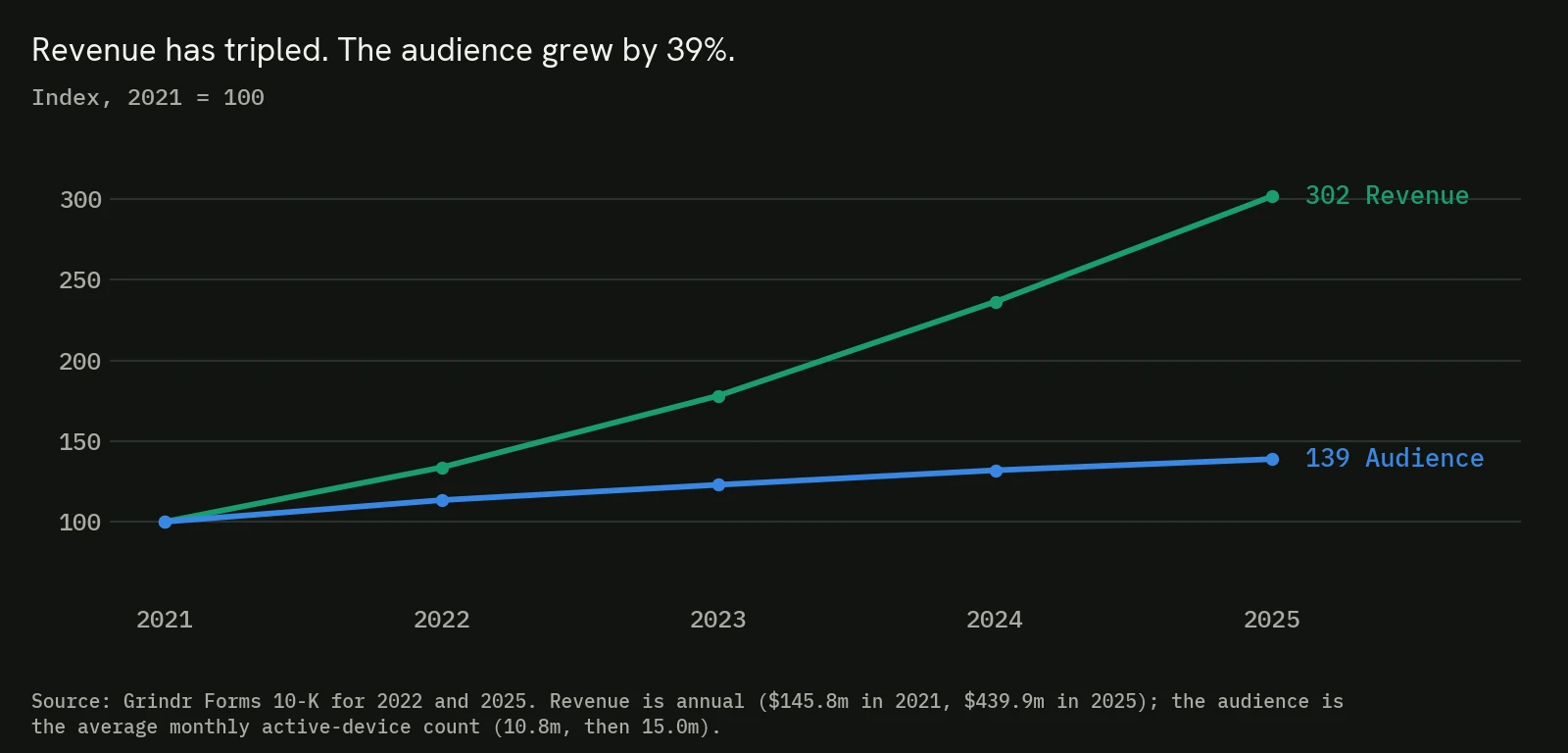
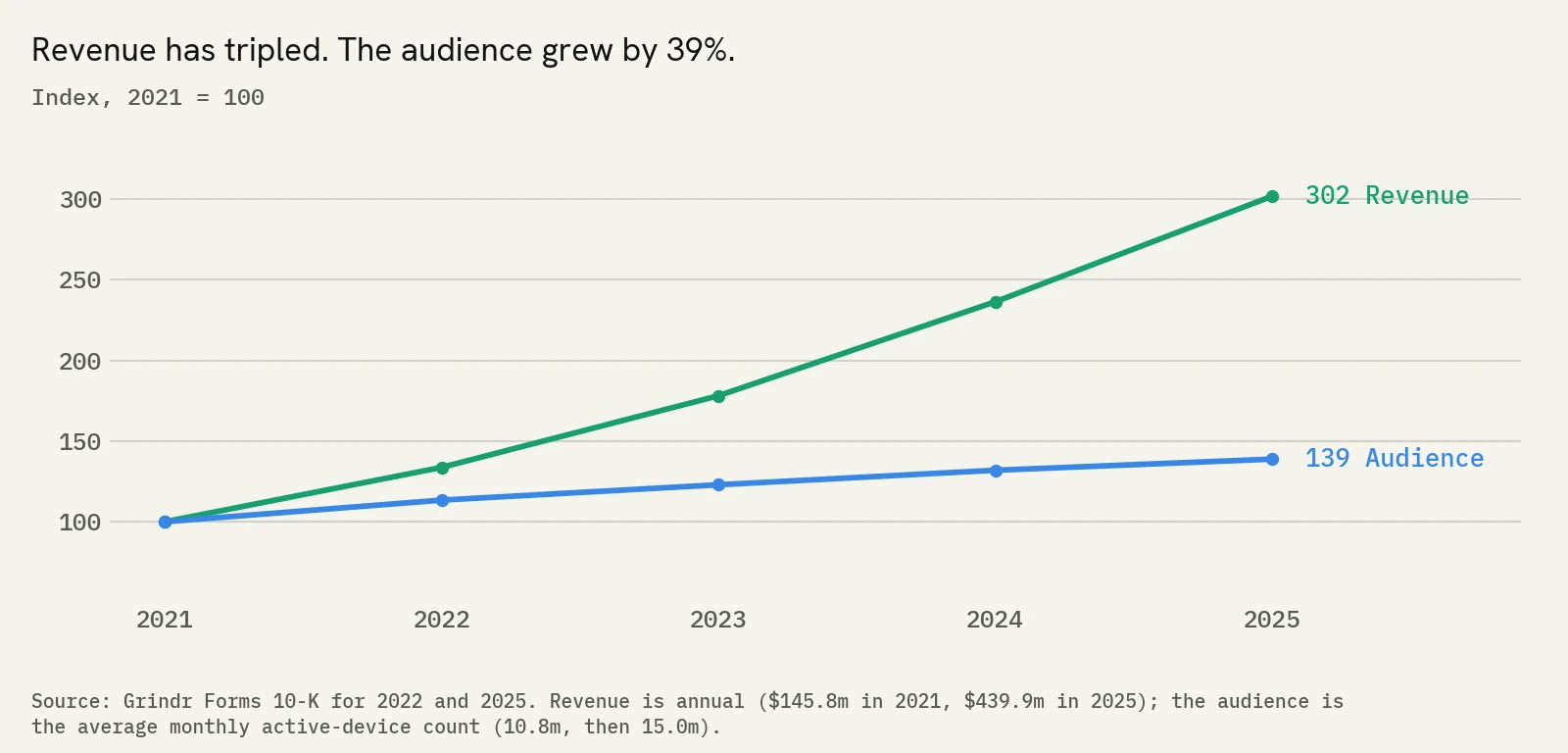
In 2025, direct revenue from subscriptions and premium purchases was $366.3 million, or 83.3% of the total. Advertising and other indirect revenue made up the remaining $73.6 million. The share of users paying rose from about 5.6% in 2021 to 8.4% in 2025, and each payer brought in $24.25 a month, up from $16.08. Grindr 2025 Form 10-K
On the surface, that’s a business getting better at making money from its audience. Underneath, it’s a business more exposed to two things it doesn’t fully control: how much a small group will keep paying, and whether everyone else keeps showing up. The second one matters more than it looks, because what a subscriber buys is access to other people. A VIP pass to an empty bar is just an expensive drink.
What do Grindr’s latest financial results show?
Still growing, but more slowly, in the last quarter before Edge went worldwide. Grindr Q3 Form 10-Q
| Measure | Q3 2025 | Q3 2026 |
|---|---|---|
| Total revenue | $115.8 million | $141.4 million |
| Average paying users | 1.299 million | 1.441 million |
| Monthly app revenue per payer | $24.70 | $27.15 |
| Adjusted EBITDA | $54.8 million | $61.7 million |
| Adjusted EBITDA margin | 47.4% | 43.7% |
| Net income or loss | $30.8 million profit | $6.6 million loss |
Revenue rose 22.1% year over year, average paying users rose 10.9%, and monthly app revenue per payer rose 9.9%. Grindr credits part of that to paywall optimization and a shift toward pricier subscriptions, including weekly Unlimited. Grindr Q3 Form 10-Q Put simply, revenue is growing about twice as fast as the number of payers because each payer is paying more.
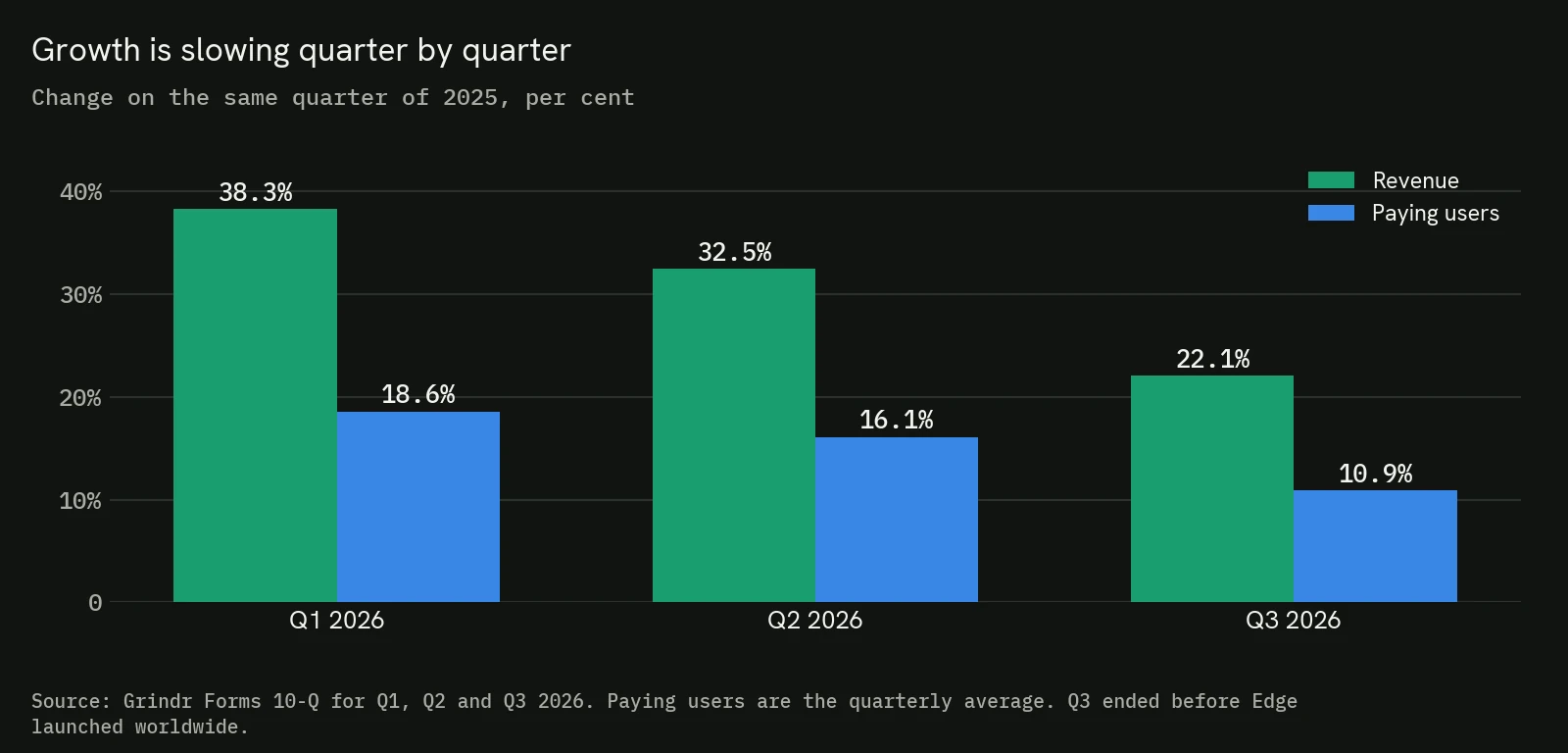
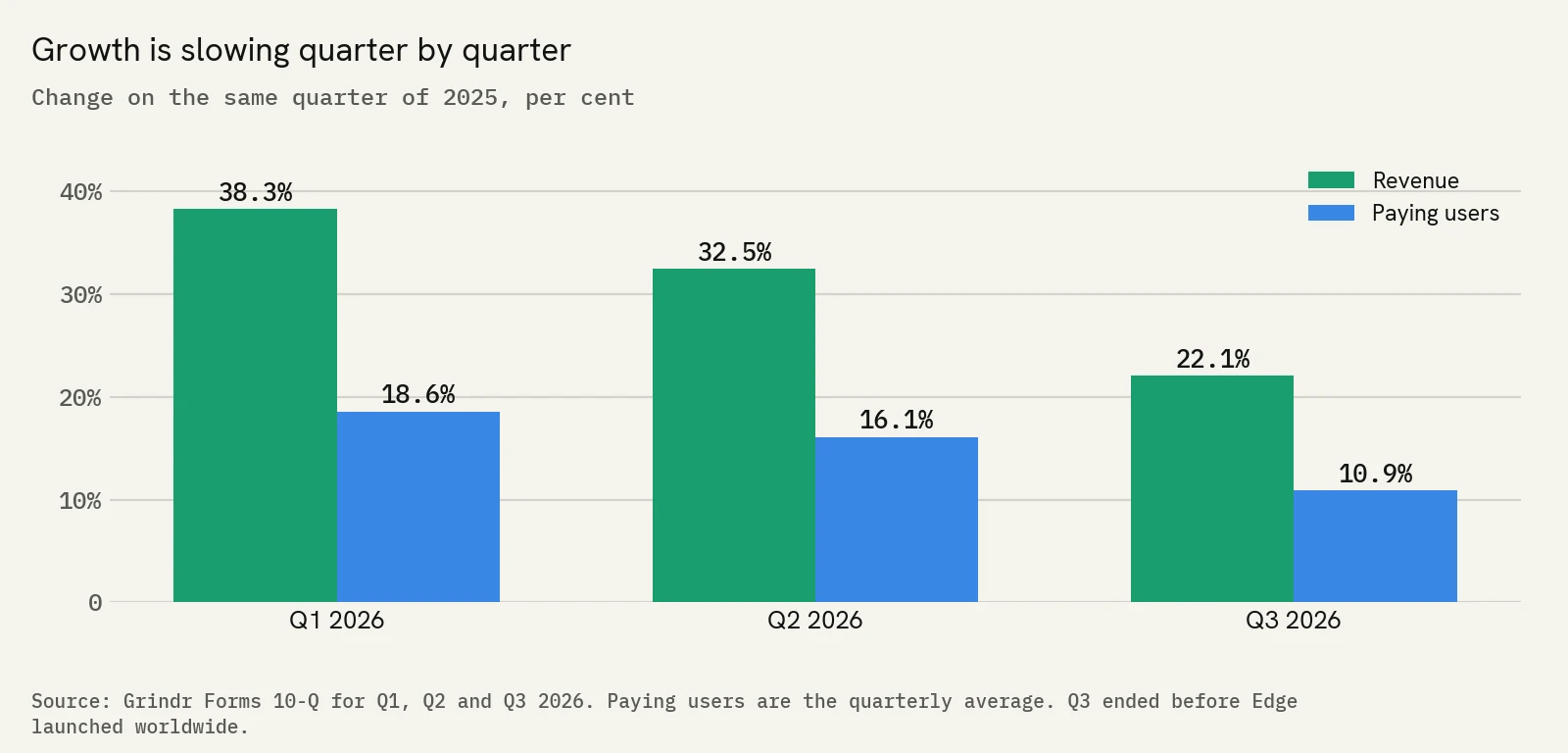
Adjusted EBITDA rose to $61.7 million, but the margin slipped from 47.4% to 43.7%. On the bottom line, Grindr lost $6.6 million. It booked about $32.8 million in legal settlement costs in the quarter, mostly for UK litigation alleging historical misuse of personal information, settled without any admission of liability. Grindr Q3 Form 10-Q, Note 14 That charge goes a long way to explaining the loss. Adjusted EBITDA is the company’s own, non-GAAP measure, so don’t read it as profit.
Edge is one more way to raise revenue per payer. What nobody knows yet is how much of its revenue will be new money, and how much will come from existing subscribers trading up.
Can Edge succeed if the free version becomes less useful?
This is the question I keep coming back to. Edge runs on a network that free users keep alive. They open the app, keep their profiles current and answer messages. If they drift away, there’s nothing left for the AI to recommend.
To be fair, there’s a decent case for an expensive optional tier. Premium money can pay for infrastructure, safety work and features everyone uses, and Grindr says that’s its plan: improve the free service while building premium products, rather than making the free app worse to push upgrades. Grindr Q3 shareholder letter
Free users already feel the squeeze, though. In March 2026, Xtra interviewed longtime users who described constant pop-up ads, restrictive paywalls and frustration with the free app. Those are individual accounts, not a survey, and Xtra‘s parent company owns Squirt, a competing service. Xtra, 17 March 2026 Grindr said in its Q1 2026 letter that it had moderated some third-party ad loads in selected locations. Grindr Q1 shareholder letter
The gap between tiers is right there in Grindr’s own help pages. Free users see dozens of nearby profiles, while XTRA subscribers see up to 500, with no third-party ads. Grindr Grid documentation · XTRA features The more that goes behind the paywall, the more it matters what a free user can still actually do.
Then there’s trust. In its Australian transparency report for July 2025 to June 2026, Grindr recorded 218,791 profile bans. Of those, 180,070, or 82.3%, fell into a combined category for spam, inauthentic and ineligible accounts. Grindr Australia transparency report

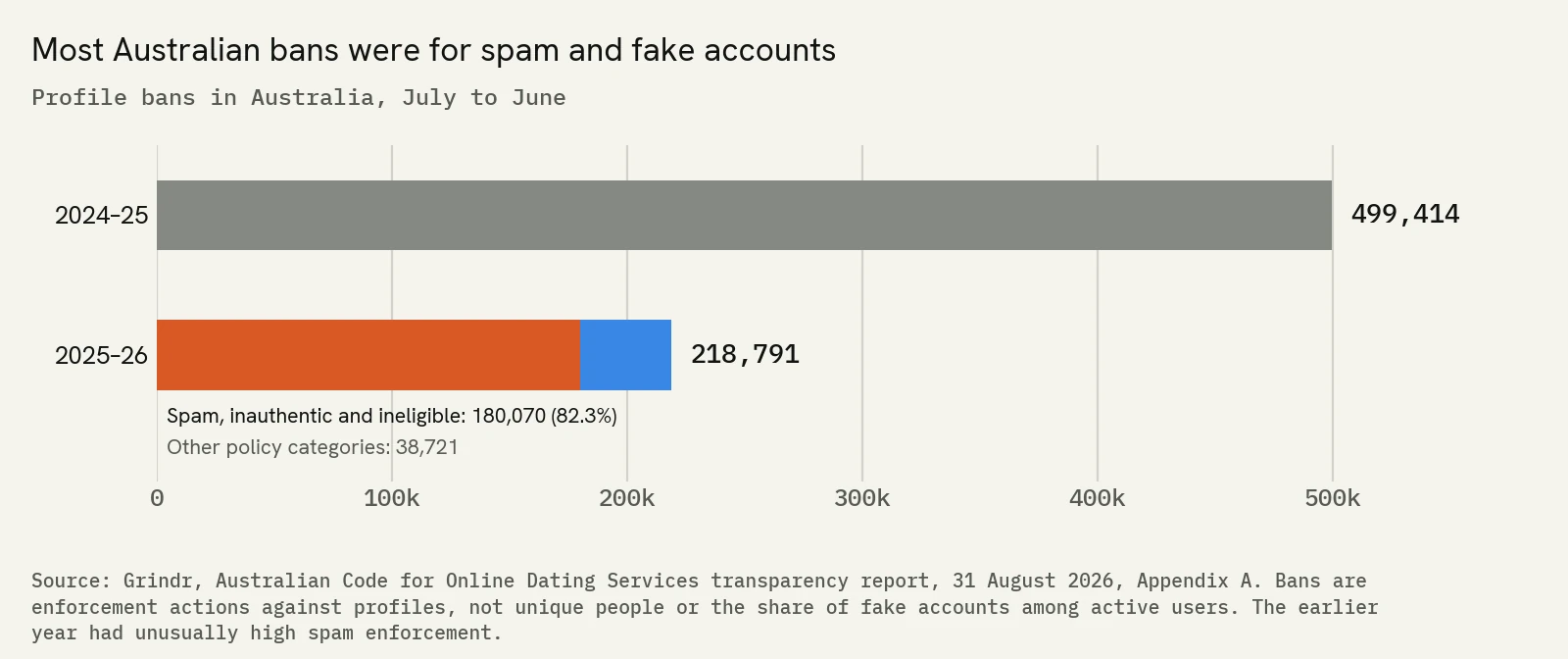
Bans don’t tell you how many fake or dead profiles are still out there. They do tell you how much cleaning the grid needs. A subscriber can pay for better recommendations, but recommendations are only as good as the real, responsive people behind them. In a small town, a thinning grid could make a $120 discovery tool close to useless, even while the global user count looks fine. It’s the same gap we found in dating-app attention statistics: what’s easy to count isn’t what people came for.
What personal information does Edge use?
More than most people will realize. With consent, Edge can use your profile, activity and chats to build recommendations and insights, and some of what it infers about you can appear to subscribers who look at your profile, even if you never pay for Edge yourself. Grindr’s Edge privacy disclosures
Subscribers don’t get your chat transcripts. Grindr says it shows inferred patterns, not conversations. But a pattern can reveal something you never chose to put on your profile, and it can simply be wrong.
Grindr describes two separate controls under Privacy Settings, then Sensitive Data.
| Privacy control | What it changes |
|---|---|
| Personalize gAI Features | Controls participation in Recommendations, Reconnect and Insights, including whether the user appears in other users’ experiences with those features. |
| Contribute to Smarter gAI | Controls use of sensitive information and chat content to improve or develop future gAI features, without disabling access to Edge. |
| Privacy Settings, Insights | Allows users to review and delete individual displayed Insights. |
Turn personalization off and the AI features stop working for you, and you stop appearing in other people’s versions of them. Grindr doesn’t say that opting out removes you from the ordinary grid. Grindr’s Edge privacy disclosures
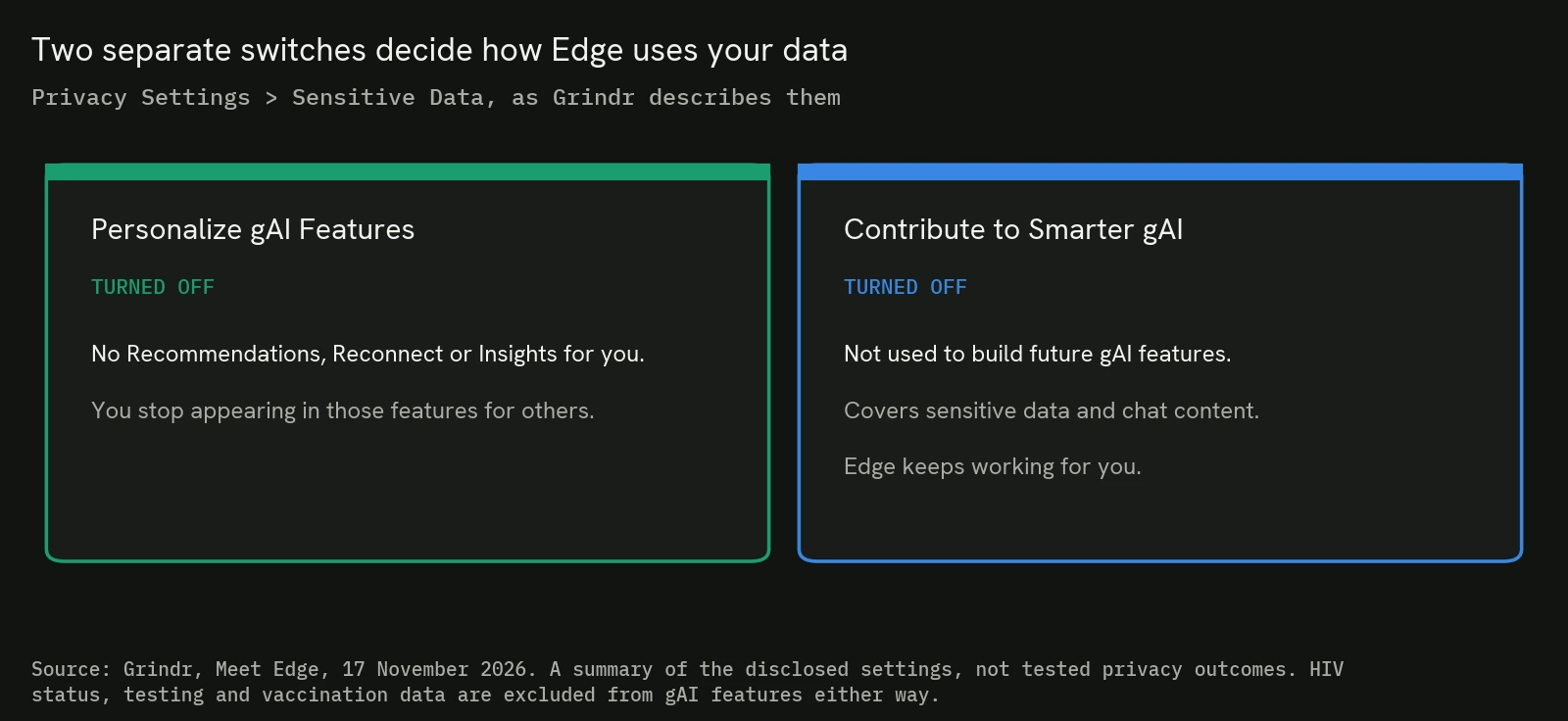

According to Grindr, HIV status, last-tested date, testing reminders, the Poz tribe and tag, and vaccination status are kept out of its gAI features and training whatever your settings. Grindr’s privacy disclosures
History is why this deserves a closer look. In October 2025, a Norwegian appeals court upheld a NOK 65 million fine against Grindr for disclosing users’ personal data to advertising partners without valid consent. On 3 November 2026, Norway’s data protection authority confirmed that a separate NOK 92 million fine against the advertising intermediary Xandr was final. That case concerned sensitive data about Grindr users in Norway, processed between 2018 and 2020. Norwegian Data Protection Authority: Grindr · Xandr decision
Both cases are about old advertising practices, not Edge. But a company asking for consent to read patterns in intimate chats should expect people to ask how clear that consent really is.
Who actually gets to meet someone through Grindr?
Plenty of people, but not equally. Grindr gives people something real: sex, dates, relationships, friendship and community, often in places where meeting other queer people face to face is hard. The research shows that value sitting alongside frustration, discrimination and uneven results.
Pew Research Center’s US survey, conducted in 2022 and published in 2023, found that 62% of lesbian, gay and bisexual men who had used online dating had tried Grindr. Among lesbian, gay and bisexual adults who had used online dating, 61% described their experience positively, and among those who had used a service in the past year, 84% had been disappointed by people they met. Pew Research Center Those are different questions about online dating in general, so they can’t give you a Grindr satisfaction score or a trend.
A Chicago study gets closer to the outcome that matters. Published in 2024 from data collected in 2016–2017, it surveyed 643 young men who have sex with men and young transgender women aged 16 to 29. Of the 261 who used Grindr to look for a sexual partner, 131, or 50.2%, had met a new one through it in the previous six months. And who met someone depended on who they were. Risher and colleagues, JMIR Public Health and Surveillance


In the researchers’ adjusted model, the difference between Black and White non-Hispanic users was statistically significant. The study can’t say why. Risher et al. (2024)
None of this predicts how Edge will perform. But here’s where it gets more uncomfortable. An AI that learns who gets attention, and uses that to decide whom to show you next, could quietly reproduce the same inequalities unless someone checks the outcomes.
The wellbeing research is just as mixed. A 2026 UK survey of 257 gay male Grindr users linked problematic use with identity threat and identity loss, but it’s correlational, so it can’t show that Grindr caused either. Jaspal, Gifford and Lopes In a Canadian study published in 2025, 239 of 250 queer adults recruited through Grindr ads had faced discrimination on dating apps in the previous year. The same study linked dating-app use with higher life satisfaction and self-esteem. Participants used several apps, and the sample doesn’t represent Grindr’s worldwide audience. Sinno and colleagues
Profiles viewed and messages sent were never a good measure of whether an app serves people. These studies show why.
What would justify Grindr Edge’s price?
Proof that subscribers find worthwhile connections faster. So far, there isn’t any.
Grindr says the average user spends almost 70 minutes a day in the app. Grindr Q3 shareholder letter That’s a lot of attention. Whether those minutes turn into conversations anyone wanted is a different question, and it’s the one Edge claims to answer.
Here’s the evidence that would settle it.
| Measure | What it would show |
|---|---|
| Replies to recommended profiles | Whether recommendations lead to reciprocal interest |
| Time to a worthwhile conversation | Whether Edge actually reduces searching |
| Successful in-person connections | Whether suggestions translate into encounters users want |
| Satisfaction over time | Whether subscribers value the experience after the initial novelty |
| Subscription renewals and cancellations | Whether the service retains commercial value |
| Free-tier engagement and response rates | Whether the wider network remains healthy |
| Privacy understanding and complaints | Whether users understand and accept AI-generated inferences |
| Outcomes across demographic groups | Whether benefits are distributed fairly |
It would also need comparable groups over time. People willing to pay $120 a month probably differ from everyone else already, in their habits, location, intentions and willingness to message first. Better results among subscribers wouldn’t prove the subscription caused them.
There’s a design choice underneath all of this. An AI can get very good at predicting which profile you’ll tap without making a good conversation any more likely. Grindr clearly knows how to optimize for the tap. I’d like to see it show it can optimize for the meeting.
The business case is simple: some people will pay a lot for convenience, exclusivity and better tools. The user case still needs evidence, and Grindr is the one holding the data. It can show whether subscribers spend less time searching and get more of the encounters they want, without making the app worse for the people who use it for free.
A subscription sold on saving time should be judged on whether it gives any back.
Frequently asked questions
How much does Grindr Edge cost?
Grindr announced an introductory price of $120 a month for the worldwide launch on 17 November 2026. Twelve months at that rate would cost $1,440, but Grindr hasn’t advertised an annual plan. Grindr Q3 shareholder letter
Is Grindr losing users?
No, but it’s growing more slowly. Average monthly active devices rose every year from 2021 to 2025, while annual growth fell from 13.4% to 5.2%. Grindr stopped publishing precise quarterly user figures in 2026, so the latest full comparison is for 2025. Grindr annual reports · Q1 shareholder letter
Does Grindr Edge use information from non-subscribers?
Yes, with consent. Grindr says AI-generated insights about you may be shown to Edge subscribers who view your profile, even if you don’t subscribe. You can opt out through the Personalize gAI Features setting, and you can review or delete displayed Insights. Grindr’s Edge privacy disclosures
Does Grindr Edge improve dating or hookups?
Not proven yet. Grindr says Edge makes discovery and messaging easier, but as of 18 November 2026 there’s no public evidence that it leads to more encounters, happier users or less time spent searching.
Why does the free version matter to Edge?
Because Edge subscribers are paying to reach other people, and most of those people use Grindr for free. If free users drift away or stop replying, premium discovery tools lose their value, even while subscription revenue grows.
How we checked the numbers
This analysis uses Grindr’s SEC filings, its November 2026 Edge announcements, Ofcom’s UK audience research, Grindr’s Australian transparency report, Norwegian regulatory decisions, Pew Research Center and published academic studies.
Grindr counts monthly active users by active devices, which are not the same as unique people. Annual growth rates are calculated from the reported yearly averages and rounded to one decimal place. Financial figures are rounded to the nearest $0.1 million where needed. Paying users include subscribers and buyers of premium add-ons, and the 2025 payer penetration figure comes from Grindr’s filing. Quarterly revenue per payer covers app-based revenue per average paying user. Quarterly growth compares each quarter with the same quarter a year earlier. Adjusted EBITDA is a company-defined, non-GAAP measure.
The UK audience figures come from Ipsos iris, as published by Ofcom, and measure a different population from Grindr’s global app metrics. The Chicago, UK and Canadian studies use different samples, populations and periods, and none of them evaluates Edge.
Green dots mark facts checked against a primary filing, study, official report or company disclosure; a checked company statement is still the company’s claim about its own product. Orange marks information reported by a named publisher or interviewee. Blue marks our own inference. First-person judgements are the author’s and are not marked. This analysis reflects information available on 18 November 2026.
Sources
- Grindr: 2022 Form 10-K, year ended 31 December 2022.
- Grindr: 2025 Form 10-K, year ended 31 December 2025.
- Grindr: Q1 2026 Form 10-Q, quarter ended 31 March 2026.
- Grindr: Q2 2026 Form 10-Q, quarter ended 30 June 2026.
- Grindr: Q3 2026 Form 10-Q, quarter ended 30 September 2026.
- Grindr: Q1 2026 Shareholder Letter, May 2026.
- Grindr: Q3 2026 Shareholder Letter, November 2026.
- Grindr: Meet Edge — More Action, Less Effort, 17 November 2026.
- Ofcom: Online Nation 2024, 28 November 2024.
- Ofcom: Online Nation 2025, 10 December 2025.
- Grindr: Australian Code for Online Dating Services Transparency Report, 31 August 2026.
- Xtra: Unusable — The Enshittification of Grindr, 17 March 2026.
- Grindr: The Grid, accessed 18 November 2026.
- Grindr: XTRA Features, accessed 18 November 2026.
- Norwegian Data Protection Authority: The Court of Appeal Upholds the Fine Against Grindr, 21 October 2025.
- Norwegian Data Protection Authority: Microsoft Company Fined NOK 92 Million, updated 3 November 2026.
- Pew Research Center: About Half of Lesbian, Gay and Bisexual Adults Have Used Online Dating, 26 June 2023.
- Risher, K., Janulis, P., McConnell, E., et al. (2024). Racial and ethnic differences in mobile app use for meeting sexual partners among young men who have sex with men and young transgender women: Cross-sectional study. JMIR Public Health and Surveillance, 10, e54215.
- Jaspal, R., Gifford, A. J., & Lopes, B. (2026). Identity threat and identity loss among gay male Grindr users in the United Kingdom. Psychology & Sexuality.
- Sinno, J., Perez-Brumer, A., Shuper, P. A., & Grace, D. (2025). Depathologizing queer adults’ dating app use in Canada: Convergent mixed methods study. Journal of Medical Internet Research, 27, e72452.